
14:53, 12-Oct-2017
Beijing Urban Planning: New sub - center Tongzhou poised to take non - capital functions
 []
[]
Share







Copied
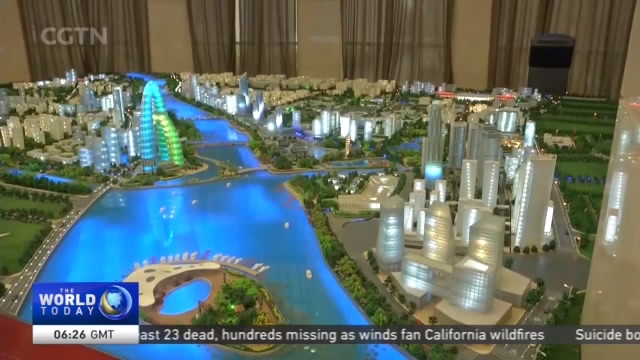
China's capital Beijing is gradually removing its non-capital functions from the city center to locations slightly further afield. Construction of a new sub-center based in the eastern suburb of Tongzhou has been underway since mid-2016. The move is part of a comprehensive plan to address urban issues such as traffic congestion and air pollution. CGTN's Meng Qingsheng visited the new sub-center to find out how construction work is going.
The Grand Canal flows two thousand kilometers to southern China. It’s the longest artificial river in the world, and starts here in Beijing's suburban district of Tongzhou. For generations, Mu Shiguo's family has lived a life of farming by the riverside. But this tradition came to an end two years ago, when the village was chosen as the new seat of Beijing's municipal offices.
MU SHIGUO TONGZHOU RESIDENT I revisited my homestead after moving elsewhere, but only found several trees left. To be honest, I sat down on the ground and cried for twenty minutes. The villagers here in Lucheng have contributed to the construction of the new sub-center. But I believe that the project will make Tongzhou a better place.
The 64-year old and many of his neighbors remain unaccustomed to a life inside high-rise buildings. But they enjoy the privilege of living alongside the municipal government, just one street away. Construction work for this new sub-center began in June 2016. It's equipped with the world's smartest underground pipelines, providing safer and more efficient public utility networks. And all the NEW buildings here are environmentally-friendly and are built using low-carbon methods.
MENG QINGSHENG TONGZHOU, BEIJING More than 200 construction projects are currently underway in Tongzhou District. And the projects behind me are the new offices of the Beijing Municipal government. They will become operational by the end of this year, after about a year and half of construction. The high efficiency of work here is being called the Tongzhou Speed.
To facilitate non-capital functions, the sub-center will build a comprehensive network of high speed roads and subway lines. Additionally, educational and medical resources are also gradually being relocated to Tongzhou. There are also plans to build 33 new parks by 2030. This would mean local residents would never be more than 500 meters away from a green space.
HU BO, DIRECTOR BEIJING SUB-CENTER PLANNING DEPARTMENT The new sub-center serves as a national pilot project featuring top level liveability, a new type of urbanization, and more coordinated regional development between Beijing, Tianjin and Hebei. We hope it will become a genuinely human-centered city. People there will enjoy a convenient life and a better natural environment. For instance, basic facilities are never more than a 15 minute walk away.
For Mu Shiguo and his neighbor Peng Qifu, however, it will take a long time before they see the real benefits of this project.
MU SHIGUO TONGZHOU RESIDENT Some of the basic facilities in this residential area are still under construction. It's understandable as Rome was not built in a day. I think more should be done to improve services like community management and landscaping.
PENG QIFU TONGZHOU RESIDENT There are no large supermarkets nearby, and the entertainment venues are quite limited. I know that authorities are working on this, which means we will eventually have a comfortable living environment.
Beijing's latest city planning document says the sub-center will be built into a world-class liveable zone that emphasizes environmental protection and cultural heritage. It will serve as a role model of city construction across China, and will have a population of 1.3 million by 2030. Meng Qingsheng, CGTN, Beijing.