
21:28, 12-Sep-2017
Technology & Innovation: How IT is changing lives in China
 []
[]
Share







Copied
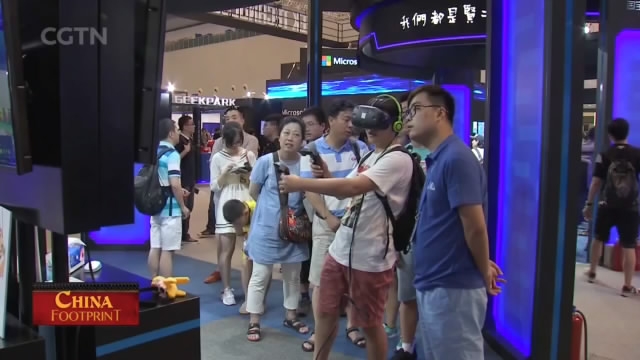
Mobile technology has transformed the way people live and work, allowing users to connect and communicate in ways never seen before. And nowhere is the mobile tech revolution more evident than in China. Lindy Mtongana went to Beijing to find out how technology is changing lives in China.
In a city of 22 million people, there's one thing that almost everybody has – a mobile phone. And, as one Beijinger tells me, from dawn till dusk it's become an important part of daily life.
TRACY TONG MOBILE USER My mobile phone is very important to me. I use it frequently, everyday, from the morning until the time I go to sleep. Every morning when I get up, I use my phone to look at news on the Internet, and check how the weather and the traffic are.
Tracy and her phone are almost inseparable. But it's the daily functions that one can perform on a mobile phone, that are truly driving the tech revolution in China - even transforming urban transportation.
Gone are the days when there's few bikes to rent. A Chinese start-up tech firm changed that by answering one simple question.
JACK YANG VICE PRESIDENT, BEIJING MOBIKE TECHNOLOGY What if we take away the stations and put all the technology, the tracking devices, the GPS etc, into the bike? So, make the bike accessible to everyone and make it extremely easy to borrow and return bicycles.
Today, Mo-Bike is on its way to becoming a global bike-sharing platform – addressing problems like urban congestion and pollution along the way.
JACK YANG VICE PRESIDENT, BEIJING MOBIKE TECHNOLOGY We started operations in Shanghai back in April last year, And Beijing in August / Sept. And since then we have deployed our bikes in 160 cities in 5 countries -- China, England, Italy, Singapore and Japan. Now we have 7 million bikes operational. Every single day we have 25 million trips completed on our platform.
China is the world's largest online retail market. And even niche stores are getting in on the action. Tracy is a fitter at "MEN'S" – a designer store for tailored suits, with a mobile app developed by the founder.
BAI YONGPING FOUNDER, MEN'S E-BUSINESS Through technology we combine art and science.
The app uses an algorithm to determine a unique style for each customer. My cameraman put the technology to the test.
BAI YONGPING FOUNDER, MEN'S E-BUSINESS We've been using our eyes to estimate the skin tone of a person's faces. But now with the relevant technology our App can determine the exact facial tones and structure, and match that to style and colour, for the perfect suit for our customers.
TRACY TONG MOBILE USER The App is very helpful to me. It helps ensure the accuracy of my measurements. It's very convenient for me and facilitates the efficiency of my work. While for our clients, the App saves them time and provides them with better service.
Needless to say, my cameraman was very pleased with the final result! It's lunch time, and Tracy has an array of menus to choose from, right at her fingertips. Without cards or cash, Tracy conveniently pays for her food, via her favourite app – WeChat – China's instant messaging, commerce, payment service, and social-media app.
LINDY MTONGANA BEIJING Since its launch in 2011 WeChat or Weixin as it's known in China, has amassed over 960 million users, making it one of the biggest social networks worldwide.
ZHOU BOYUN PUBLIC RELATIONS DIRECTOR, WECHAT What started as a social media app has now become a lifestyle. You can book a doctor's appointment with WeChat, connect it with your health insurance and pay using your phone. Having dinner, watching movies, refueling at the gas station, paying for parking - people are using WeChat for all of these things. WeChat solves our daily problems, giving us more time and space in our lives. That's why people love it.
TRACY TONG MOBILE USER I usually spend 3 or 4 hours a day on my phone. But I think it's a good thing. For example, through WeChat I can message my friends and family, send voice notes, talk face-to-face, or send funny emojis. I think it makes us closer than before.
And if this is the present, what does the future hold? Chinese online retail giant Alibaba is leading the way - with virtual reality. The company is set to launch "Buy+" - a VR shopping experience, that will allow users to browse the isles of Macy's Department Store in New York, from the comfort of their homes in Beijing.
Consumers are already testing out VR technology through experiential gaming stalls around the country.
WANG LONG VR MANAGER, SEEKERS In the future, VR will be used to bring more benefits and convenience to fields, like experimental gaming, shopping, medical treatment, education, tourism.
LINDY MTONGANA BEIJING Well here in the virtual world, and certainly in real life technology is moving at a fast pace. And the development and adoption of key technologies in China is a sign as to what the future may look like. Lindy Mtongana, CGTN, Beijing CHINA.