
21:40, 27-Oct-2017
Wildlife Protection: Momoge reserve, heaven of migratory birds
 []
[]
Share







Copied
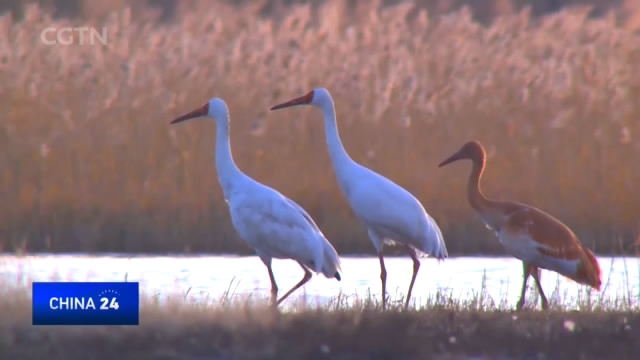
China's Momoge nature reserve is a key stopover site and breeding place for migratory birds flying south to winter - attracting hundreds of thousands of them every year. The local government's wetland protection measures have been successful enough that the number of migratory birds, especially oriental white storks and cranes, has increased in recent years. Tang Meng has more.
It's migratory season again. Hundreds of oriental white storks sweep the Momoge National Nature Reserve in Zhenlai County, northeast China's Jilin Province. The gathering of the rare species attracts ornithologists and experts who regard the scene as a sort of miracle.
PAN SHENGYU CHINA WILDLIFE CONSERVATION ASSOCIATION "The coast of Nenjiang River has long served as a key stopover point for migratory oriental white storks in spring and autumn. This year we observed more than 6-hundred, which is very rare. The number in the year before last was only more than 3 hundred."
Rare birds have special requirements for their living environment. The fact that Momoge has so many oriental white storks, and a significant number of other crane species, is evidence of an appealing environment. But the 14-hundred-square-kilometer nature reserve is not like it was before. A severe flood in 1998 and subsequent droughts over the next 15 years were key factors for the sharp decline in Momoge's wetlands. Human activities have also been blamed for a dramatic reduction in the number and variety of birds. Local authorities are trying to restore the areas by linking rivers and lakes, as well as putting in restrictions to protect the birds.
FU XUEMING ZHENLAI COUNTY WETLAND MANAGEMENT CENTER "Since we set up a pumping station in 2012, it has added 2-million cubic meters of water annually to the natural reserve.”
YU HE ZHENLAI COUNTY FORESTRY INSPECTION TEAM "We have put in place three measures. The first is to set barriers and close the roads. The second is to prohibit outsiders from farming and fishing. The third is to forbid bird watchers from taking photos at close distance, in case they disturbe the birds."
The efforts have paid off. Water inflows have helped recover the wetlands, which now account for more than 80 percent of the total area. The number of annual migratory white cranes, one of the world's most endangered, has increased to roughly 38-hundred from 2-hundred. It is home to 10 of the most highly protected bird species, and 42 species in a lower protection rating in China. It's hoped the wetlands will become much bigger, to welcome more rare birds as they fly through. Tan Meng, CGTN.