
18:02, 28-Feb-2019
Full Episode - Xi’s Targeted Poverty Alleviation at the Grassroots

Share






Copied
By Robert Lawrence Kuhn
For President Xi Jinping, poverty alleviation is one of his most important tasks. The goal is the complete elimination of all extreme poverty in China by 2020. Xi has made it clear that no one shall be left behind on the path out of poverty. Even if there are only a few extremely poor households by 2020, China cannot claim to be a moderately prosperous society no matter how large its economy or per-capita GDP. Officials responsible at all levels have made a pledge: If the pledge is not fulfilled, the relevant officials will face punishments; they must suffer the consequences. I met residents who are the beneficiaries of that pledge. They move from mountains to the cities, where the government builds houses for them, also providing furniture and appliances. I traveled to remote and underdeveloped areas of China to see how targeted poverty alleviation works at the grassroots, household by household, door by door. I saw poor villagers being relocated to urban areas; I witnessed micro-industries created so that poor households could generate sustainable incomes; I met young Party officials assigned to poor villages to work with impoverished families.
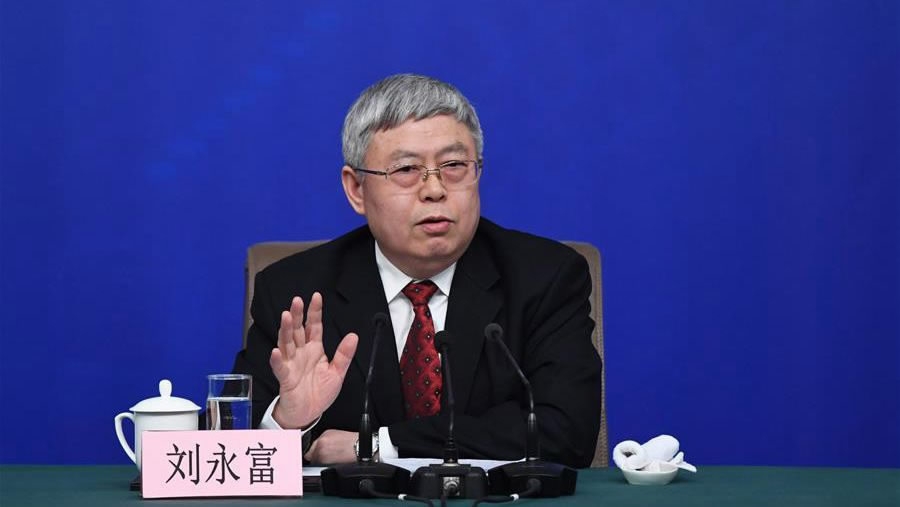
Liu Yongfu, Director of the State Council Leading Group Office of Poverty Alleviation and Development, answers questions at a press conference on the "battle" of targeted poverty alleviation during the first session of the 13th National People's Congress in Beijing, March 7, 2018. (Photo/Xinhua)
Liu Yongfu, Director of the State Council Leading Group Office of Poverty Alleviation and Development, answers questions at a press conference on the "battle" of targeted poverty alleviation during the first session of the 13th National People's Congress in Beijing, March 7, 2018. (Photo/Xinhua)
As of the end of 2017, China had lifted more than 68 million people out of extreme poverty over the previous five years, a remarkable achievement. But China still had 30 million people living in extreme poverty. In 2018, China plans to lift, at least, another 10 million people out of poverty. To win the fight against poverty, China has targeted measures as well as a tight timeframe. What are the targeted measures? How to ensure reliable data? How to sustain the process? To understand the situation, I spoke with senior officials in the central government, met with leaders in poverty-stricken areas, and traveled with village cadres at the lowest level. I was determined to go literally to the “grassroots” - to visit those poverty-stricken people in person. Five methods of poverty alleviation are used: industry, creating a sustainable micro-business; relocating, moving people from remote areas; education and training; ecological compensation for those living in ecologically vulnerable areas; and social security, medical subsidies and direct payments to those who cannot work. I was startled to see that every poor family in China has its own file, each with its customized plan, checked monthly, recorded on paper and digitized for central analysis. Millions of households. Equally startling, local officials are dispatched to impoverished villages to manage poverty alleviation for two years. I watched a “democratic evaluation” in a remote village, where villagers voted into poverty status one young man whose father has cancer and cheered when another man was raised out of poverty.