
Opinions
11:38, 06-Apr-2018
Opinion: Martin Luther King's forgotten legacy for young activists
 ["china"]
Share







Copied
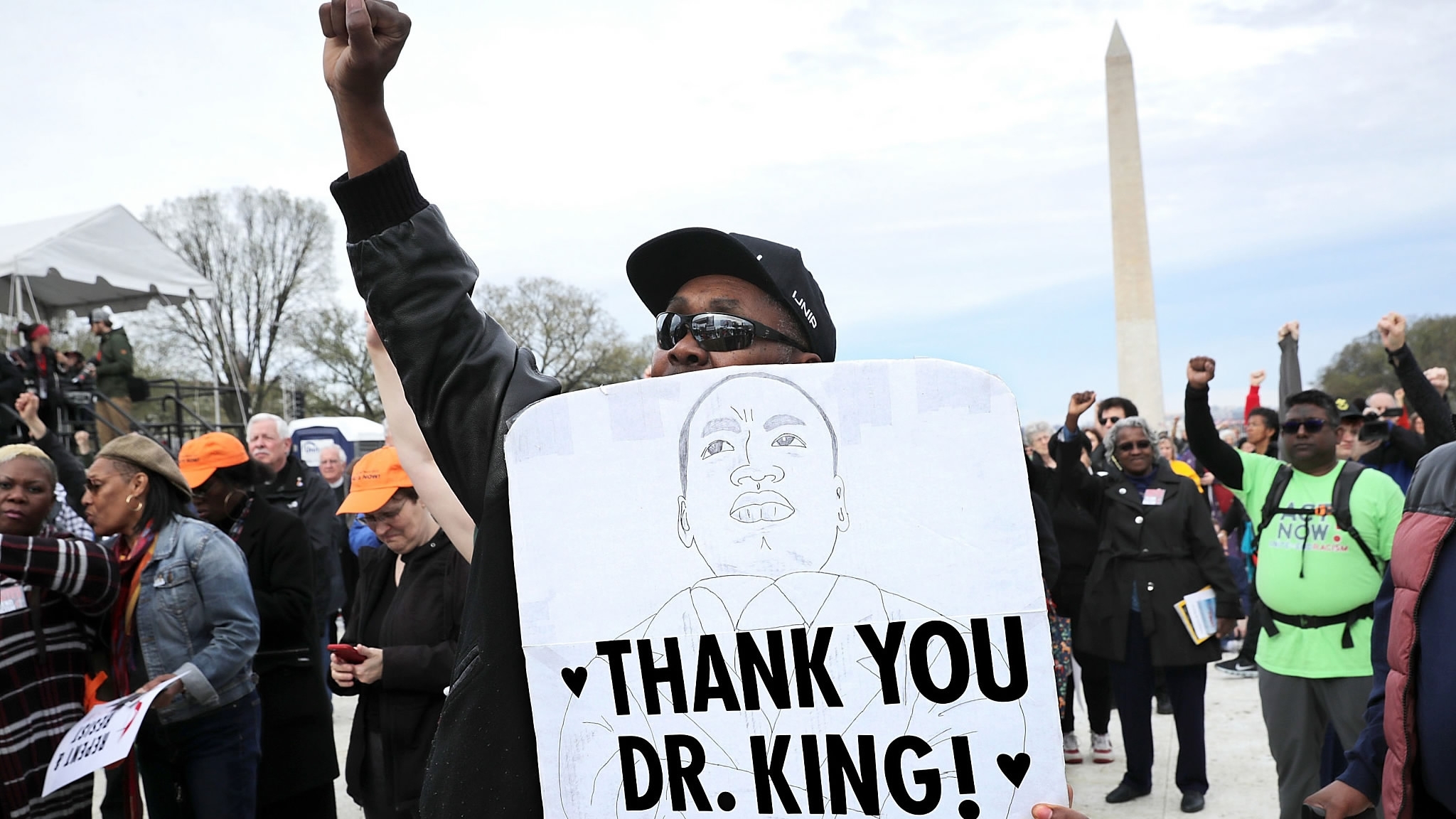
On August 6, 1946, a 17-year-old Morehouse College student demanded racial justice. In a letter to the editor of the Atlanta Constitution in the racially segregated American state of Georgia, Martin Luther King Jr summarized the moral imperatives that would guide him for the rest of his life.
“We want and are entitled to the basic rights and opportunities of American citizens: The right to earn a living at work for which we are fitted by training and ability; equal opportunities in education, health, recreation, and similar public services; the right to vote; equality before the law; some of the same courtesy and good manners that we ourselves bring to all human relations,” the future Nobel Peace Prize winner wrote.
Seventeen years later, at the tender age of 34, King delivered his most famous speech at a rally he prophetically predicted “will go down in history as the greatest demonstration for freedom in the history of our nation.”
“The whirlwinds of revolt will continue to shake the foundations of our nation until the bright days of justice emerge,” King declared as he began his “I have a dream” speech at the memorial to Abraham Lincoln, the US president who issued the Emancipation Proclamation ending slavery one hundred years earlier.
King was assassinated 50 years ago this week as he stood on a balcony at the Lorraine Motel in Memphis, Tennessee, his dream cut short at age 39, his youthful visage frozen in time. A half-century later, this “young man in a hurry” is justifiably known as a voice of moral truth, a passionate and unyielding advocate for social and economic justice, an unshakeable advocate of ending the evil of American apartheid, an exemplar, along with Gandhi and Mandela, of global non-violent civil disobedience in the 20th century, and a ceaseless advocate for peace and international brotherhood.
While others urged him to accept incremental progress, King sought justice. While others cautioned compromise, he demanded equality. While others feared a backlash against a movement led by strong black men, he continued to march and march, inexorably, toward for progress.
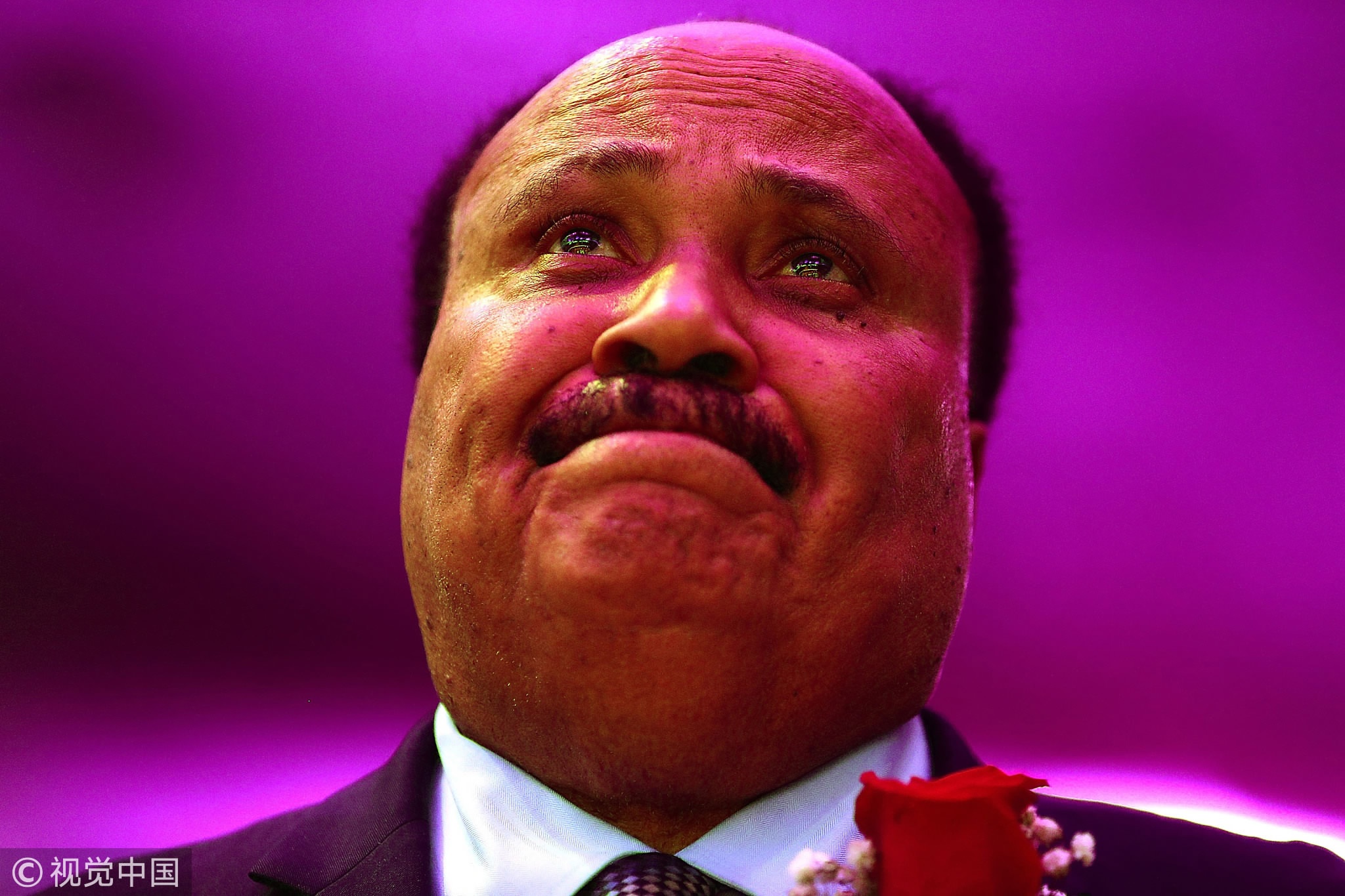
Martin Luther King III, the son of Martin Luther King, Jr, attends the I AM 2018 "Mountaintop Speech" Commemoration at the Mason Temple Church of God in Christ, the same place his father delivered his "Mountaintop" speech on the eve of his assassination, in Memphis, Tennessee, Apr. 3, 2018. /VCG Photo
Martin Luther King III, the son of Martin Luther King, Jr, attends the I AM 2018 "Mountaintop Speech" Commemoration at the Mason Temple Church of God in Christ, the same place his father delivered his "Mountaintop" speech on the eve of his assassination, in Memphis, Tennessee, Apr. 3, 2018. /VCG Photo
“Doctor King taught us to be brave, to be courageous, to be bold,” Congressman John Lewis told former President Barack Obama this week as he discussed his martyred friend’s importance. “His legacy was to speak up, stand up. When you see that something isn’t right or fair, you have to do something – you have to get in the way. Get into good trouble.”
While King is being rightfully remembered for all of these reasons, he leaves another legacy that is less frequently mentioned but is increasingly relevant in a modern world plagued by growing nationalism, xenophobic demagoguery, and transnational purveyors of chaos and terror. That legacy is the power of committed young people to push for progress. Nowhere in the world is King’s appeal more true than in his native South, where teenagers are building a global movement to force common sense changes to US gun laws amid an epidemic of mass murders at American schools. The most recent was the Valentine’s Day massacre of 17 people at Marjory Stoneman Douglas High School in Florida.
Like King, the teenagers from Stoneman Douglas High speak with the moral clarity of youth, unimpeded by the ambiguities and ethical compromises that come with age. Like King, who saw injustice and called it injustice, America’s young generation is speaking truth to power without fear or equivocation. While many of the students’ elders say it is politically impossible to overcome the clout of the American firearms industry and massive resistance among Republicans who control the Congress, the idealistic youngsters say, like King, that they shall overcome.
Both King and the Florida students met with US presidents to press their case. When unsatisfied with the results, they organized and marched on Washington to showcase their grassroots support.
King’s 1963 “March on Washington for Jobs and Freedom” protested the political establishment’s resistance to change. On March 24, 2018, the students’ “March for Our Lives” protested the political establishment’s refusal to enact any gun control. Nearly one million Americans marched down Pennsylvania Avenue in the heart of Washington. The students, harnessing the reach of social media, coordinated more than 800 satellite marches in cities across America and on every continent except Antarctica.
At age 17, King was writing letters to his local newspaper. At age 17, Cameron Kasky of Parkland, Florida, was speaking to 800,000 people in Washington. “To the leaders, skeptics and cynics who told us to sit down and stay silent [and] wait your turn: Welcome to the revolution,” the high school junior said.
Like Cameron Kasky and his Stoneman Douglas schoolmates, King was a young person on a mission. At age 19, he was ordained a minister. At age 25, he became the pastor of a church in Montgomery, Alabama. At age 26, he became the president of a movement for justice after local seamstress Rosa Parks was arrested for refusing to sit in the back section of a public bus, as mandated for all black people under local apartheid law. At age 27, after his home was firebombed, he asked his followers to channel their anger into non-violent protest.
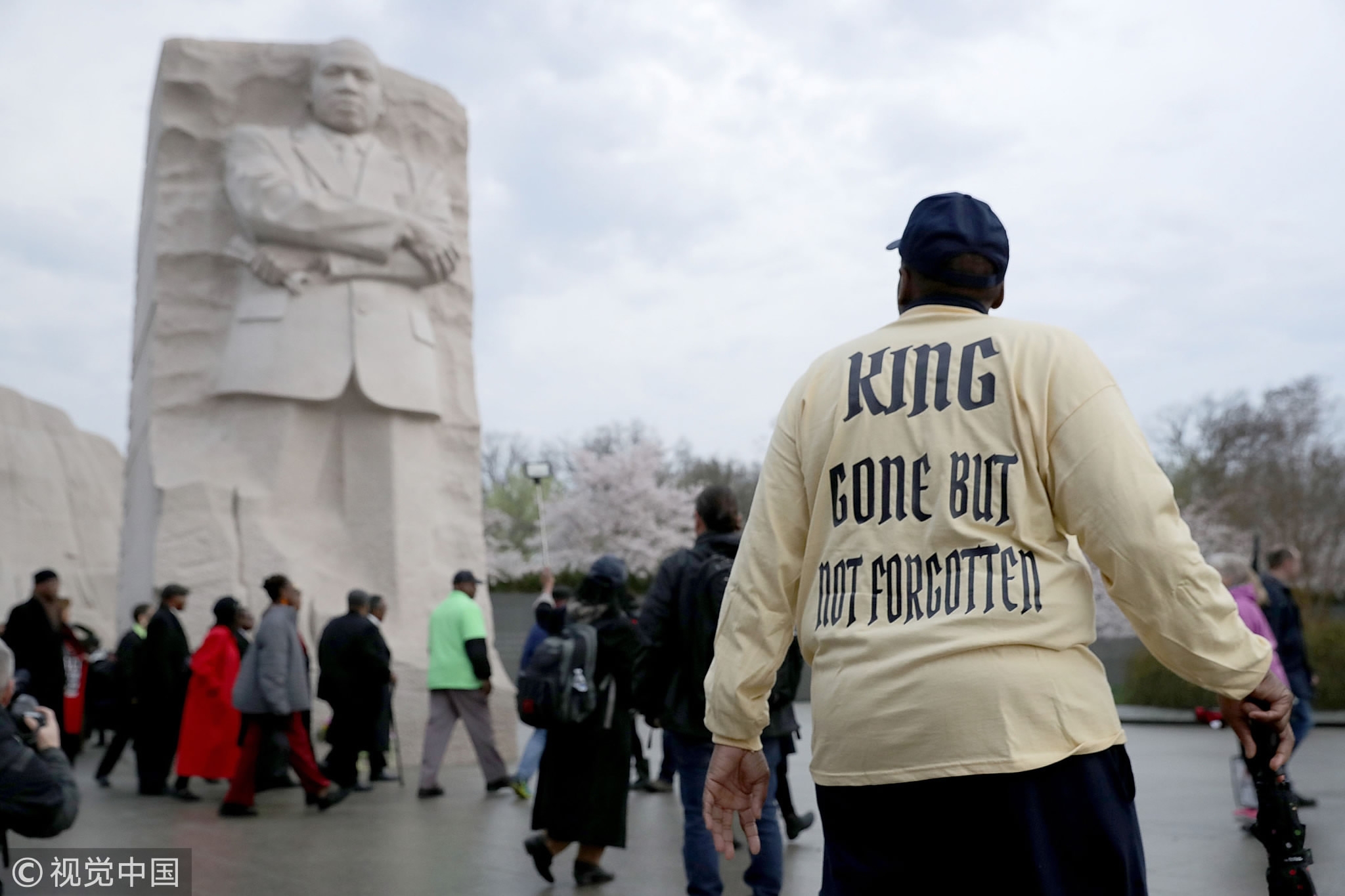
Marchers gather at the Martin Luther King Jr Memorial for a silent walk to a prayer service on the National Mall to mark the 50th anniversary of King's assassination in Washington, DC, Apr. 4, 2018. /VCG Photo
Marchers gather at the Martin Luther King Jr Memorial for a silent walk to a prayer service on the National Mall to mark the 50th anniversary of King's assassination in Washington, DC, Apr. 4, 2018. /VCG Photo
At age 28, he appeared on the cover of Time Magazine, transforming him into a global figure. Within months, he was invited to the inauguration of Kwame Nkrumah as the leader of the post-colonial nation of Ghana. At age 29, he published a book, “Stride Toward Freedom,” and met President Dwight Eisenhower. At age 30, he traveled to India to see Prime Minister Jawaharlal Nehru and talk to followers of his revered role model, Mahatma Gandhi.
King’s global fame made him a target at home. He was charged with tax fraud by racist prosecutors in Alabama but acquitted. He was arrested at a sit-in demanding an end to segregation at Atlanta’s leading department store and later at a whites-only restaurant in Florida. FBI director J. Edgar Hoover, a notorious racist, was obsessed with King, once declaring that King’s organization was led “by communists and moral degenerates.”
His courage won the respect of new President John F. Kennedy, the youngest man ever elected American president. At a meeting of the two young leaders, King asked Kennedy to issue a “Second Emancipation Proclamation” banning racial segregation.
At the age of 35, in 1964, he won the Nobel Peace Prize and was chosen as Time magazine’s “Man of the Year.” Young and impatient, King kept pressing forward. He pushed for economic progress to accompany the sweeping civil rights laws of Lyndon Johnson’s Great Society. He opposed the Vietnam War. Though not yet 40, he feared he would not reach old age. A day before his murder, King ended a one-hour speech by contemplating his own mortality.
“Like anybody, I would like to live a long life,” he said. “Longevity has its place. But I'm not concerned about that now.”
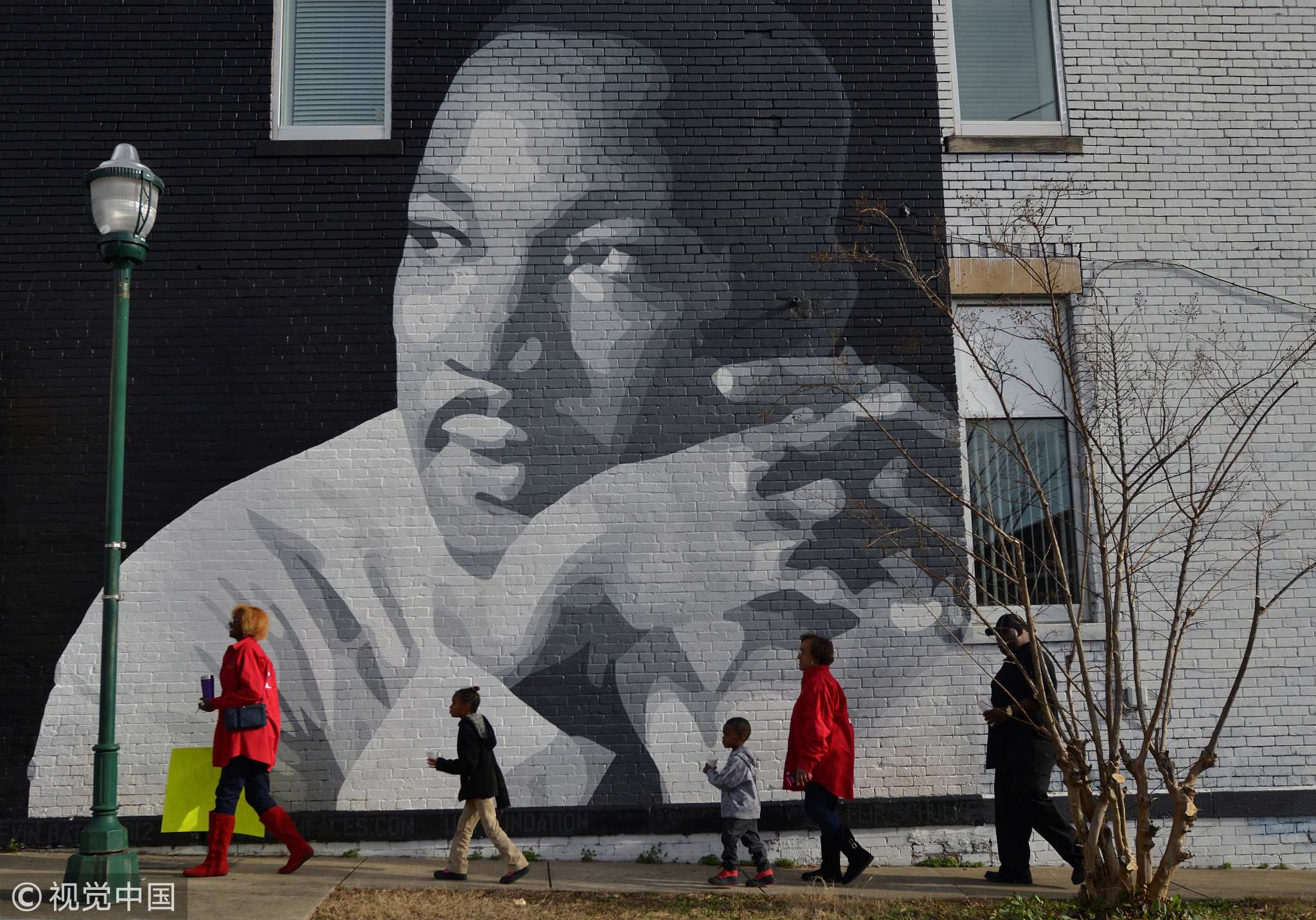
People gather to march in the annual parade down MLK Boulevard to honor Martin Luther King, in Chattanooga, Tennessee, Jan.16, 2017. /VCG Photo
People gather to march in the annual parade down MLK Boulevard to honor Martin Luther King, in Chattanooga, Tennessee, Jan.16, 2017. /VCG Photo
The young students from Parkland, Florida, and the generation they have inspired are not contemplating longevity now. Like King, they are committing themselves to a mission. Civil rights leader John Lewis, now 78 years old, recognizes their spirit.
“When I got involved in the civil rights movement as a young man, we’d sit in at restaurants,” he told students from Ron Brown College Preparatory High School in Washington this week. “People would spit on us, put their cigarettes out on us, pour hot coffee down our backs. I was arrested 45 times in the 1960s. I was beaten, left bloody and unconscious. But I never gave up. And today, you cannot give up. That’s what Dr Martin Luther King can teach us today. His message is as important now as it was 50 years ago.”
(Rick Dunham is co-director of the Global Business Journalism Program at Tsinghua University. The article reflects the author's opinion, and not necessarily the views of CGTN.)