
18:06, 28-Feb-2019
Full Episode – 40 Years and Counting Ⅴ: China’s Opening up

Share






Copied
By Robert Lawrence Kuhn
In this 40th year of China’s reform and opening up, President Xi Jinping calls for comprehensively deepening reform and further opening up. That’s why we title this series, “40 Years and Counting: Transforming Reform and Opening up for the New Era.”
What lessons have been learned? What challenges lie ahead? In this final episode, we explore why, after four decades, China still needs to open up further.
We take a retrospective look at reform and opening up, and what they mean prospectively for China’s goals at three critical dates – 2020, 2035, 2050. We distinguish between reform and opening up, elucidating each: “reform” as the agent of change, especially in giving more play to the market in allocating resources, and “opening up” as representing the mechanism by which China engages progressively more with the global community, including foreign investment in China and Chinese investment in foreign countries.
We assess how the two transformational ideas — reform and opening up — have enabled what China calls its “peaceful rise”, and what the Chinese experience can mean for the world, especially for the developing world.
Reform and opening up have marked a dramatic inflection point in China’s history, from a closed or semi-closed society to a major trading partner with over 130 countries and actively engaging with multiple international bodies, including the UN, WTO, G20, and BRICS. There are challenges, of course, domestic tensions are not waning, and international frictions are not weakening.
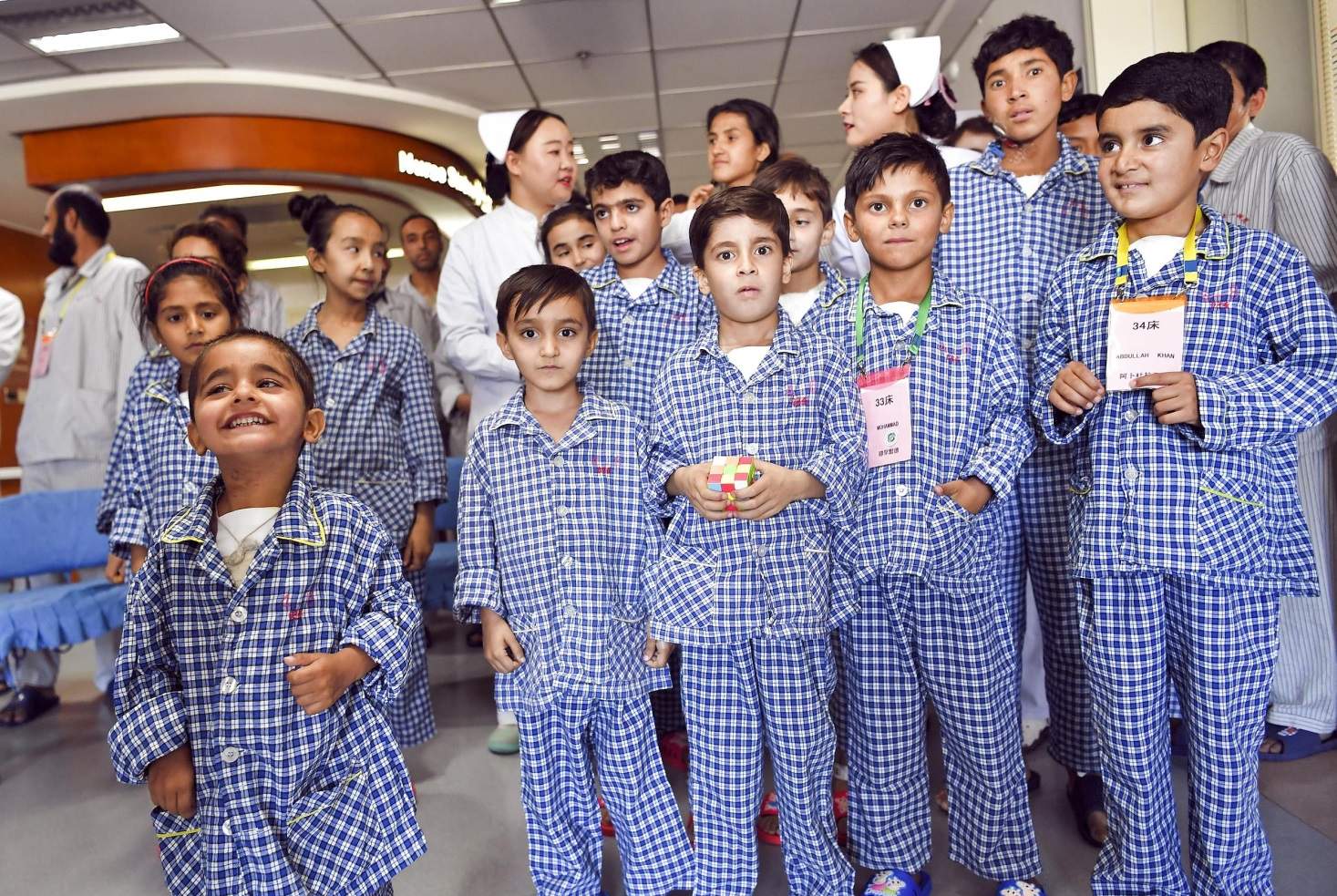
27 Afghan children with heart disease were receiving treatment in Xinjiang Uygur Autonomous Region, China. They are beneficiaries of China’s Belt and Road humanitarian project. / VCG Photo.
27 Afghan children with heart disease were receiving treatment in Xinjiang Uygur Autonomous Region, China. They are beneficiaries of China’s Belt and Road humanitarian project. / VCG Photo.
When China’s leadership looks back on the country’s 40 remarkable years of reform and opening up, and then looks ahead to the grand goals of China 2035 and China 2050, what do they see? According to China, what has changed, not changed, should change, and never change?
What has changed: the economic miracle, becoming the world’s second-largest economy; huge elevation in standards of living; unprecedented global engagement.
What has not changed: still low GDP per capita; still a developing country; continuing growth fueled by continuing urbanization, tensions between quantity and quality of growth; social contractions exacerbated by rising expectations.
What should change: reduce social disparities and pollution; enhance social services and scientific excellence; increase contributions to the developing world and to the global commons.
What will never change: continue to follow China’s own model; promote new ways of thinking; maintain economic development as priority; seek inclusive growth, sustainable development, social democracy, a beautiful country, a civilized and harmonious society; and promote win-win cooperation for a global community with a shared future.
For China to achieve these grand goals, the country’s domestic and international affairs must be integrated. President Xi Jinping has promised, “The more developed China becomes, the more open it will be.” Much has been accomplished; much more must come. It’s an exciting time, to be… Closer to China.