
World
13:45, 03-Mar-2018
Facebook apologizes for its censorship, again
 ["europe"]
Share







Copied
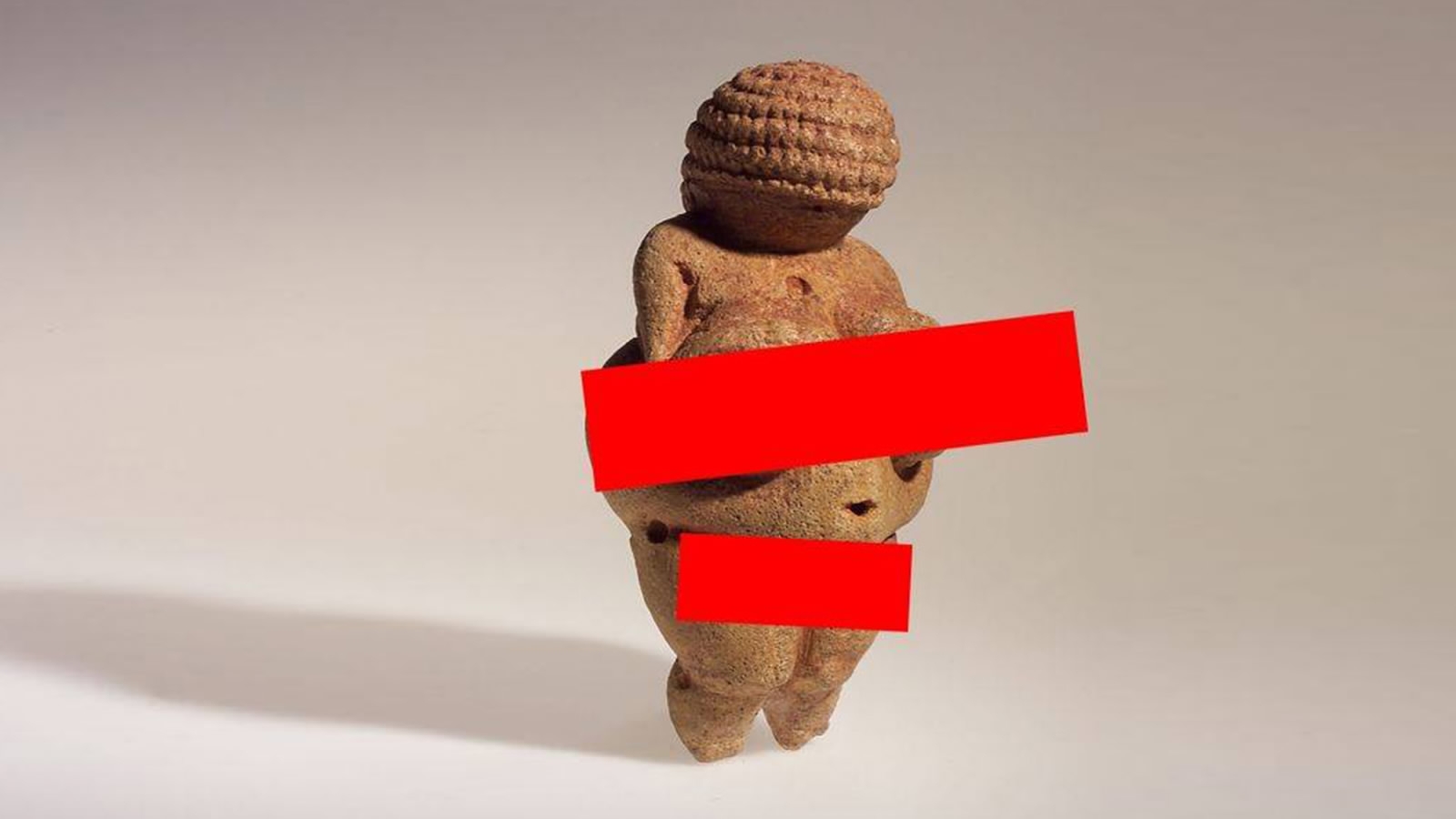
Facebook apologized, again, for mistakenly banning a picture and calling it a “dangerous pornographic image” on Feb. 28.
However, the picture was of a nude and prehistoric statue called the Venus of Willendorf. It is one of the world’s earliest symbols of female fertility, and was discovered in 1908 and is currently in the Natural History Museum in Vienna. Due to its depictions of a naked woman with exaggerated sexual figure, the Venus of Willendorf is alongside other similar statues as being regarded as a representation of a mother goddess.
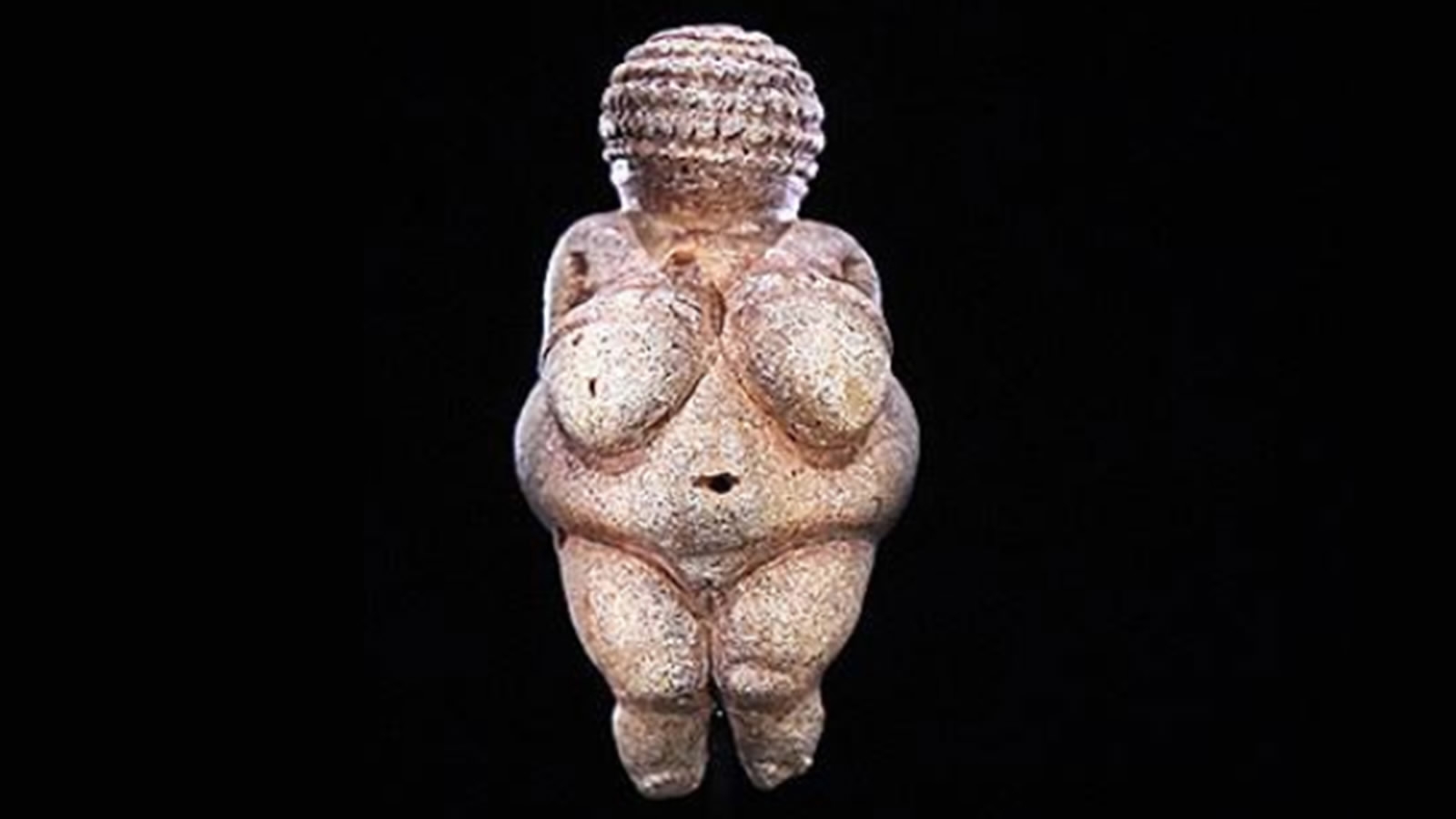
The Venus of Willendorf, a 4-inch statue made from limestone, was estimated to be made between 28,000-25,000 BCE. /Picture from Facebook
The Venus of Willendorf, a 4-inch statue made from limestone, was estimated to be made between 28,000-25,000 BCE. /Picture from Facebook
Christian Koeberl, the director of the museum, said there was no reason to cover the world-famous Venus of Willendorf.
“There is no reason for Austria’s Natural History Museum covering the Venus of Willendordf and hide her nudity, whether it’s in a museum or on a social network”, he told Business Insider.
“There has never been any complaint by visitors concerning the nakedness of the figurine,” he added.
Facebook quickly apologized for its mistake and approved the picture.
The controversy around Facebook banning masterpiece artworks began when Laura Ghianda, an Italian arts activist, tried to post a photo of the Venus of Willendorf on Facebook in December 2017, claiming that she was banned because her image violated the company’s nudity policies.
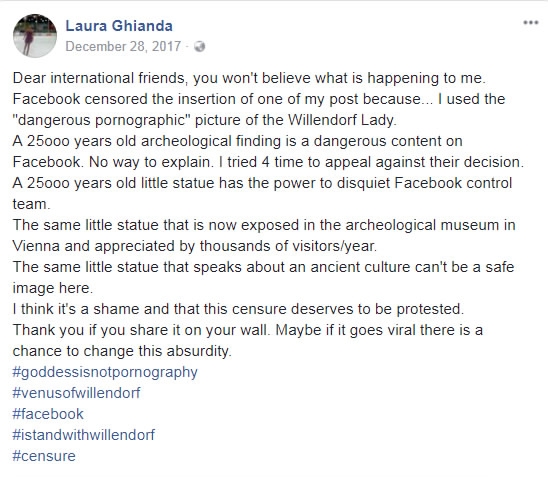
Screenshot of Laura Ghianda's Facebook post.
Screenshot of Laura Ghianda's Facebook post.
Facebook has been constantly criticized for banning content that should have been published.
Krista Venero, an author of a romance novel, bought ads on Facebook for her book last year. The ad showed an image of a woman photographed from behind with a portion of her upper back exposed. However, the social media giant rejected the ad, considering it to be sexually implicit.
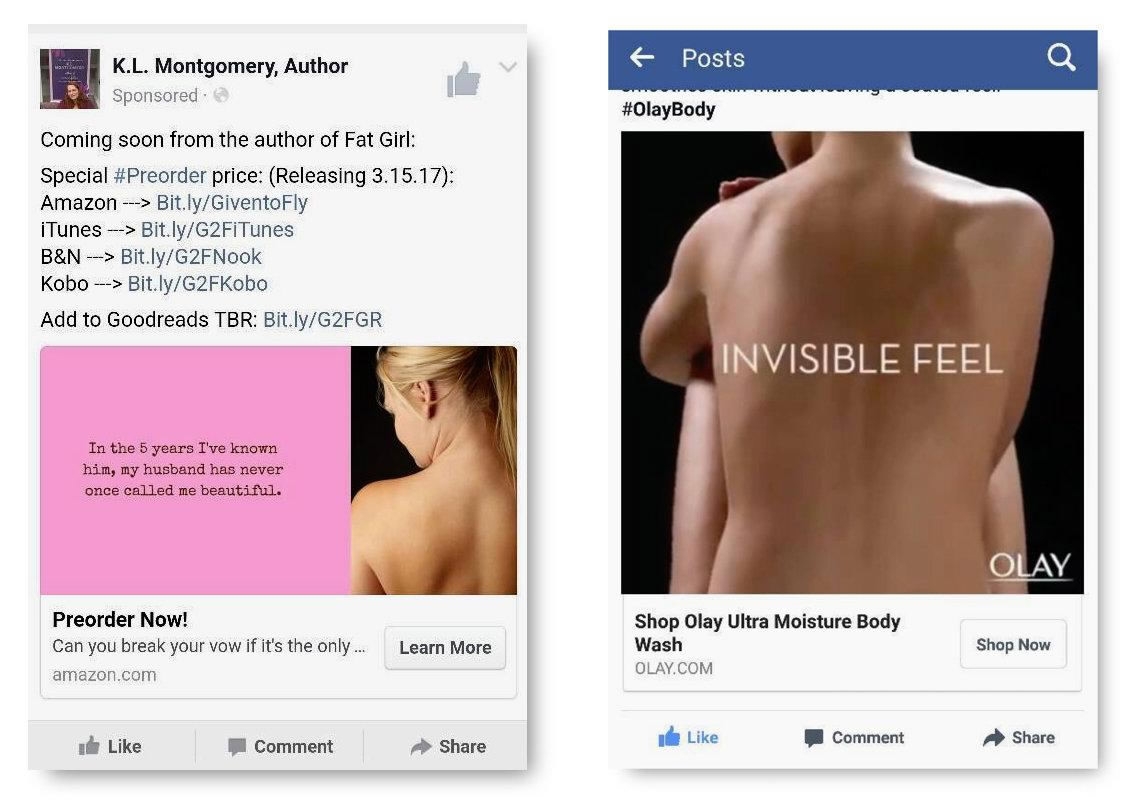
Screenshot of Krista Venero's ads on Facebook
Screenshot of Krista Venero's ads on Facebook
Facebook closed the account of a user who posted a photograph of French painter Gustave Courbet’s “Origin of the World” painting, which depicts female genitalia.
There are also lots of complains about Facebook’s inconsistency on deciding which images are sexually suggestive.
“The back and forth shows the social network’s struggles over images of the human body,” The New York Times said, “The company once flagged down a photo of a woman in a T-shirt reading in a dim light, while allowing provocative images about a man’s bare stomach for an ad of movie 50 Shades Of Grey (2013).”
Apparently, the company processes millions of commercials per week through a mix of an automated system and human review. But who makes the decision on which is acceptable and which isn’t?
Joel Jones, the vice president of global marketing solutions operations, once said in a pubic letter that the company could not ask an automated system about these decisions.