
21:44, 10-Jul-2019
China-US Trade Tensions: Unofficial venues offer opportunities for exchanges
Updated
22:46, 10-Jul-2019

Share






Copied
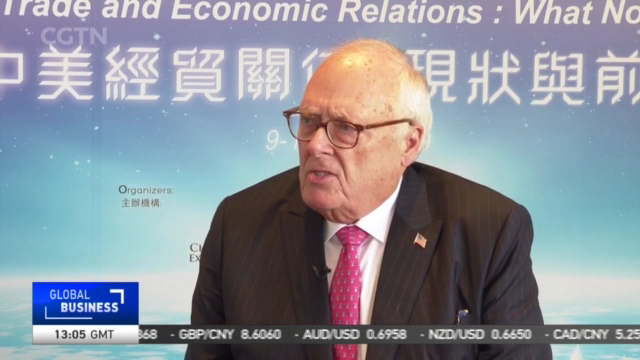
Staying with the trade negotiations. China and the US are keeping their talks at a high level through phone calls between Beijing and Washington and through the much broader ground of unofficial exchanges. A Hong Kong forum gave business leaders, scholars and formal officials from the two countries a chance to speak their minds. CGTN reporter Zhu Dan has more.
ZHU DAN HONG KONG "It goes without saying that China and the US are important for one another. And the two are strongly advised to work together and strengthen the ties between them. So for bilateral relations, what's now and what's next? Experts from both nations are here in Hong Kong to work that out."
Former Hong Kong Chief Executive Tung Chee Hua, now the chairman of the China-US Exchange Foundation led the conference with about 40 experts from both sides.
Zhu Dan: US and China trade officials held a phone conversation on Tuesday. How do you look at it?
TUNG CHEE HWA, CHAIRMAN CHINA-UNITED STATES EXCHANGE
FOUNDATION "When the talk is going on, it's always good news, and basically because if we are together, we are talking, we are looking for solutions. We hope as time goes on, we see more and more possibility."
In the conference, former Japanese Prime Minister Yasuo Fukuda said they have considerable understanding on today's friction between the U.S. and China. Fukuda recalls the trade friction Japan had with the US for decades – likening it to today.
YASUO FUKUDA FORMER JAPANESE PRIME MINISTER "China should take this difficult time as a national chance to find new engines to a continuous economic growth."
Former Chinese Vice-Premier Zeng Peiyan accuses the US of worsening the trade spat. He says several factors made a US trade deficit with China inevitable, including the US dollar's dominant status as an international currency.
ZENG PEIYAN, CHAIRMAN CHINA CENTRE FOR INTL. ECONOMIC EXCHANGES "Not long ago, some people in the US alleged that due to its trade deficit with China, the US has suffered losses. Such a view is lopsided and lagging behind the development of the times."
Meanwhile, Ed Feulner, chairman of the Asian Studies Centre at the Heritage Foundation, said he is optimistic, and if the two countries solve the problem, it will highly benefit both countries and the rest of the world.
ED FEULNER, CHAIRMAN ASIAN STUDIES CENTRE AT THE HERITAGE FOUNDATION "For the next 50 years, it's going to be the Chinese and American economy together that are going to control the whole world economy. We have to work together and I think we're on track to start doing that now. The Osaka Summit was important, because the leaders said their people both on their staff level, and people generally, hey, we want to solve this, we want to work together, so ground work is there, now it's up to the working level people to get down and say these are the specifics we had to deal with."
As the organizers say, the work that this forum has undertaken over the last two days is only a small step of a long journey. This is just the beginning. Zhu Dan, CGTN, HK.