
13:06, 13-Jul-2019
Global AI & Robotics Summit: Driverless car solutions on the agenda at Shenzhen meeting
Updated
13:22, 13-Jul-2019

Share






Copied
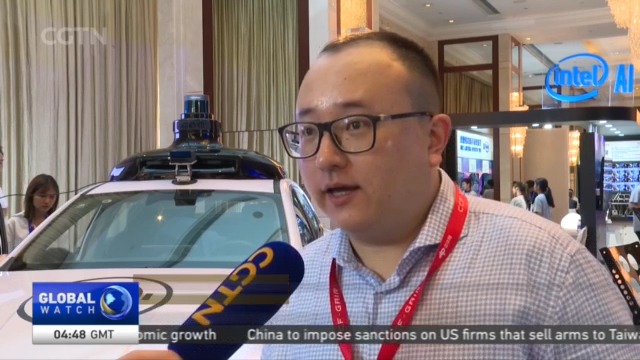
Artificial intelligence -- or AI -- has been coming more and more into our daily lives in recent years. From virtual assistants on smartphones and in cars, to facial recognition cameras in airports and our city streets. In Shenzhen, or what many call China's Silicon Valley, industry experts have gathered to discuss the future of this sophisticated technology and how China is primed to be the leader in development. Here's Ge Yunfei again.
"Hi, firstly let me give some figures of China's AI industry. In the ten years from 2009 to 2018, over 33 hundred AI start-ups popped up across China. And since 2011, China has surpassed the US in terms of AI patent applications. We know the quantity is not always equal to quality, but it tells something important. And I've been following this AI summit for four years. And one of the most exciting things is that you really can witness and feel the wild growth of China's start-ups. Last year, when I came here, a company Robosense is still a small-sized start-up making homegrown laser radar for autonomous driving. But just months after last year's summit, it raised 300 million RMB, or about 43 million US dollars. Now you can see it has already started cooperation with an autonomous driving company to develop a driverless car solution. Many people say it could be China's next DJI."
This room is filled with thousands of young engineers, keen for the sparks from the pioneering scholars. There were even some arguments outside from people who couldn't squeeze themselves in. This is the Global AI & Robotics Summit in China's Silicon Valley, Shenzhen.
WU HAIFENG ASSOCIATE PROFESSOR, CHINESE UNIVERSITY OF HONG KONG, SHENZHEN "Although we're in the front-tier of AI, you still can feel that it's an eye-opening experience for many audiences here."
These passionate developers are evidence of China's explosive AI industry growth. According to the Wuzhen Institute, since 2000, the global AI industry has raised a total of 78.5 billion U.S. dollars, 72 billion of it coming in just the last five years. And the market in China is even hotter. In 2018, Chinese AI enterprises raised 15.6 billion dollars, accounting for nearly half of the total fund-raising worldwide. Some say it's a good thing.
China's booming AI industry is luring more and more leading Chinese scientists back home. But they say the situation here in China is somewhat different than elsewhere.
ZHANG ZHENGYOU DIRECTOR, AI LAB & ROBOTICS X, TENCENT "I feel that in America, AI research is more calm and steady. In China, some people are hasty. The rankings of competitions and the numbers of journals are much more important in measuring their achievements."
GE YUNFEI SHENZHEN "AI is being used in many good ways, like in financial technology, education, and security. But everything has two sides. Now it's gradually showing its possible dark side."
This is not Mark Zuckerberg. This is a video manipulated by a technology called Deep Fake. It's arousing global concern over AI.
ZHANG ZHENGYOU DIRECTOR, AI LAB & ROBOTICS X, TENCENT "It's becoming a big problem. First off, we need policies to regulate these things; and secondly, the developers also need self-discipline to not do these kinds of things."
Experts at the summit say AI is still in its early stages. They call on both the industry and society, in general, to be more patient and cautious as we head into the 2020s. Ge Yunfei, CGTN, Shenzhen.