
10:49, 11-Jul-2019
Iran-UK Tanker Row: US official: Iranian boats unsuccessfully try to seize British tanker in the Gulf
Updated
12:54, 11-Jul-2019

Share






Copied
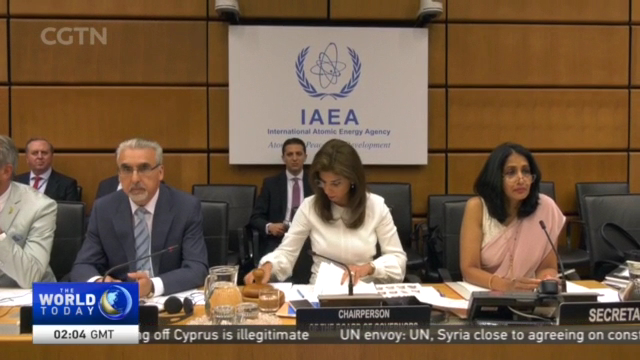
We begin with the growing tensions between Iran and the West. A US defense official says Iran has tried to detain a British oil tanker in the Gulf. The official said five boats, believed to belong to Iran, approached the ship in the Gulf on Wednesday. The boats asked the vessel to stop in Iranian waters, but withdrew after a warning from a British warship. The UK has not confirmed the incident. Last week, the British navy seized an Iranian tanker bound for Syria, in waters off the British overseas territory of Gibraltar. Iranian President Hassan Rouhani said on Wednesday that Britain will face what he called "consequences". Meanwhile, on the nuclear front, the UN's nuclear watchdog agency has held an emergency meeting on Iran. Washington called the session after Iran said it exceeded limits on uranium enrichment set in the 2015 nuclear agreement. CGTN's Natalie Carney has that story.
"Nuclear extortion" is what the U.S. Ambassador to the IAEA, Jackie Wolcott, accused Tehran of doing by breaching the 2015 nuclear agreement in an effort to gain economic compensation for American sanctions.
Iran hit back, calling the U.S. "economic terrorists" for reimposing the crippling sanctions on the Islamic republic after Washington unilaterally withdrew from the Joint Comprehensive Plan of Action deal a year ago.
KAZEM GHARIB ABADI IRANIAN IAEA REPRESENTATIVE "The United States has not only withdrawn from the JCPOA and violated its own commitments, but through political and economic pressure, prevents international community, states and private entity to implement their commitments towards Iran."
Earlier this week, IAEA investigators confirmed that Iran had exceeded the 300 kilogram limit for stockpiles of low-enriched uranium and the 3.67% purity level included in the agreement.
Tehran rejects accusations by the U.S. that this is a breach to the nuclear accord.
The head of China's delegation told CGTN that Beijing does not view Iran's recent moves with concern.
FU CONG, DIRECTOR GENERAL ARMS CONTROL DEPT. OF CHINESE FOREIGN MINISTRY "We should not overreact to the actions taken by Iran because in our view, these actions do not incur any proliferation risks, and they do not contravene Iran's obligations under the forcipes safeguard agreement, and also all the actions they have taken are reversible."
Meanwhile, the E3 group, Germany, France and Britain, has been working hard on diplomacy with Iran in an attempt to keep the deal alive.
Iran wants Europe to do more to protect it from Washington's economic sanctions.
NATALIE CARNEY VIENNA "The E3 countries have even designed a financial scheme known as The Instrument in Support of Trade Exchanges or INSTEX to skirt around the U.S. sanctions through a barter type system. The problem is that it's only operational for humanitarian goods, which aren't subject to sanctions, so it produced no real relief for Iran."
U.S. sanctions target Iran's main source of foreign revenue crude oil exports.
Tehran's latest moves are seen as an attempt to convince the remaining signatories of the JCPOA to provide more relief from those sanctions.
KAZEM GHARIB ABADI IRANIAN IAEA REPRESENTATIVE "Iran's actions fall in line of the remedial clauses incorporated in the JCPOA and are taken in order to restore the long lost balance of the implementation of the commitments under the deal."
Tensions have been mounting with fears this could escalate into all out war.
Wednesday's closed-door IAEA meeting is not expected to bring about any consensus. Natalie Carney, CGTN, Vienna, Austria.