
11:09, 23-May-2019
多处跳帧,备用India General Elections: PM Modi's foreign policy and regional impact of vote
Updated
15:02, 23-May-2019
 []
[]
Share







Copied
03:40
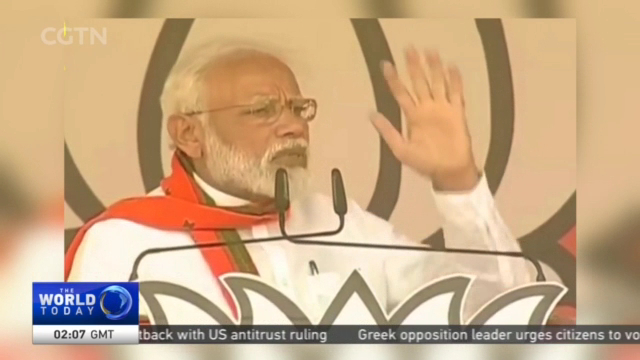
多处跳帧,备用. 第一处跳帧在第一段。
Vote counting begins on Thursday in India's general elections. Opinion polls predict a massive win for Prime Minister Narendra Modi's party. This could secure him a second term in office during which foreign policy would play a very important role. Shweta Bajaj has more.
Whichever party that comes to power in India on Thursday will have its task set.
In the past five years, Narendra Modi's government played on national pride and put India on the global map.
He first came to power through the promise of a strong economy. Five years later, his election campaign has taken a new turn.
SHWETA BAJAJ NEW DELHI "Domestic considerations are usually top of mind for many Indian politicians during electoral campaigns. But, for this round, the agenda has included neighboring Pakistan, illegal immigration, and security concerns. This means whichever party that comes to power on the 23rd of May will have a lot of explaining to do."
Modi's 2019 campaign played to India's 80 percent Hindu majority with fiery speeches on Pakistan's role in funding terrorism, illegal Muslim immigrants from Bangladesh, and the promise of national security.
Dhruva Jaishankar is a fellow in foreign policy at Brookings India. He says even though aggressive statements tend to affect Modi's statesmanship, India's stance on Pakistan is likely to remain the same.
DHRUVA JAISHANKAR FELLOW IN FOREIGN POLICY, BROOKINGS INDIA "I think these elections have been rather unusual in the sense that it's the first time that national security has featured so prominently in the months leading up to the elections particularly the recent standoff between India and Pakistan after February 14th – after the terrorist attack in Jammu & Kashmir has centered the political debate on national security and Pakistan in particular. India's response has been domestically very popular in the sense using air power to strike the terrorist targets but I don't think this issue will go away even after the elections."
As Modi began his first term as prime minister, he invited India's South Asian neighbors including Pakistan to his inauguration. This was followed by an aggressive foreign policy to reach out to the world. But, five years later, troubles lie closer home. Experts say China, Nepal, Pakistan, Bangladesh, and other South Asian neighbors should be the focus of India's foreign policy.
UDAY BHASKAR DIRECTOR, SOCIETY OF POLICY STUDIES "I would say that India-China relationship is even more important than the India-US relationship. And the short point is that both for Beijing and New Delhi, there is a political realization at the highest levels that if there has to be an Asian century, it would be predicated on a stable Sino-Indian relationship. India has its own concerns on issues like territoriality and the fact that we have almost 4,000 kilometers plus of an unresolved territorial dispute. India is very concerned about Pakistan and the whole linkage between the nuclear missiles and terrorism. So these are the issues I think are on the radar. Wuhan I think is a means to an end and much depends on how Beijing and Delhi decide they want to manage this relationship."
Prime Minister Modi's foreign policy saw him meeting world leaders and addressing crowds in stadiums to loud cheers. However, to achieve the global superpower status he seeks for India, Modi will have to put more focus on the country whose growth is being hampered by an economic slowdown and high unemployment rates. Shweta Bajaj, CGTN, New Delhi, India.