
22:26, 14-May-2019
Golden Spike Conference: US descendants remember Chinese railroad builders
Updated
22:20, 17-May-2019
 []
[]
Share







Copied
03:20
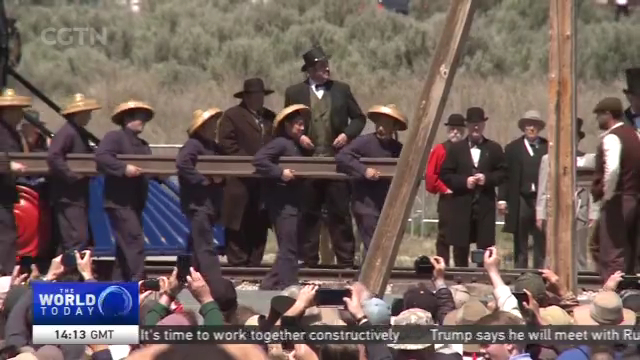
The western US state of Utah celebrated the 150th anniversary of the nation's first transcontinental railroad on Friday. More than 12-thousand Chinese laborers -- among the first Chinese immigrants to the United States -- endured harsh conditions to help build the mega project. CGTN's Mark Niu has more from Utah.
At Promontory Summit in Utah, the 150th anniversary of the Golden Spike featured historic re-enactments that included Chinese American performers.
Historian Connie Young Yu reminded the crowd how on the 100th anniversary, the Chinese-American community representative wasn't even allowed to speak, cut from the program at the last minute.
AVA CHIN CHINESE RAILROAD WORKER DESCENDANT "There is something very moving for me to be able to represent my great-great-grandfather railroad worker and take part in this story that is a very triumphant American story."
Also in attendance, high school teacher and rail worker descendant Linn Lee, who says her school's textbook only has one sentence on the Chinese rail workers, so she brought in supplemental material.
LINN LEE CHINESE RAILROAD WORKER DESCENDANT "It's such an insult to all the work our ancestors have done, and it's time for us to recognize the labor that helped build the transcontinental railroad. We have to really appreciate the significance of immigrant labor not just back then, but today."
MARK NIU PROMONTORY SUMMIT, UTAH "At this Golden Spike anniversary celebration, organizers have been careful to include contributions from many ethnicities. But the role of the Chinese rail worker is being further examined at events across the state of Utah."
The Chinese Railroad Workers Descendants association held its own Golden Spike 150 conference where about 750 people attended, at least 60 of them, descendants of Chinese rail workers. President Michael Kwan learned his great-great-grandfather worked on the transcontinental railroad from his grandparents.
MICHAEL KWAN PRESIDENT, CHINESE RAILROAD WORKERS DESCENDANTS ASSOCIATION "That's how most descendants discover it through oral history because the documentation wasn't there. The Chinese really were not considered people worthy of recording. This conference is an opportunity for descendants to share their stories and begin to change the narrative of today."
RUSSELL LOW CHINESE RAILROAD WORKER DESCENDANT "We weren't celebrating a Golden Spike or a railroad. What we were celebrating is the people celebrating the people, celebrating their families celebrating the generations of Chinese who came after that."
The family's descendants even include two World War II heroes who saved lives. Stanford University Professor Gordon Chang pointed out how Chinese Railroad workers laid tracks with a speed and quality no other group could match, ultimately lining the pocketbook of the president of the Central Pacific Railroad - Leland Stanford.
PROFESSOR GORDON CHANG AMERICAN HISTORY, STANDFORD UNIVERSITY "Because without the Chinese railroad workers, the Western portion of the central Pacific railroad probably would not have been completed. And Leland Stanford probably would not have become so wealthy that he donated his money to build Stanford University which means I might not be here today."
History-altering work that is finally being attributed to those who gave their blood, sweat and tears for the development of America. Mark Niu, CGTN, Promontory Summit, Utah.