
19:20, 09-May-2019
Ancient Paestum: Exhibition exploring multicultural exchanges of Italy in archaic Greece
Updated
19:20, 12-May-2019
 []
[]
Share







Copied
04:45
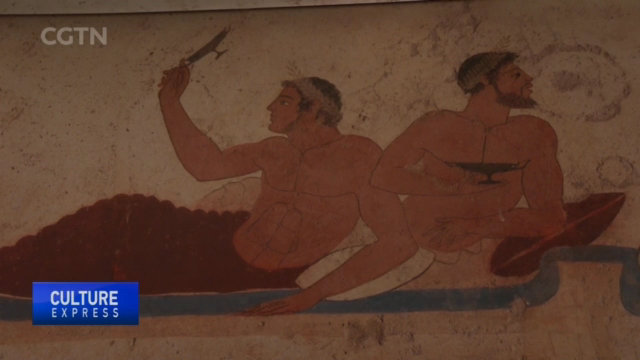
Paestum, in Campania, Italy, is what you might say is a classic Mediterranean city. It is listed on the UNESCO World Heritage List for its magnificent Greek temple sites and splendid colored frescos. Currently, many of the city's relics are being shown at the China Millennium Monument in Beijing. The exhibition explores the collision of cultures between ancient Italy and Greece. Li Qiong takes us there.
A tour of the history of more than 23-hundred years ago in another ancient civilization attracts many Chinese visitors.
These 134 artifacts came from excavations in Paestum, located in the southeast of Naples, Italy.
They present the historical changes and cultural integration of this ancient city, as well as times of war and peace in 'Great Greece' -- an area that once was a Greek area of the Italian Peninsula.
JIANG HAIMEI CURATOR, CHINESE SIDE "The biggest highlights are the colored frescos on the walls of the tombs. People in Paestum have a tradition of narrating their life on the tombs after death, like what Chinese people may have used to do. The themes cover their daily life, wars and religious stories. Mostly, four colors are found in the frescos: red, yellow, black and white."
A selection of 11 frescos presents ancient funeral customs around Paestum.
Through these paintings, we can roughly trace people's lives in the region more than 23-hundred years ago -- how they looked, the cattle they used, and war scenes.
These vivid figures emerged on the tomb walls after hundreds of years of development of fresco culture. The images were much simpler in the initial stage.
LI QIONG BEIJING "Tombs dating back to around 500 BC have banded or zonal decorations painted black and red, like these ones here. Most of them don't have complicated decorations. But there are exceptions. This piece is an important one here. It's called the Tomb of the diver. The original one is a national treasure of Italy, so we are not able to see the real piece here in Beijing. But in this simulated tomb, visitors could have an immersive experience, if you want. This is said to be the only tomb in Paestum from this period to be decorated with figurative scenes."
People have painted decorations on the four inner walls of the stone cist where the deceased was placed.
It portrays the scene of a symposium, a Greek banquet.
And above, a naked young man is diving into a pool of water flanked by two trees.
LI QIONG BEIJING "Look at the man above my head, we could see him on the covering slab. This is the diver who gave his name to the tomb. Here comes the most mysterious part. Where is he going? Where does he come from? Is he diving into the better world? No one knows exactly what the dive means."
Paestum, buried in the swamp for over a thousand years, was only discovered in the 18th century and is well preserved till now.
Once a colony of Ancient Greece, this city has three magnificent Dorian temples, which are even more ancient than the Parthenon in Athens.
The pottery paintings and sculptures on display bear witness to the prosperity and the development of poetry, philosophy, art and craft of this region.
VISITOR "I was making a comparison between their culture and ours. The exhibits on display were applied in a time when China was in the Zhou Dynasty, a bronze-ware period. Pottery was not as largely applied as in Paestum. And in the portraits of human figures, there are similarities and differences. Very interesting."
This is the very first time that the cultural relics of Paestum came out of Europe and appeared in Beijing. They'll also go to other Chinese cities by the end of June. LQ, CGTN.