
19:30, 11-Jul-2019
Thailand High-Speed Rail: Drivers get virtual training for new network
Updated
19:51, 11-Jul-2019

Share






Copied
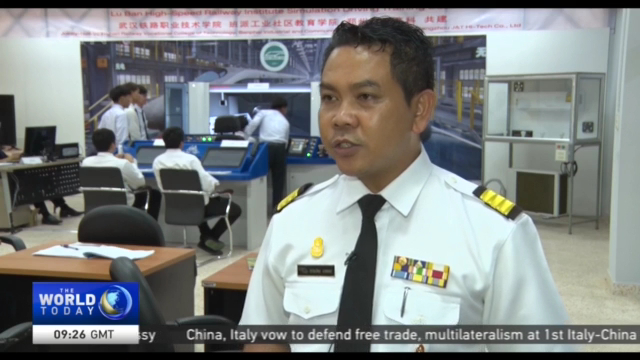
A new breed of train drivers is under instruction in Thailand to operate the country's first ever high-speed network. Before the trains are delivered, they've been using virtual reality to learn. Martin Lowe explains.
For these future train drivers, this is a first glimpse of what it will be like to hurtle along at speeds of up to 250 kilometers per hour.
Flight simulators have been in use for decades – now the technology's been adapted to instruct drivers of high-speed trains.
These students are preparing for Thailand's first high-speed network, being built in partnership with China. In the future they'll travel to China to drive actual trains but for now, this is as close to the real thing as they can get.
ATITHAN NAMBUDDEE LEARNER DRIVER "I hope to be one of Thailand's first high-speed train drivers, it will be so much faster than normal trains and much more convenient than flying."
ASAWIN CHAINILPAN LEARNER DRIVER "I can learn on a virtual train, how to drive, how to stop at a station."
The simulator's the centerpiece of the Lu Ban High-Speed Railway Institute at Khon Kaen in northeast Thailand established to teach drivers and engineers how to operate the new trains. The institute's a co-operation between Banphai College in Thailand and the Wuhan Railway College in China.
THAMPAPON KETNOK, DIRECTOR LU BAN HIGH-SPEED RAILWAY INSTITUTE "Students learn how to drive and solve problems – starting the train, stopping, doors not closing, obstacles on the track, birds and tree branches hitting the cab, even someone running in front of the locomotive."
MARTIN LOWE KHON KAEN, THAILAND "At the moment the average speed of Thai trains is just 40 kilometers per hour. The new high-speed trains will travel up to six times faster than that, so for the drivers, there's a lot to learn!"
The 12 billion U.S. dollar Thai network is a joint scheme with China which already has an extensive high-speed system and is a key part of China's Belt and Road mega-project to connect Asia, Africa and Europe.
Driver training will take two to three years to coincide with the planned opening of the network. Martin Lowe, CGTN, Khon Kaen, Thailand.