
19:40, 29-Jan-2019
Australia's Toad Problem: Poisonous amphibian poses major ecological challenge
Updated
22:50, 07-Feb-2019
 []
[]
Share







Copied
03:22
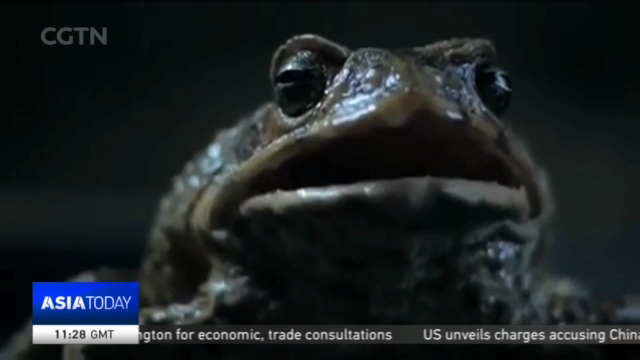
When cane toads were first introduced in Australia to manage a crop beetle 80 years ago, no one could have imagined the impact they'd have on the country. Today, there are millions of the poisonous amphibians and they pose a huge environmental and ecological threat. And so far no one has figured out how to get rid of the invasive pests. Greg Navarro explains.
The styrofoam container inside a Brisbane lab is filled with frozen cane toads - sent to scientists who are working on a way to get rid of them.
PROFESSOR ROB CAPON INSTITUTE FOR MOLECULAR BIOSCIENCE, UNIVERSITY OF QUEENSLAND "This is a first shot across the bow in the value of chemical ecology."
A toxin from the toads is extracted, blended and dripped onto bait. It's used to draw cane toad tadpoles into a container, where they are captured and killed.
PROFESSOR ROB CAPON INSTITUTE FOR MOLECULAR BIOSCIENCE, UNIVERSITY OF QUEENSLAND "We think that taking out hundreds of thousands or even millions of poisonous tadpoles is an end in itself because those were poisonous tadpoles that had the capacity to poison aquatic life - they are taken out."
But the groundbreaking process, developed at the University of Queensland, relies on the public to catch adult cane toads and send them to the lab.
Killing hundreds of thousands of tadpoles may sound like a lot, until you consider that female cane toads can produce up to 40,000 eggs at a time, and there are millions of the poisonous amphibians across the country.
Cane toads were introduced to Australia from South America eight decades ago to eat sugar cane beetles that threatened the Queensland crop.
GREG NAVARRO BRISBANE "The problem with that initial failed experiment is that nobody really thought through the fact that cane toads are not prolific jumpers and didn't have the ability to reach those beetles on the sugar cane, the very beetles they were brought in to eradicate."
Instead, the toad population exploded, each one equipped with a toxin that is used to deter hungry predators.
PROFESSOR RICK SHINE, BIOLOGIST MACQUARIE UNIVERSITY "There are no native toads in Australia so our native predators can't deal with that poison, so we get massive mortality. 90% and 95%, these big predators are killed within a few months of the toads arriving so it is a catastrophe."
The amphibious invader has also become a cultural icon. Featured in movies and TV ads and over the years, finding creative ways to get rid of cane toads has become something of a sport.
PROFESSOR RICK SHINE, BIOLOGIST MACQUARIE UNIVERSITY "There was something about the toad being an alien and not belonging here that really seemed to reinforce this remarkably strong hatred."
Some native animals have learned not to eat the poisonous toads, and their numbers have rebound over time.
PROFESSOR ROB CAPON INSTITUTE FOR MOLECULAR BIOSCIENCE, UNIVERSITY OF QUEENSLAND "Today we look around us and see some of the wildlife but imagine what the wildlife looked like before the toads got here and caused the chaos that they have done."
Some politicians have proposed cash for cane toads schemes to help reduce the population. And while the science being used here is impressive.
PROFESSOR ROB CAPON INSTITUTE FOR MOLECULAR BIOSCIENCE, UNIVERSITY OF QUEENSLAND "To be really blunt it is not going to eradicate cane toads."
There's still nothing stopping these creatures from creating chaos as they continue to move across the country. Greg Navarro, CGTN, Brisbane.