
19:58, 27-Jun-2019
Short Video Market: Rising market promotes China's diverse cultural heritage
Updated
17:06, 09-Jul-2019

Share






Copied
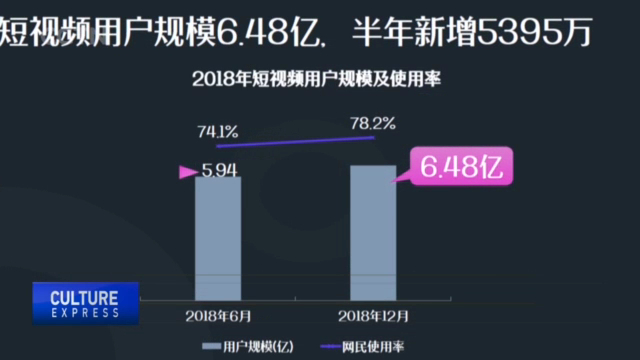
As smartphones become ever more present, SHORT VIDEOS are gaining popularity among Chinese internet users. By the end of 2018, China's internet users reached 725 million, and 650 million of them were avid viewers of short videos. With the emergence of 5G networks and other advanced technology in the country, short videos are expected to grow exponentially. Let's head to an industry event in southwest China to check out the latest trends.
For the more than 700 million Internet users in China, short video content has become one of the most popular services, second only to instant messaging.
Short videos are most popular among teenagers and people in their 20s. But the consumer base is expanding to older generations, as people in their 40s and 50s begin to take a liking to the rich and varied content of short videos.
ZHOU JIE, DEPUTY SECRETARY-GENERAL CHINA NETCASTING SERVICES ASSOCIATION "It's a bit of a surprise that short videos have overtaken conventional video programming, such as TV and films. Short videos have become the most popular content provided on the Internet. Over a space of just six months, the number of users soared by nearly 54 million. This is truly impressive. In terms of market expansion, last year short videos saw its share grow by sevenfold. Certainly, short videos are here to stay. Chinese Internet users just love them."
The change in viewers is driven by the improving quality of short video content. In addition to the entertaining and spectacular, short videos have become a source of information and knowledge for viewers. With the variety and brief format, short videos are effective at arousing people's curiosity.
ZHOU JIE, DEPUTY SECRETARY-GENERAL CHINA NETCASTING SERVICES ASSOCIATION "To be sure, we cannot expect to learn all our facts and viewpoints from the short videos on the Internet. But there's no denying that short videos present fresh ways for us to explore the world around us."
Short videos are playing an increasingly vital role in promoting China's traditional culture. Historic relics and artifacts are being presented in more accessible and interesting ways.
According to the latest statistics, ink wash paintings, local operas, instrumental music, martial arts, tea ceremonies and traditional crafts are among the most watched content. Using their smartphones, people can take advantage of their spare time to admire content ranging from literature lectures to age-old stage arts.
CHEN HAIFENG TRADITIONAL CULTURE CONTENT SUPERVISOR AT TIKTOK "When it comes to cultural content, we cannot just blindly follow the latest trend or confine ourselves to a particular category. It's most important to pick the most suitable form for the content. Take bamboo umbrellas for instance. In conventional print media, the editors and writers might present the craft with nothing but text and graphics. Such a story may have to be told using thousands of words. By contrast, with a video of no more than forty seconds, viewers can see a more vivid portrait of the craftsman. They can experience and participate in the master's distinctive process of making umbrellas. Short videos can involve viewers."
According to Chen Haifeng from TikTok, as of April 2019, his company has hosted short videos about more than 13 hundred national cultural heritages. And the project has generated over 24 million original video clips.
CHEN HAIFENG TRADITIONAL CULTURE CONTENT SUPERVISOR AT TIKTOK "Apart from the technology and storytelling skills, the intent is also very vital in making short videos. I believe the goal is to bring our traditional culture to young people born in the 1990s and 2000s. We're trying to make young people recognize the value in these traditional crafts and their cultural significance."
Short videos are also transforming the dynamics of China's intangible heritages. Especially in rural areas, local residents have found economic benefits in sharing the natural scenery and traditional crafts of their hometowns. And local governments are integrating cultural-themed short videos into their poverty relief endeavors. CGTN.