
Opinions
16:41, 27-Jan-2018
Opinion: China strives to become a constructive partner in Arctic affairs
 ["china"]
Share







Copied

Dramatic changes, mainly caused by global warming and globalization in recent decades, have been evident in the Arctic. The peace and stability of the Arctic, scientific research in the region, potential business opportunities and international governance have sparked widespread attention and debates around the globe.
Unfortunately, many of China’s moves relating to the Arctic have been met with suspicion in light of its population size and its status as one of the largest consumers of oil and natural gas products. The "China threat" has become a hot topic that is highlighted in the media worldwide. It's also discussed in scholarly arguments that have misinterpreted China’s involvement in the Arctic.
In a newly published white paper on China’s Arctic Policy, China is defining itself as an important stakeholder in the Arctic, which reflects the fact that China has many interlinks with changes in the region, rather than a political decision.
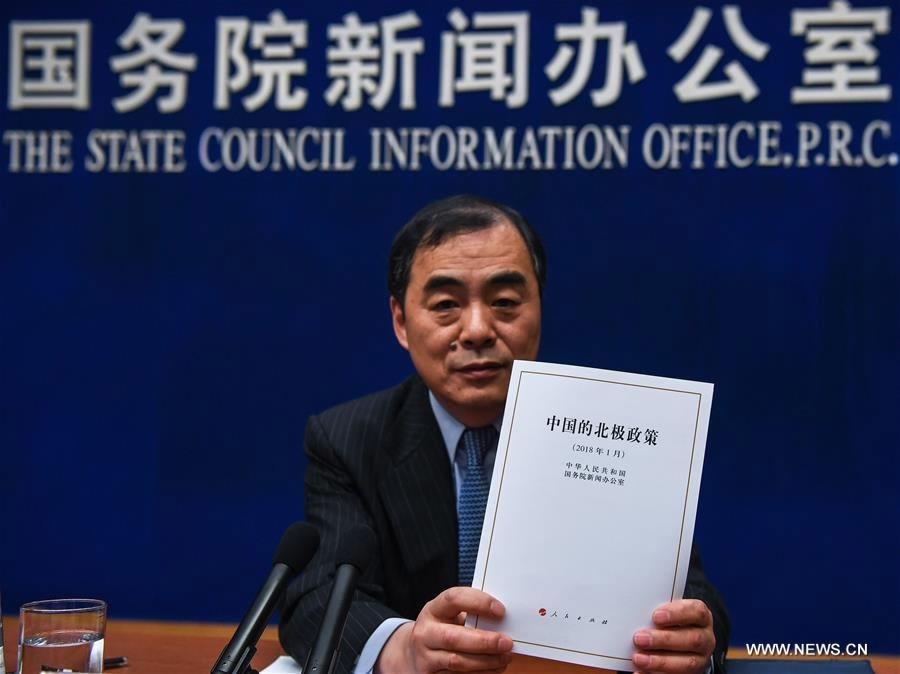
Chinese Vice Foreign Minister Kong Xuanyou shows a white paper on China's Arctic Policy during a press conference in Beijing, capital of China, on January 26, 2018. /Xinhua Photo
Chinese Vice Foreign Minister Kong Xuanyou shows a white paper on China's Arctic Policy during a press conference in Beijing, capital of China, on January 26, 2018. /Xinhua Photo
In fact, China can geographically be considered to be a near-Arctic state as its northern region borders Russia, one of the biggest Arctic states. Sitting downstream from the Arctic's climate system, northern China's climate, biological and environmental systems are directly affected by changes in the Arctic. In practice, China is already attached to Arctic governance.
China is an active player in scientific research and cooperation relating to the Arctic, and Chinese experts have been active in the research projects of several groups under the Arctic Council. China is playing an important role in balancing the interests of development and protecting the fragile Arctic environment. On economic development, China’s funds, markets and proficiency relating to infrastructure construction and resource exploitation are highly valued by some Arctic countries.
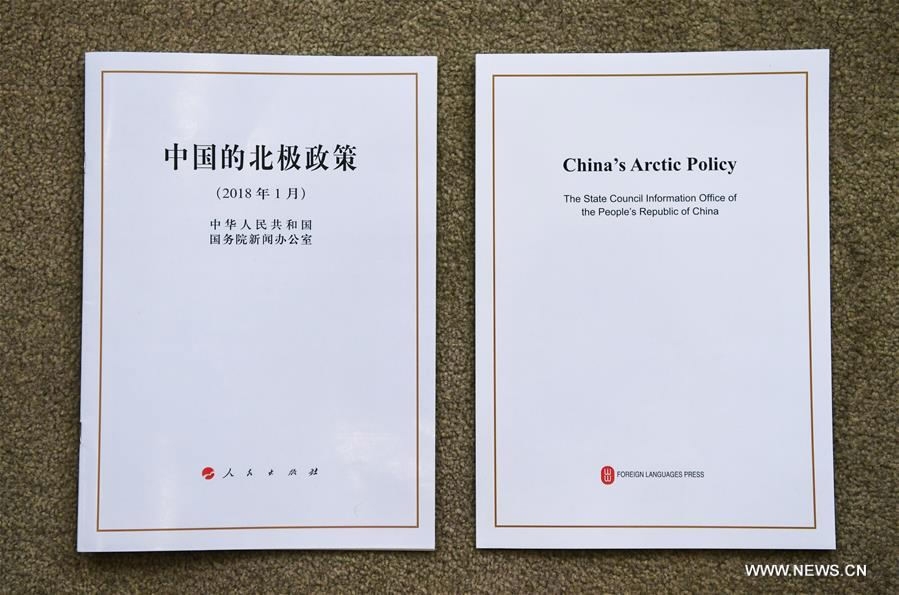
January 26, 2018: The Chinese and English editions of the white paper on China's Arctic Policy in Beijing, capital of China. /Xinhua Photo
January 26, 2018: The Chinese and English editions of the white paper on China's Arctic Policy in Beijing, capital of China. /Xinhua Photo
"Respect" is one of the keywords of China’s policy. The Arctic is completely different than the global commons; it includes areas beyond the national jurisdiction of Arctic states, and spaces directly or indirectly under their sovereignty. Interests of Arctic states and lawful concerns of other stakeholders are not in opposition, but require coordination and integration.
Chinese President Xi Jinping's new approach to global governance – including the idea of community with a shared future for mankind, the Belt and Road Initiative and the principles of cooperation in new frontiers – are well explained in the white paper.
China has redefined the relationship between the interests of Arctic states and the lawful concerns of other stakeholders, calling all players of Arctic affairs to find a balance between human involvement and protecting the region's environment. China has also confirmed its vision of a peaceful and sustainable Arctic region to ensure it becomes an example of "win-win" cooperation instead of confrontation.
(Zhao Long is an associate professor at Shanghai Institutes for International Studies. The article reflects the author's opinion, and not necessarily the view of CGTN.)