
Politics
22:07, 19-Oct-2017
Rule of law in focus at 19th CPC National Congress
 ["china"]
Share







Copied
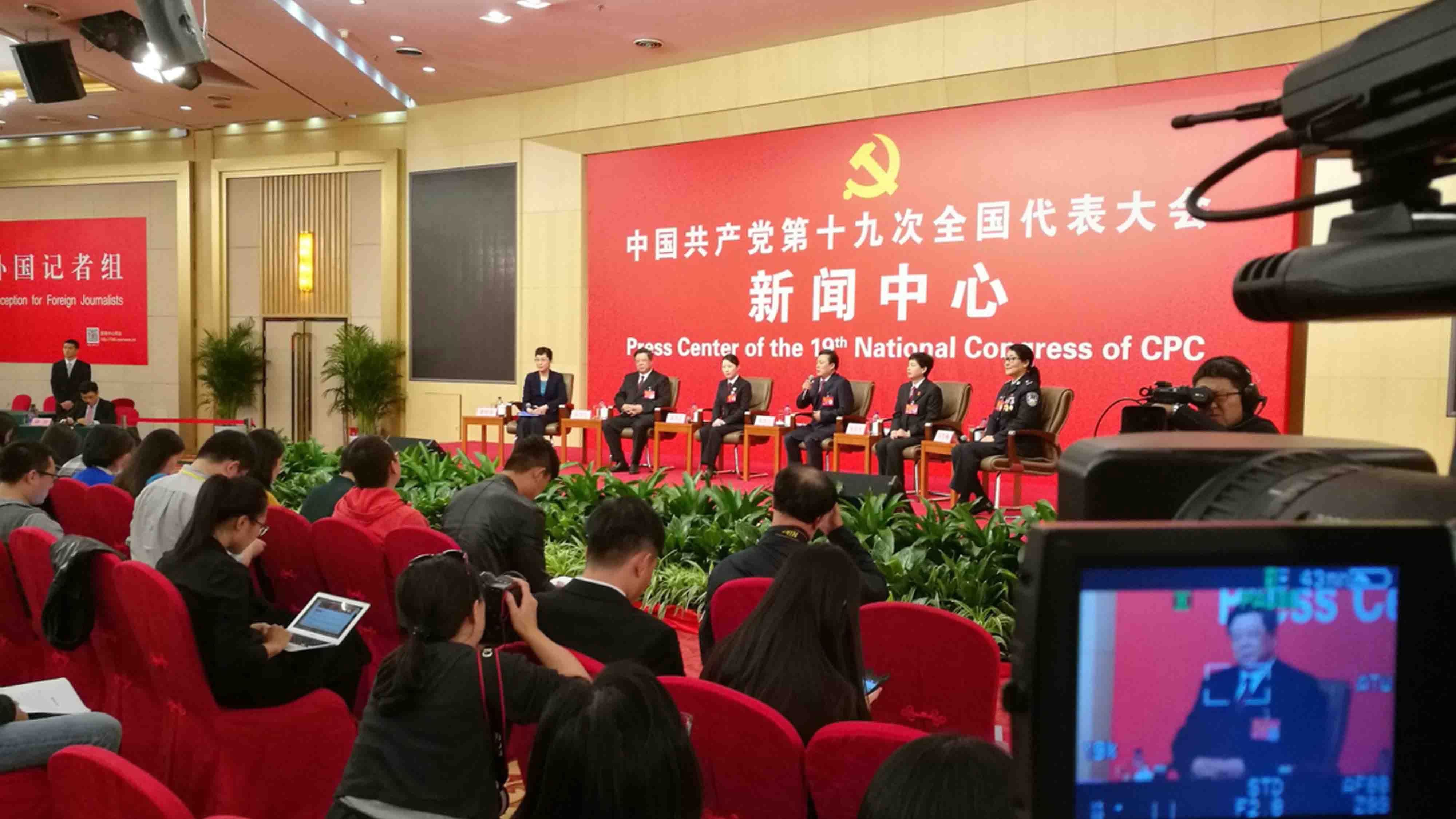
The importance of the legal system and rule of law to strengthen Chinese society was on the agenda of the 19th National Congress of the Communist Party of China (CPC) on Thursday, thanks to a group interview with five delegates involved in the legal system in different parts of the country.
Xi Jinping, General Secretary of the CPC Central Committee, has consistently urged reform of the country's judicial system to follow the path of socialist rule of law with Chinese characteristics.
Discussing their own experiences of working in the grassroots, the delegates explained how strengthening the rule of law will ensure that all Chinese are equal before it.
Legal reforms since 2012 have made the environment increasingly lawyer-friendly, according to Xue Jimin, deputy secretary of the CPC Committee of Jiangsu Bar Association and the company's president. He noted that an expanded legal service network has benefited more people across the country.

Xinhua Photo
Xinhua Photo
"I took the job since 1986, so I witnessed the development of Chinese lawyers group," said Xue. "From 2013 to 2016, the the number of Chinese lawyers has increased to 326,000, the number of law firms have also reached to 26,000. We have achieved the goal of Deng Xiaoping's initiative on the construction of a well-off society to have 300,000 lawyers."
Xi has also called for modern technology to be a part of the judicial reform, an issue that was extolled by Song Yushui, head of the Political Department of Beijing Intellectual Property Court. She urged the extension of online courts to efficiently cover more of China’s 1.3 billion people.
Zhu Guangyuan, deputy secretary of the CPC Jiangsu Provincial Committee for Political and Legal Affairs, said authorities in east China's Jiangsu have been enhancing infrastructure and increasingly using high technology, handling equally serious offences and small crimes, and mobilizing the general public to increase awareness.
Advances in technology were not limited to the use of AI or online courts, but also the accuracy of forensic criminology.
Senior coroner Tian Xuemei told journalists that science safeguards justice. Technological improvement has enhanced the accuracy of examining evidence, she explained, and increased awareness of the risks of miscarriage of justice.
Shi Jinglan, senior prosecutor in Shanghai, explained the checks and balances in China's legal system. She said the prosecutors, the courts, and the police have been working effectively to spot discrepancies, while Tian added that it was increasingly common for evidence to be returned by prosecutors.
Song said coordination between the three divisions was essential, and a system has been put in place to ensure that misconduct at every stage is corrected.
Addressing the protection of lawyers' rights in China, Xue said the protections had improved over his three decades in the profession. He added that regulations had been put in place to safeguard the rights of China’s 340,000 professional and registered lawyers to question evidence.
(CGTN's Su Yuting also contributed to this story.)