
13:51, 26-Mar-2019
Reshaping China's Economy: Migrant workers, engineers and robots
Updated
13:50, 29-Mar-2019
 []
[]
Share







Copied
07:07
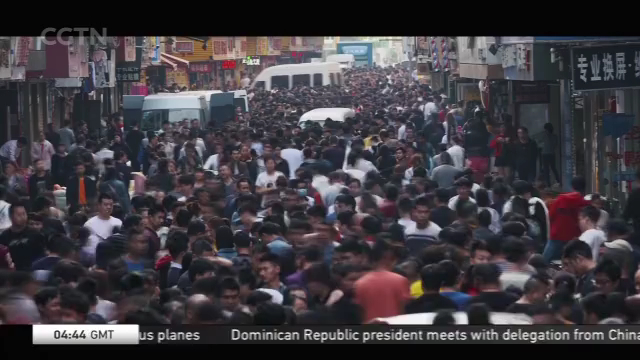
Though China's slowdown is part of a natural cycle, that doesn't mean it's completely risk free. Without the hard-working migrant workers in the manufacturing and construction sectors, the phenomenal success of China wouldn't have been possible. But now as they become increasingly expensive, how can China handle the rising labor cost? Let's follow our reporter Ge Yunfei to China's southern Guangdong Province in the second episode of the CGTN special series, "RESHAPING CHINA'S ECONOMY".
Migrant workers, the silent, resilient and hard-working people. They helped create China's economic miracle over the past four decades. Hundreds of millions of peasant workers left their farmlands to work in factories and on construction sites. It is the biggest human migration in history.
They are driving the most massive urbanization process the world has ever seen. But now the cheap labor force is aging and getting more expensive, with the average wage increasing more than 50% over the past six years. And the change has been felt strongly in the south, which has the biggest number of migrant workers.
I came to Datang Village, an urbanized area hidden in downtown Guangzhou, the provincial capital. Hundreds of garment factories and workshops in the alleys make the village a garment-making center of the region.
Early every morning, factory representatives gather here trying to find new workers. Some even offer the price of 10,000 yuan a month, three times the average wage of migrant workers.
Doing business is hard. Even on the bulletin boards, I see at least half of the posters are owners trying to sell their factories and workshops.
GE YUNFEI GUANGZHOU "Without the hundreds of millions of migrant workers, China's 40 years of economic growth wouldn't have been possible. The fruits of their labor are evident in southern China's Guangdong Province, making the region a global manufacturing hub for the world. But facing rising labor costs, the factory owners only have three options: die, change or leave."
Some choose to embrace the change with the robots and innovation. Li Shengli is now running a cashmere clothing factory in Dongguan, a city famous for making smartphones and garments for the world.
LI SHENGLI, CEO INIGIO CASHMERE CLOTHING "In three years, it'll be totally different here. Automated machines that can weave clothes will fill this room."
Reporter: "Now you have over 200 workers. How many will you need at that time?"
"60 people."
With the rising labor costs, more and more Chinese manufacturers are using robots to replace humans. That makes China the biggest market for industrial robots. And 27% of them are made domestically. For Li Shengli, the transformation from humans to robots has really worked wonders.
LI SHENGLI, CEO INIGIO CASHMERE CLOTHING "In ten years, our revenue grew from 10 million yuan to over 100 million yuan. Now we have over100 chain stores across China, because of the breakthrough we've made in smart manufacturing."
Some stay, some go. With the uncertainties of trade frictions between China and the US, many manufacturers are leaving China for other lower-cost countries to find cheaper labor.
HARLEY SEYEDIN, PRESIDENT THE AMERICAN CHAMBER OF COMMERCE IN SOUTH CHINA "Energy-intensive, labor-intensive products will naturally move to other markets. It happened to Hong Kong, even South Korea, as they transition their economy from export manufacturing to consumer based economy. We expect some industry's moving out, but we also expect many many new industries are moving into China to take advantage of China's growth in this market."
One of the new industries is here on the outskirts of Guangzhou. Foxconn, the iPhone manufacturer, is reshaping itself as a technology giant instead of just assembling smartphones.
GE YUNFEI "From there to there, those factories all belong to the mega project with a size of 200 standard football fields. It's hard to imagine that two years ago, this place was still a barren land. Within six months, it'll make the world's most advanced big-screen panel displays."
Amid the reports that the company might be moving its iPhone manufacturing out of China, Foxconn is building its future here, a 9.1 billion US dollar display production center, the company's biggest-ever investment on the Chinese mainland. 15 thousand engineers will be working here to make displays with 8k resolutions. And 50 thousand more postgraduates will be recruited.
PROF. YAN SE GUANGHUA MANAGEMENT SCHOOL, PEKING UNIV. "China's skilled labor cost is one of the lowest around the world. Chinese engineers are highly productive, extremely hard working and relatively less expensive. This is what we call China is switching from the demographic dividend of quantity to quality."
For China, a golden era of relying on cheap labor to boost growth is over. But still it has the world's largest pool of skilled labor force. More than eight million college graduates come out of universities every year. They're the biggest asset for China to win the high-tech future. But before achieving that goal, it has an urgent problem to solve: debt. In the next episode, I'll go to the third tallest skyscraper in the world to see how the surging debt has been mounting? Ge Yunfei, CGTN.