
14:01, 03-Jul-2019
World Economic Forum: Challenges remain as China promotes clean energy vehicles
Updated
16:56, 09-Jul-2019

Share






Copied
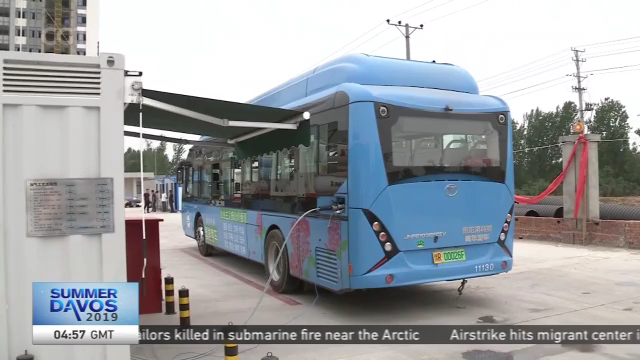
Promoting clean energy vehicles is one of the major topics during this year's Summer Davos forum. And while China has increasingly decided to promote methanol-fueled vehicles and hydrogen-powered cars, there are still many challenges ahead. CGTN's Wu Lei has more.
More clean energy vehicles mean less air pollution. One of the latest examples is in China's northwestern city of Xi'an, where local officials say they have put 10 thousand methanol-fueled taxis on the road, accounting for over 80% of the city's total number of taxis. And with technology advancements, China's Geely Group is now expanding to offer more methanol-fueled commercial vehicles.
LIU GUOQIANG, VICE PRESIDENT GEELY COMMERCIAL VEHICLE GROUP "China is rich in coal, while poor in petroleum. It is easier to produce methanol from coal, so methanol-fueled vehicles will be more popular in coal-rich areas."
Methanol is indeed a clean-burning fuel, but it's far more difficult to ignite than gasoline and burns about 60% slower. Experts say Chinese automakers need to greatly improve its efficiency.
PROFESSOR YAO CHUNDE STATE KEY LABORATORY OF ENGINES, TIANJIN UNIVERSITY "Methanol is very corrosive, hard to combine with diesel, and difficult to be ignited by compression. But as long as automakers focus on how to make its compression-ignition much easier, they will overcome the challenges."
So far there are 9 automakers producing methanol-fueled vehicles in China, with over 30 different vehicle models on the road.
WU LEI HANGZHOU "After a 5-year trial, China started widely promoting methanol-fueled vehicles nationwide in March. Experts say it shows the country's broader efforts to relieve environmental pollution and reduce its dependency on imported petroleum."
And the hydrogen-powered vehicle is also known for its clean and environmentally-friendly qualities. Many Chinese manufacturers have heavily invested in its research and development, but they say they need more related infrastructure to boost its expansion.
LIU GUOQIANG, VICE PRESIDENT GEELY COMMERCIAL VEHICLE GROUP "One of the biggest challenges is lack of basic facilities for adding, producing and storing hydrogen, which needs more time to process."
Liu said their hydrogen-powered vehicles will first be deployed for public traffic and logistics, which rely on fixed routes and stable stations. With only dozens of hydrogen stations in China, experts say it will require more reform to lower the cost and promote the vehicles from public to private use. WL, CGTN, HZ.