
21:44, 04-Apr-2019
Fortune Favors the Fold: Companies race to gain edge in flexible phone market
Updated
21:40, 07-Apr-2019
 []
[]
Share







Copied
03:19
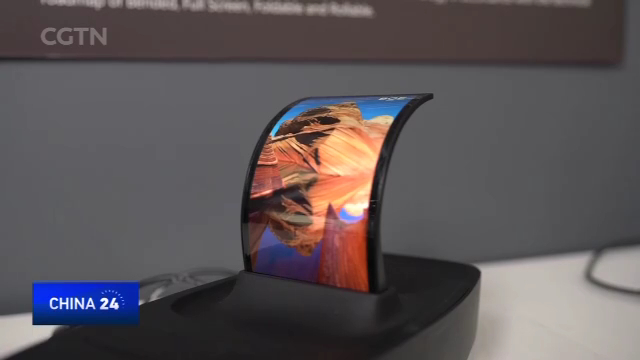
Well, it's been said that what's old is new. Case in point, flip-phones are making a comeback more than a decade into the smartphone era. CGTN's Xu Xinchen reports.
From Huawei to Samsung, and even Apple in the future, flip phones are back. But you're better off calling these ones foldable phones, a regular smartphone that turns into a tablet doubling the size of the screen in a second. Yet, to be able to produce such a device, the key is having a screen that can bend. Such screens are now produced by Chinese firm BOE.
"The screen illuminates on its own upon activation. It will be totally dark when switched off and really bright when back on."
In addition to being more power efficient with better image quality than traditional LCD screens that depend on backlights, it can enhance media experience as people spend more and more hours on digital devices.
QIN XIANGDONG, VICE GM CHENGDU BOE OPTOELECTRONICS TECHNOLOGY CO. "We use smartphones often for entertainment, watching videos and browsing social media. The screen is usually around 6 inches, very small, it could tire our eyes easily. However, if we can unfold the screen making it into a much bigger tablet. Not just eye comfort will improve; the whole experience will also improve."
XU XINCHEN CHENGDU "OLED or organic light emitting diode is the core technology behind flexible screens, while Chinese firms like BOE are now capable of producing many of them, the global OLED market is still dominated by Korean firms. The market for OLED is promising, yet, the competition is equally fierce."
According to industry reports, LCD screens took up two-thirds of the smartphone market in 2017, but that number is falling fast, and smartphones are expected to be primarily made with OLED screens by 2021, an industry worth some 30 billion US dollars globally. But still, today's flexible and foldable screens are basically all made by Samsung, accounting for over 95% of the market share.
ZENG LIAOYUAN, ASSOCIATE PROFESSOR UNIVERSITY OF ELECTRONIC SCIENCE AND TECHNOLOGY OF CHINA "Behind flexible screens is not just the screen itself. And the technology and raw materials are not just coming from one single country."
While Professor Zeng is excited about China's OLED technology capabilities, he says Samsung has its perks in terms of the design, management and marketing of its products.
ZENG LIAOYUAN, ASSOCIATE PROFESSOR UNIVERSITY OF ELECTRONIC SCIENCE AND TECHNOLOGY OF CHINA "As China's technology capability edges up with the government and industry spending huge money for research and development, Chinese firms can now compete globally. And the competition is really about how Chinese firms manage supply chain and skilled workers, and how they can learn from mistakes and improve."
BOE will be able to produce 140 million sheets of flexible screens per year once its two factories in Sichuan are put to full throttle, bringing in an estimated 3 billion US dollars, a much larger share compared to today. In order to make that happen, the firm is also investing a large portion of its revenue into R&D, including those with supply chain partners. Xu Xinchen, CGTN, Chengdu.