
13:44, 23-Jun-2019
Perspectives for Peace: How significant is US plan for Israeli-Palestinian relations?
Updated
17:13, 09-Jul-2019

Share






Copied
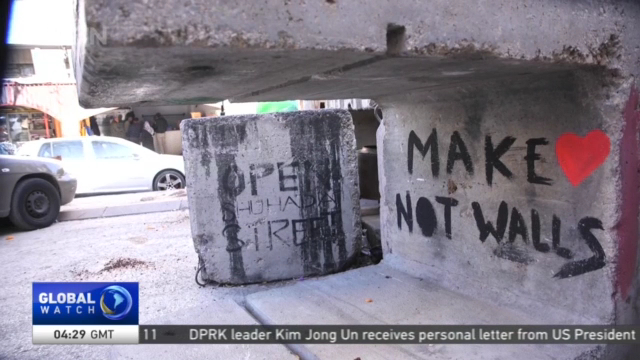
Pop-up military checkpoints, violent attacks, nowhere to turn. That's the reality for Palestinians living in Hebron--the West Bank epicenter of the Palestinian-Israeli conflict. For a 25-year-old Palestinian woman living there, how significant is the US plan for Israeli-Palestinian peace? In the conclusion of our series, CGTN correspondent Stephanie Freid takes us to meet Sundos, a young woman who says she hopes for peace and plans for escalation.
SUNDOS AZZA PALESTINIAN WOMAN LIVING IN HEBRON "They attacked all my family, they attack us physically, they are throwing stones, they are throwing dirty water, wine bottles, some of them empty some of them full. All the Palestinians who live in this area were attacked by Israeli settlers or even Israeli soldiers."
The political complexity of Sundos' life becomes clearer on her rooftop. From this vantage point, there's a clear view of an Israeli military guard post, an apartment building occupied by Jewish settlers and Baruch Marzel's home.
Marzel is notorious for his role as a terror group leader and for multiple, violent attacks on Palestinians. All three are perched on a hilltop overlooking the Azza family home which is why they erected a wire canopy over the entrance.
SUNDOS AZZA PALESTINIAN WOMAN LIVING IN HEBRON "All the attacks happens to my family or to all the families they put a pressure on us to leave our houses. They are trying their best to kick us out from our houses."
Sundos lives in Hebron's H2 city center - one of an estimated thirty-four-thousand Palestinians living alongside some seven hundred Jewish settlers. Israel's army controls H2. For Palestinians that means multiple & pop-up checkpoints, random nightime raids and settler violence.
SUNDOS AZZA PALESTINIAN WOMAN LIVING IN HEBRON "It's not allowed at all to use violence or even to fight back even if someone attacked us it's not allowed to attack them back because we will be in the prison."
Jewish settler movement is unrestricted.
SUNDOS AZZA PALESTINIAN WOMAN LIVING IN HEBRON "I can't live with them at all. The neighbors, the settlers who is living next to us, I can't think or believe that I will be with them or live next to them all my life. I don't want to be next to them."
Her options are limited - especially when factoring in recent statements from Israel's Prime Minister and the U.S. Ambassador to Israel about annexing the occupied West Bank. A peaceful future doesn't seem close at hand.
SUNDOS AZZA PALESTINIAN WOMAN LIVING IN HEBRON "The situation is getting worse and worse. If they want peace they will not put more and more checkpoints. They will not do really bad things for us."
She says she's an eternal optimist when it comes to peace, but her personal plan is to get a Master's degree abroad and eventually settle in a place where she can, quote, 'be free'. Stephanie Freid, CGTN, Hebron.