
18:34, 25-Apr-2019
National Treasures from Afghanistan: Exhibition reveals rich culture at the crossroads of East and West
Updated
18:30, 28-Apr-2019
 []
[]
Share







Copied
03:19
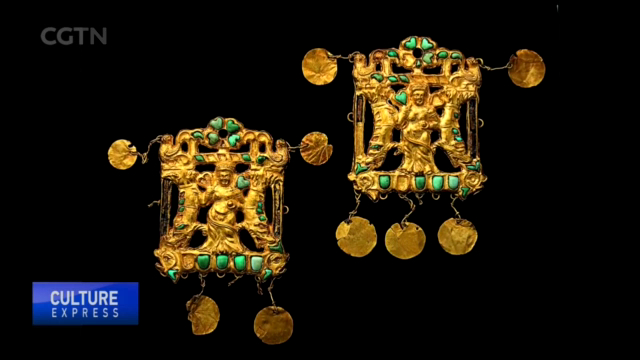
Meanwhile, an exhibition entitled "Utensils and Ornaments Endlessly Fine" is also underway in Beijing, showcasing national treasures from Afghanistan. These artifacts, that escaped the war and political chaos back home, have TRAVELED around the world since 2006. Our reporter Ding Siyue has the story.
A visual feast at the Tsinghua University Art Museum. The exhibition showcases over 230 precious items, which illustrate the development of the central Asian country between the third century BC and the first century. Golden objects are the biggest attraction, and many of them contain Chinese elements.
TAN SHENGGUANG CURATOR "We want to emphasize Chinese elements in the exhibition. For example, in a gold ornament here, we can see there are two fish at the lower part and two birds above. In between, there is a human surrounded by two dragons. This structure is exactly the same as this silk painting found in the Mawangdui Han Dynasty Tomb."
Afghanistan boasts a long history of over 5,000 years. It was also a major stop on the ancient Silk Road. Exchanges between China and Afghanistan can be dated back to more than 2,000 years ago, when envoy Zhang Qian of the Han Dynasty travelled there during his first mission.
TAN SHENGGUANG CURATOR "Afghanistan is a very unique area that can infuse many kinds of culture. It has nomads to the north, China on the east, India to the south and Iran on the west. All the cultural elements formed the multi-cultural character of Afghanistan."
Due to the turbulent situation in Afghanistan beginning in the 1970s, the protection of cultural relics has been a great challenge for the country.
In 1994, the Afghan National Museum, which housed over 100,000 artifacts, was hit by artillery shells. Some warlords even ransacked the museum and sold the cultural relics overseas to pay for military expenses.
DING SIYUE BEIJING "Since the situation in Afghanistan stabilized in 2003, many cultural relics lost in the war and hidden in various places have been recovered. Through exhibitions, scholars want to show a different side of Afghanistan that is not violent and ruined."
This particular exhibition has toured around the world since 2006, visiting countries including France, Germany, and the United States.
DU PENGFEI STANDING DEPUTY EXECUTIVE DIRECTOR TSINGHUA UNIVERSITY ART MUSEUM "China joined the relay in 2017. The exhibition first met Chinese audiences at the Palace Museum in Beijing, and travelled to many cities, including Dunhuang, Zhengzhou, Shenzhen, and Chengdu. And this time, we feel very happy to have the opportunity to join the relay in protecting and displaying these treasures."
The Tsinghua University Art Museum has added a section to the exhibit, displaying related archives and even the boxes that have carried the artifacts around the world.
The exhibition not only showcases the splendid culture at the crossroads of the East and West two thousand years ago, but also serves as an important symbol of post-war cultural renaissance in Afghanistan, helping visitors to remember the past, reflect on the present and explore the future. DSY, CGTN, BJ.