
17:07, 07-May-2019
Heart-Warming Letters: China's left-behind children form friendships with pen pals
Updated
17:00, 10-May-2019
 []
[]
Share






Copied
03:44
"Left-behind children" have long been a thorny issue in China, as the country ramps up efforts to expand urbanization. Millions of children are left at home in rural areas, usually with elderly family members, while their parents move to the cities for jobs. A Chinese NGO – known as Blue Letter – has been helping these children in a unique way. CGTN's Li Jianhua reports.
For most, writing letters by hand has been something of a bygone era. but here, about two thousand letters are coming in and out every day.
These letters are connecting China's left-behind children – who don't get to see their parents often - and over 10-thousand volunteers nationwide.
Started some 11 years ago, the organization Blue Letter sends out 200-thousand letters a year. The aim is to create a welcoming space for the children to express themselves.
ZHOU WENHUA FOUNDER, BLUE LETTER "We're not teaching these children how to behave. All they need is some company. The volunteers talk to them on an equal basis, and the quality of empathy is also quite important in a volunteer. More importantly, these children tend to imitate, so if you'd like to share your life and experiences with them, they are more likely to open their worlds to you."
Most children are from central China, whose economy is comparatively weaker, prompting more rural workers to relocate to urban areas. Over the next three years, Blue Letter is planning to reach out to 1,000 schools where left behind children study.
We visited one of the volunteers, a college student in Guangzhou. She has been writing to a child in central China's Hunan province over the past year.
ZHOU JIAMIN VOLUNTEER PEN PAL "This is very new – college students and left-behind children writing letters to each other to help the children deal with their difficulties in life. Being an only child, I myself met some problems in my social and school life when I was a kid, but I didn't have anyone older who could help me. Now I can help these children as an older sister."
Volunteers read the letters from the other end online, and the only means allowed for the two parties to communicate is by writing letters.
We drove all the way to the place where the child lives.
LI JIANHUA HUNAN "Now I'm on my way to the home of the left-behind child. Usually, the letter is uploaded online, printed out and delivered to the school where the child studies. But now, I have the privilege of delivering the letter personally. It's all sealed and confidential."
It was during the May Day holiday, and the child was at home with no school, in a remote village tucked away in the mountains.
"I've brought you the letter. I believe you never met the one whom you've been writing letters to."
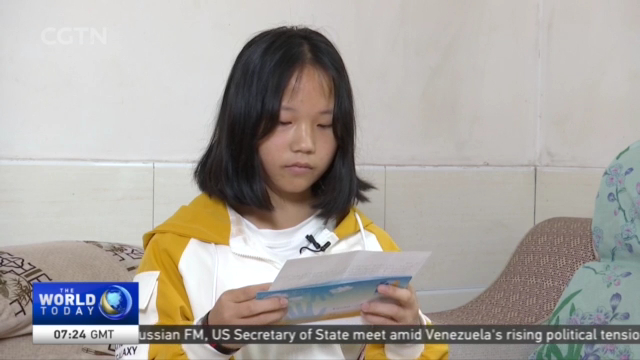
Contrary to what one may have guessed, Tan Xiaojiao seems to be well adjusted to her life at home, living with her grandmother without her parents most of the time.
She imagined her "pen pal" to be someone who's "charismatic and very kind", someone who's been helping her cope with difficulties at school.
TAN XIAOJIAO LEFT-BEHIND CHILD "In seventh grade, my teachers told us about this program. Then they submitted the list of left-behind children in class. That's how I joined. I feel happy and comfortable every time I finish a letter. I guess writing letters is a way for me to relax."
Officials figures show the number of left-behind children is nearly seven million.
Some Chinese authorities are vowing to eradicate poverty by next year, and rural areas have been put on top of the agenda. With that comes the hope that these children will no longer be left behind. LJH, CGTN, HUAIHUA, HUNAN PROVINCE.