
13:36, 10-Apr-2019
Images of Black Hole: First ever images of the shadow of a black hole to be expected
Updated
13:30, 13-Apr-2019
 []
[]
Share







Copied
02:20
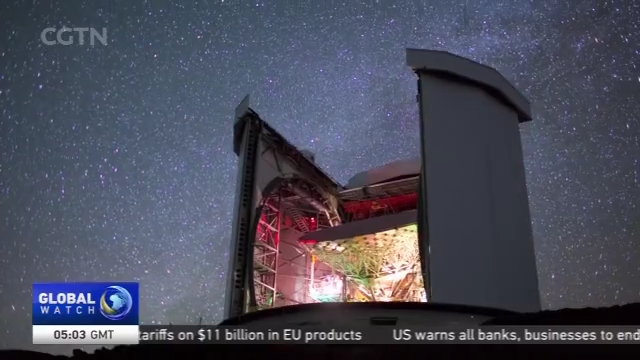
We are expecting to see the very first images ever captured of the shadow of a black hole. The images are being published by the Event Horizon Telescope, a data collaboration from eight different radio telescopes around the world. CGTN's Daniel Ryntjes has more.
DANIEL RYNTJES WASHINGTON "A black hole is defined by NASA as a volume of matter packed into a relatively small area. This matter has a gravitational force that is so strong, even light can't escape and where time and space are warped. Almost exactly a century ago, Albert Einstein studied images of stars which helped him form his general theory of relativity, which predicted the existence of black holes. When stars die he said, they leave behind a core. If that core is three times the mass of the sun, the force of gravity is sufficient to overwhelm all other nearby forces and a black hole is formed. We are expecting to see the very first images ever captured of the shadow of a black hole. We are expecting a pattern of the light that is bent by the force of the black hole but isn't sufficiently close to be immediately sucked in."
DANIEL RYNTJES WASHINGTON "The first of the two black holes is called Sagittarius A* star and it's located at the center of our own galaxy the Milky Way. Its mass is about the size of 4.1 million suns. The other is located within a giant galaxy called Messier 87 and is thought to be seven billion times the size of our sun. The images are being published by the Event Horizon Telescope, a collaboration of data from eight different radio telescopes around the world. They have effectively created a single telescope dish as wide as the Earth. The project is named after the event horizon, the boundary around which matter can no longer escape. Daniel Ryntjes, CGTN, Washington."