
14:47, 04-May-2019
The Ivory Game: Chinese wildlife activist explains what prompted his passion
Updated
14:40, 07-May-2019
 []
[]
Share







Copied
02:51
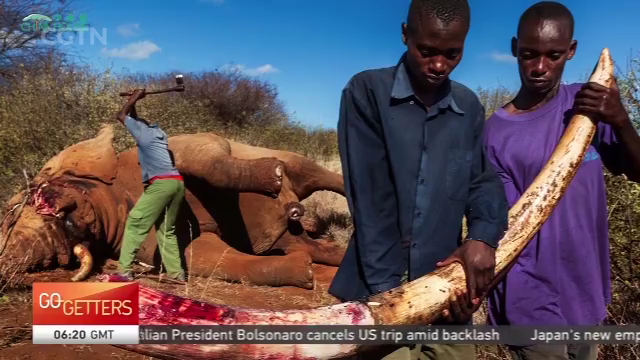
To commemorate the 100th anniversary of the May Fourth Movement, CGTN's Go-Getters series is sharing the stories of China's youth who are trying to make a difference not just in their own country, but also around the globe. Today, our reporter Liling Tan brings us the experience of an ivory protector -- Huang Hongxiang.
Armed with a background in journalism and a love for animals, Huang Hongxiang posed as an ivory buyer to capture a Ugandan dealer in the gripping 2016 Netflix documentary "The Ivory Game".
HUANG HONGXIANG WILDLIFE ACTIVIST & FOUNDER OF CHINA HOUSE "Since I was very young, I already loved animals a lot, so I always wished someday I can do something to help protect animals. And then when in 2013, I got to learn all those ivory trade and elephant poaching in Africa, and then I got to realize China's role in it."
That realization prompted him to address China's appetite for ivory, AND confront misconceptions about the Chinese, topics he readily took on when we attended his presentation at Columbia University.
HUANG HONGXIANG WILDLIFE ACTIVIST & FOUNDER OF CHINA HOUSE "When it comes to ivory trade, many non-Chinese people will feel all Chinese eat dogs, all Chinese buy ivory, all Chinese don't care about elephants and so on because China is the number one ivory market in the world. And when it comes to the Chinese people, they have a lot of misunderstanding as well. Not many of them actually know you need to kill elephants to get ivory. Not many of them know what is wildlife conservation and what are those NGOs. Many Chinese people think that ivory trade is just a tool used by the anti-China westerners to attack China. Sometimes I feel the two sides have a lot of misunderstanding about each other and therefore they are not working together."
But ivory is only the tip of the iceberg.
LILING TAN NEW YORK "I'm here at Times Square, where ivory crushes have been held, big machines that pulverize seized ivory into dust. The U.S. and China have banned the legal ivory trade, but illegal trafficking still persists, as does demand for other illicit wildlife products. That means that Huang's fight extends beyond this 'white gold'."
HUANG HONGXIANG WILDLIFE ACTIVIST & FOUNDER OF CHINA HOUSE "Ivory, where China is the number one market. Rhino horn, China is the second market. Pangolin trade, sharks fin, South African abalone, rosewood, there's so many many issues that are related to China, and for all those issues we wish to get involved because I believe China needs to be part of the solution and we want to be part of that solution."
To do that, Huang in 2014 set up China House in Kenya to connect Chinese overseas investment with sustainable development. It brings young, bilingual Chinese professionals to Africa, Latin America and other developing regions to bridge differences and change the game in wildlife conservation. Liling Tan, CGTN, New York.