
22:32, 21-Mar-2019
Smart Hospital: Chinese hospitals keen on information technology
Updated
22:30, 24-Mar-2019
 []
[]
Share







Copied
02:55
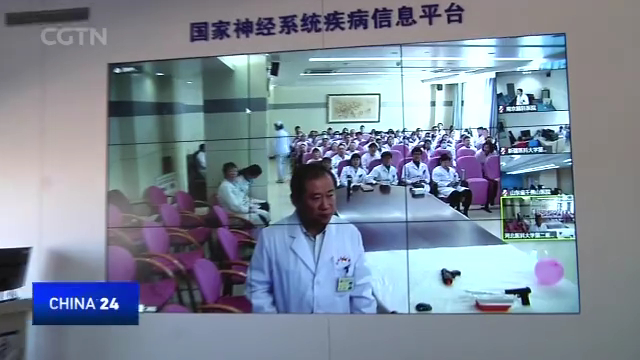
In a world of smart phones, smart cars, and even smart toilets, the next information technology breakthrough may be the smart hospital. Patients can enjoy medical services from their fingertips, and a 5G network can even help surgeons conduct long-distance operations. But China's Health Authority says more work remains in this area. CGTN's Wu Guoxiu shows us what lies ahead.
Open for six months now, New Tiantan Hospital in southwestern Beijing is considered a good model for the government's smart hospital campaign.
ZHOU JIANXIN, DEPUTY DEAN BEIJING NEW TIANTAN HOSPITAL "Through all the outpatient procedures, patients don't need to use cash. Mobile payments, and various kinds of auto services make seeing a doctor very convenient."
Outside the hospital bedroom, nurses monitor patients via two big screens.
One is for their basic information, one for their infusion process.
WU GUOXIU BEIJING "In this smart hospital room, a patient can find his case report, read doctor instructions, and even order food from this pad. This small box is to monitor the infusion process and send it to nurses. The bed pad can monitor the body functions of the patient like their heartbeat. And it costs the same as other regular hospital bedrooms."
China first pursued the "smart hospital" model ten years ago, after seeing the concept in the US.
Hospitals appear eager to try trendy technology.
ZHOU JIANXIN, DEPUTY DEAN BEIJING NEW TIANTAN HOSPITAL "We are discovering how to best apply big data, cloud calculations, and Artificial Intelligence to medical practice. Like surgery robots, bone wearing robots and medical AI robots are on the way. They can be researched and put to use very soon."
Last year China's State Council drafted a document to encourage internet plus medical care. Just a few days ago, the Peoples Liberation Army General Hospital conducted the nation's first long-distance surgery via a 5G network on a human body--with a doctor controlling a surgical robot 3000 kilometers away.
But the health authority takes an attitude of "tolerance and prudence" for such trials.
JIAO YAHUI, DEPUTY DIRECTOR MEDICAL ADMINISTRATION BUREAU, NATIONAL HEALTH COMMISSION "It's not too risky for telediagnosis, but telesurgery demands precision, with no room for mistakes. If the internet has a problem, we can't just leave the patients on the operating table. We hope 5G technology can develop quickly to assist medical development."
And with a pilot program to set up hospital unions in 100 Chinese cities this year, the "smart hospital" idea will be promoted to share medial resources across hospitals.
Wu Guoxiu, CGTN. Beijing.