
14:42, 28-Mar-2019
China's Opening Up: Northeast China pushes supply-side structural reforms
Updated
14:40, 31-Mar-2019
 []
[]
Share







Copied
03:16
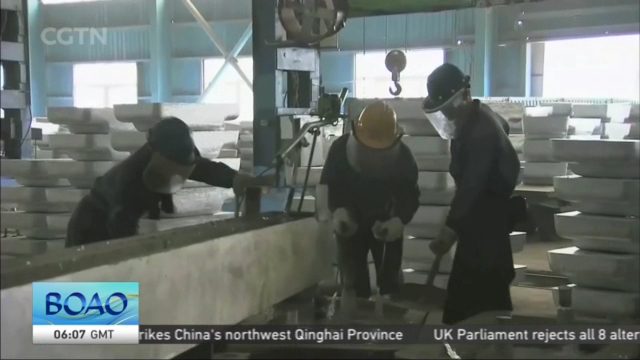
At this year's forum, economists and business leaders are closely following China's efforts and progress in structural reform. CGTN Reporter GUAN YANG went to the northeast - once the face of the country's all-powerful state economy, and finds out if the reforms have paid off.
The state-owned zinc factory in Huludao city was once the largest of its kind in Asia.
It had all the legacies of an planned economy: over-staffed and with uncompetitive products.
Six years ago, it was on the verge of bankruptcy, thousands of workers like Zhong Yilin were earning minimum wage. What was worse, the 7,000 employees could have lost their job if the reform failed.
ZHONG YILIN, ZINC WORKER ZHONGYE HULUDAO NON-FERROUS METAL GROUP "2009 was a tough year. My oldest daughter had just enrolled in college and my wife wasn't working because of illness. We had to borrow money to buy daily necessities and pay the enrollment fee."
The central government has declared China's northeast a high priority.
Officials have pushed supply-side structural reform in recent years while promoting mixed ownership for inefficient state-owned enterprises.
They've also eliminated excess capacity in the iron & coal sectors.
Small coal pits were shut, chimneys of old factories were torn down, while industrial facilities were upgraded.
FANG YONG, DEPUTY DIRECTOR DEVELOPMENT AND REFORM COMMISSION, LIAONING PROVINCE "Liaoning has fulfilled its obligation of eliminating overcapacity in various sectors in accordance with the nation's 13th five-year plan. The structural reforms are starting to pay dividends, competitiveness and profitability of the traditional heavy industries have been boosted."
Back in Huludao, after structural reform, one private company now holds the largest stake in the zinc factory.
The first thing they did was to improve operational efficiency, they had zero tolerance for corruption and lackadaisical attitudes. Efforts to remove the state from day-to-day control, introduce market forces and strengthen the role of shareholders are making progress: None of the 7,000 workers was redundant. And Zhong's income is now more than double what he earned in 2009.
JIANG HONGBO, VICE GENERAL MANAGER ZHONGYE HULUDAO NON-FERROUS METAL GROUP "We've brought this company back to life with the help of structural reform, which allowed for transfer of technology and managerial expertise. We think the threat of poverty among the workers is one thing, but what's more, thousands of laid-off workers can also lead to severe problems for social stability."
And across China's three northeastern provinces, economic vitality unleashed by the reforms are expected to bring new levels of efficiency.
GUAN YANG SHENYANG, LIAONING PROVINCE "China's development has spillover effects on the rest of Asia, and the development of other countries, in turn, promotes China's economy. While this year's Boao Forum is calling for 'Shared Future, Concerted Action and Common Development', the supply side structural reform in China's rust-belt region can be seen as a sample on how China tackles one of the most pressing issues in its economy. GUAN YANG, CGTN."