
17:40, 12-Jan-2019
Medical Partnership: SW China's Yunnan, Singapore cooperate in palliative care
Updated
17:29, 15-Jan-2019
 []
[]
Share







Copied
03:24
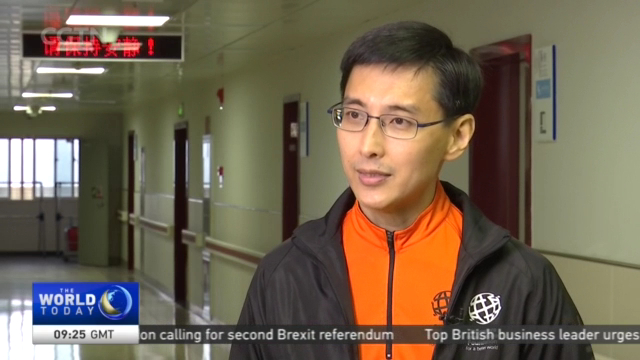
In an aging society like China, there's a growing demand for medical services geared for the elderly. And that includes end-of-life care for patients with chronic and terminal illnesses like cancer. Palliative care is still relatively undeveloped in China, but interest is growing. Now, medical institutions from southwest China's Yunnan Province and Singapore have signed a deal to help improve palliative care practices in the province. Meng Qingsheng reports.
This is a special care unit at Yunnan New Kun Hua Hospital. Dr. Ma Ke works here to provide palliative care to the terminally ill. This patient has advanced ovarian cancer, and he is helping to relieve her symptoms.
MA KE, HEAD OF PALLIATIVE CARE YUNNAN NEW KUN HUA HOSPITAL "I have been working in palliative care for over twenty years. More than 30 thousand patients have passed away in front of my eyes. But I don't think China has a complete system in the field. Medical institutions are still testing the water, and we are still on the road."
But practices here are changing. Experts from Singapore have come to join the local medical staff on a three-year training program.
WU HUEI YAW, SENIOR CONSULTANT TAN TOCK SENG HOSPITAL "Right now, the method is very much focused on the medical aspect. I think there's also a lack of medical social workers, people who can actually look at patients' emotional aspects. I think this is an area we can help them develop, because doctors and nurses have a lot of other roles to play."
As outlined by the program, the Singapore side will offer courses on palliative care to 50 Chinese master trainers, who will then pass on that knowledge to their peers in Yunnan.
DAVID CHONG, GOVERNOR SINGAPORE INTERNATIONAL FOUNDATION "With economic influence, people think more about managing the comforts of their relatives, even the patients themselves. They are more educated and aware of the needs to basically better manage their illnesses."
MENG QINGSHENG KUNMING, YUNNAN "China is now home to more than 200 million people over the age of 60. Chronic diseases like cancer are their primary causes of death. Yet across the nation, fewer than 150 institutions and nursing homes specialize in end-of-life care. Most of the services are provided by community health care centers, instead of large-scale public hospitals."
Palliative care focuses on quality-of-life and pain relief, and allows end-of-life patients to die peacefully. Dr. Ma Ke says China needs to get past its traditional reluctance to talk about death. Openness, he says, can pave the way for peacefulness.
MA KE, HEAD OF PALLIATIVE CARE YUNNAN NEW KUN HUA HOSPITAL "China lacks a formal death education program. There's not even one for medical professionals. We hope to make it part of the national curriculum. We need to discuss the topic with patients after their initial diagnosis that death is a natural process."
The program is expected to directly benefit some 36-thousand local patients and caregivers by the end of 2021. The practices put in place could then serve untold numbers of aging Chinese for years to come. Meng Qingsheng, CGTN, Kunming, Yunnan Province.