
14:43, 13-May-2019
A Taste of Asia: The art of the Indian Curry
Updated
14:40, 16-May-2019
 []
[]
Share







Copied
04:00
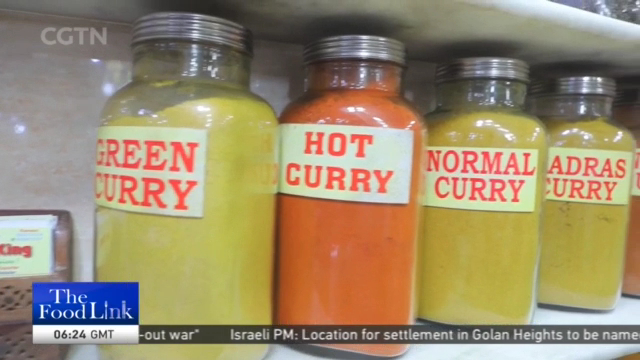
When people come to India, the first taste coming to mind is curry. How many types of curries are there, and how do they vary? CGTN's Shweta Bajaj talked to an expert to sample the flavors, and file this report from Mumbai.
SHWETA BAJAJ MUMBAI "If there is one dish that truly signifies the diversity of India, It's the curry. Depending on which state, region or even house you go to, the taste of the curry can be totally different. It's the spices that make it so. For instance, the trusted garlic. I am going to meet a chef from India who is almost an encyclopaedia on curries and try and understand what does it take to make a mean one."
SANDEEP SREEDHARAN CHEF "The Indian curry for me, it's when people mention, what is a sauce? Sauce is a sauce is a sauce and curry is a curry is a curry. So you probably cannot say that I had bread or I had this chicken with a sauce. You got to mention what kind of sauce it is. So curry is basically a form. How to come to that form based on the region, based on the terroir base, the vegetables, the ingredients, the spices – that's where the curry comes from. In India, depending on the region, depending on the sect, depending on the cast – your curry's flavour could come from two different vegetables or it could be a spice and a vegetable.
In India, we get 40-50 varieties of chillies. You have Guntur chillies which are very spicy, you have Madras chillies, you have Byadgis, you have Brown chillies. You substitute one chilly with another and your flavours totally change.
There is a big difference between what is authentic and what are the flavours that represent a particular region. So you have to look at each and every ingredient and how it behaves based on the particular terroir. Where is the flavour coming from? What are the basic flavours based on a particular region? State of Assam and Manipur, the food is very different from Nagaland.
Most of the time when foreigner and tourists, they come here, they are fed with very complex layers of flavours that they are not exposed to. One thing I will tell is to go to the simplest factor of making a curry.
There is a lot of process and science behind making food. It is not about how well you make. If you have to tell someone how to make a dish, you should be able to tell the actual process of making it.
The traditional methodology, you apply to it – that is where it differs from your cooking to your mother's cooking. When you ask your mother, your mother tells you exact recipe, but she doesn't tell you the exact process.
I think there is a lot of energy in the way we touch, feel every ingredient, you still want to keep your base flavour intact and build on top of that, so that when you eat, it will hit your memory somewhere.
I only concentrate on one thing: that is balance. Flavour is subjective but balance is not.
It's impossible to say how many types of curries. In Indian food, the more you preserve and more you add on it, it just evolves."