
16:17, 19-May-2019
Chinese Digital Economy: WeChat into London Business School
Updated
16:10, 22-May-2019
 []
[]
Share







Copied
03:28
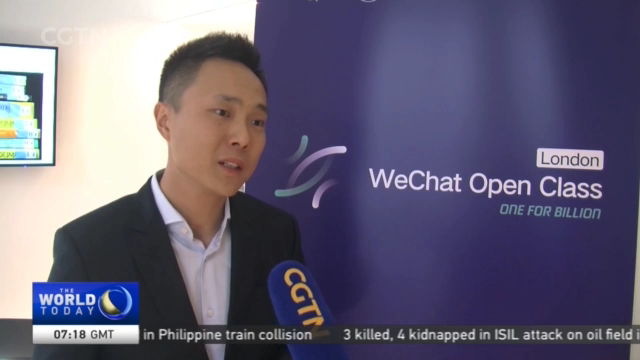
Since its founding as a modest 10-person operation back in 2010, to its emergence as China's leading digital platform for social engagement and business services, WeChat is a story of continuous innovation. On Thursday, the app was discussed in an open class at London Business School, which has also developed an academic study of the Chinese platform. Our reporter Xi Jia spoke to the school's Julian Birkinshaw and Liang-Hong Ke about WeChat's stunning transformation.
LIANG-HONG KE, CO-AUTHOR, SLOAN FELLOW LONDON BUSINESS SCHOOL "I told Julian that because I am from China, I know the Chinese innovation very well, so I think we need to put some effort in the researching of Chinese digital economy. So starting from that point, Julian was aware of all these innovations in China."
Having held senior leadership roles at Microsoft, Ericsson Business Consulting and Nokia, Professor Ke is one of the pioneers of incubating Mobile Internet and Cloud Computing industries. Three years ago, when Professor Ke first discussed with Professor Birkinshaw cases of Strategic Agility at London Business School, where he was Birkinshaw's student 10 years ago, he insisted that if any of the Chinese companies could be included in the case library, Tencent's WeChat should be one.
LIANG-HONG KE, CO-AUTHOR, SLOAN FELLOW LONDON BUSINESS SCHOOL "The reason we selected it at London Business School is they are very innovative and have 1 billion users."
Three years later, London Business School introduced its latest case study named 'Innovation and Agility at Tencent's WeChat' in its Strategy and Innovation Class. It describes the emergence and growth of WeChat, and how it came to dominate large parts of daily life in China; it also provides insight into how WeChat operates, and the current strategic challenges facing it. The case study holds up WeChat as a classic example of a product evolving from application to platform and then becoming an industry standard.
PROFESSOR JULIAN BIRKINSHAW DEPUTY DEAN, LONDON BUSINESS SCHOOL "Tencent is very successful in two ways, one is it has the world biggest gaming company, sometimes they create it, sometimes they brought; and obviously WeWhat is the other hugely successful piece as I will tell the students later today that WeChat is succeeding in creating a platform and had a steady stream of user innovations, I think a lot of western companies can learn from that success."
WeChat was originally a social app. It then adapted its open strategy, launched the Official Accounts and created the WeChat Pay system, successfully converting itself from a social networking app to an influential platform.
DAVE FAN, SENIOR DIRECTOR WECHAT PAY INTERNATIONAL BUSINESS "In Britain, people used to pay by contactless, which is a kind of fast payment that has no value of appreciation, as they left after they made the payment which really should be made better use of. The value that WeChat pay has is that it is a way of connecting service and customers."
Both Professor Birkinshaw and Professor Ke say China's idea of mass entrepreneurship and innovation has created a lot of successful businesses which are gradually being recognized by western countries. Xi Jia, CGTN, London.