
14:24, 17-Jan-2019
Venezuela Conservation: Zoo finds food for endangered manatees amid economic crisis
Updated
14:14, 19-Jan-2019
 []
[]
Share







Copied
02:37
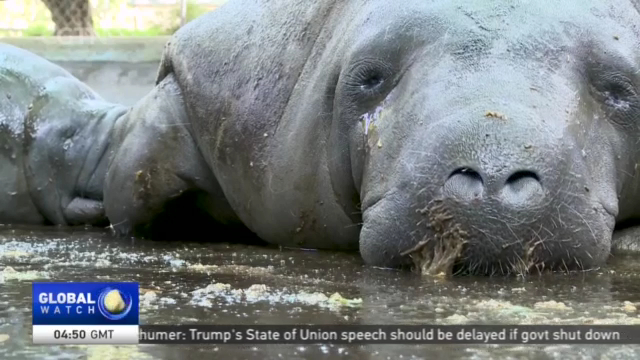
Manatees, also known as sea cows, are an endangered marine mammal species. Each year, around 100 of them are killed by collisions with boats. CGTN's Juan Carlos Lamas has this story from Venezuela.
Best known as Chicho and Fernanda, these were the first West Indian manatees, or sea cows, to arrive at the Bararida Zoo. They were rescued by zoo workers who took them from fishermen more than 20 years ago. The West Indian manatee is the largest surviving member of the aquatic mammal order Serenia.
CARLOS SILVA MEDICAL DIRECTOR, BARARIDA ZOO "It's an endangered species, protected by Venezuelan law since the 1970s. Their habitats and population have been reduced dramatically."
Poaching and destruction of habitat meant only a few hundred manatees were left in the late 1970's. The staff at Bararida Zoo developed a reproduction program that's helped Chicho and Fernanda produce offspring.
JUAN CARLOS LAMAS BARQUISIMETO "Since 1992 workers here at Bararida Zoo have successfully managed to breed four manatees in captivity, making this a leading zoo in South America for manatee reproduction."
In their natural habitat, manatees eat up to 20 percent of their weight each day, grazing in seagrass beds. These manatees at the Baraida Zoo eat food provided by the local government, 150 kilos of lettuce and 12 kilos of carrots each day, plus bananas and broccoli. In a country where hyperinflation is expected to reach 10 million percent this year, that's not easy.
RAQUEL VALLARELLI ZOO KEEPER "I'm doing this because I love animals, and as an environmentalist, it's rewarding to see how animals somehow thank you for being here helping them."
Visitors appreciate the efforts to keep the manatees alive.
LEOMER MIRANDA ZOO VISITOR "It's an interesting and mystical animal. I like the way it swims. It caught my attention immediately."
The manatees are now living in an aquarium that's just 60 centimeters deep the zoo says it doesn't have the funds to repair the glass in a deeper aquarium. Workers say they hope someday to release the manatees to swim freely in their natural habitat in Venezuela's freshwater rivers, and estuaries, and in the coastal waters of the Gulf of Mexico and the Atlantic Ocean. Juan Carlos Lamas, CGTN, Barquisimeto city, Venezuela.