
12:09, 19-Jun-2019
5G & Huawei: Huawei ban has far-reaching repercussions
Updated
17:22, 09-Jul-2019

Share






Copied
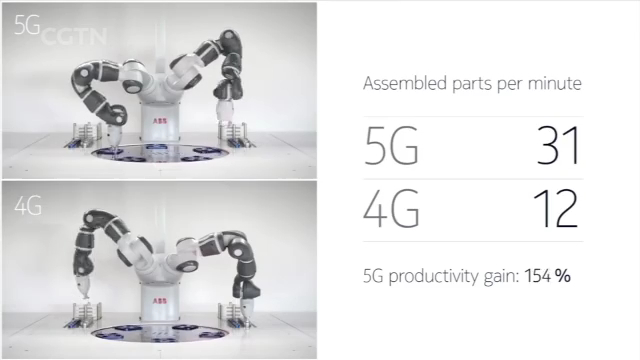
5G is all the rage in today's tech news. But the world's progress towards a 5G future might be hindered as the US administration's ban on China's Huawei takes effect. Our reporter Yang Chengxi explains why the repercussion of this ban might be more serious than most people think.
This is the Hongqiao train station in Shanghai, one of the busiest in China. Usually, in a packed place like this, or at a concert or other crowded venue, people worry about weak signals. But that concern will be a thing of the past when this station is covered by 5G in the future. The new network allows for up to a million mobile connections within one single square kilometer.
YANG CHENGXI SHANGHAI "Also, it is fast, it's really fast. For those who are curious, here's a trending video of just how fast 5G could be on your phone. This video gained over six million views in two days in China. Suddenly the future feels not so far away anymore. Imagine driverless cars, efficient robots, remote precise surgeries and countless other applications enabled by the fast speed and low latency. By 2025, half of the US and a quarter of China's mobile connections will be made through 5G. It is the next big thing and this is where it gets complicated. We need to talk about the H word -- Huawei. Apart from making smart phones, the company also makes telecommunications equipment. It holds the most 5G patents, and claims to be head of its competitors by as much as 18 months. Millions of people around the globe have learned how to pronounce this curiously-spelled Chinese brand in recent weeks. But unfortunately, many got to know about it from news clips like this."
TOM COTTON US SENATOR FOR ARKANSAS "I hope all of you in the gallery are not using a Huawei or a ZTE product. If you are, you might wanna buy a different one. These companies are dangerous to our national security and your privacy."
YANG CHENGXI SHANGHAI "That sounds severe. The US has banned its companies from doing business with Huawei, claiming it might install back doors in their products for espionage. That would be understandable if there was solid evidence. The American government still has yet to publish any credible proof to back it up. Yet, every allegation sounded more real than the last one."
MARCO RUBIO US SENATOR FOR FLORIDA "They are used for espionage, they're part of the supply chain, whether it is routers or anything else, they embed stuff in there that can be used to spy against us."
YANG CHENGXI SHANGHAI "Actually this rhetoric is hardly new. With that amount of distrust from western countries, Huawei had offered the source codes of their product for thorough inspections by government agencies from countries such as Great Britain, Germany and Canada since 2012. And to this day, there has been NO evidence of any back door used for spying."
On May 30th, British mobile carrier EE launched the first commercial 5G network in Great Britain using Huawei equipment. European countries have refused to ban Huawei despite heavy pressure from Washington to do so.
YANG CHENGXI SHANGHAI "Why? Because no country wants to lose out on the global 5G race. The cost of building this new network is much higher than 4G because 5G requires a hundred times more radio transmitters. It only makes sense to choose a company that experts say offers 5G solution with the best price-point in the market. Many European countries like Britain and The Netherlands say that they wouldn't use Huawei for their 5G network cores, but they would still use their transmitters and what Huawei needs to do is to work closely with suppliers and regulators. That's not happening with America, at least for now."
ANDY PURDY CHIEF SECURITY OFFICER, HUAWEI TECHNOLOGIES USA "We need to take these measures to develop a new uniform cyber security standards. Use these mechanisms to assess risks objectively and based on evidence. So that we can have conformance programs that we can prove our products are worthy of trust. That's how we address the risk. That's how we are all safer in cyberspace. The United States doesn't feel secure in cyberspace. The kinds of individuals in the government who would normally talk with us are not really open to talking with us to help address real cyber security issues."
YANG CHENGXI SHANGHAI "Experts say that leaves Huawei between a rock and a hard place. It is suspect but not able to prove its innocence and that has reinforced the idea that the US is persecuting Huawei not just because of security issues, but as a way to maintain its supremacy in technology. In fact, similar cases have happened before. Consider Alstom, the French industrial conglomerate. The U.S. Justice Department in 2010 used an extra-territorial law to investigate the company for alleged corruption. Alstom's energy business was later acquired by America's GE, despite competing bids from Germany and Japan. Some analysts suspected that the investigation might have influenced the acquisition. Former Alstom executive Frederic Pierucci, who was arrested by the US in 2013 and sent to jail, later called the episode politically sensitive dealmaking, and 'Underground Economic Warfare'."
FREDERIC PIERUCCI AUTHOR, 'THE AMERICAN TRAP' "Europe needs to react, China needs to react, Otherwise we are going to live in a world basically where the United States decides who should trade with whom."
Now, with the Huawei ban continuing, collateral damage is beginning to surface. The company's equipment has been used in the U.S. for years. Huawei supplies technology to about 40 small carriers across rural America. Replacing that could cost hundreds of millions of dollars, and farmers might be facing the danger of losing their mobile service, which they rely on every day to monitor their environment.
MIKE KILGORE, CEO NEMONT TELEPHONE COOPERATIVE "Nobody in their right mind would shut down a network and shut down public safety. Sometimes I equate it to flying in a jet with two engines. And you want to replace one of the engines at 30,000 feet. Probably not a good idea."
The US government has offered a pool of 700 million dollars to mitigate the situation, but some experts say that's not nearly enough.
YANG CHENGXI SHANGHAI "That's not to mention that Huawei has been a big buyer of American products. The company spent 70 billion USD to purchase parts in 2018, and 11 billion of them came from the US."
MICHAEL WOLF FOUNDER & CEO, ACTIVATE "So much of the US tech industry is intertwined with Chinese companies. It is not like steel in terms of being able to shut out one player."
Analysts say the costs will likely be passed down to ordinary consumers.
YANG CHENGXI SHANGHAI "Yet there is a MUCH deeper long term risk at play here. Experts say that the U.S. government's intervention in the telecom sector sets a dangerous precedent in America, and could be a warning call for other companies around the world."
RICHARD WOLFF FOUNDER, DEMOCRACY AT WORK "By interfering in a peace time world, in a private, profitable interaction between Huawei and US companies, every major company in the world will associate a new risk with doing business with American companies."
YANG CHENGXI SHANGHAI "Of course, companies including Huawei could eventually reduce their interdependence with American firms. But that is not at all ideal in a globalized market. So if the current American administration's mentality is Huawei, no way, the people are losing out on more than just a smart phone."