
Politics
16:52, 04-Dec-2017
WeChat stickers are China's latest tool to fight corruption
 ["china"]
Share







Copied
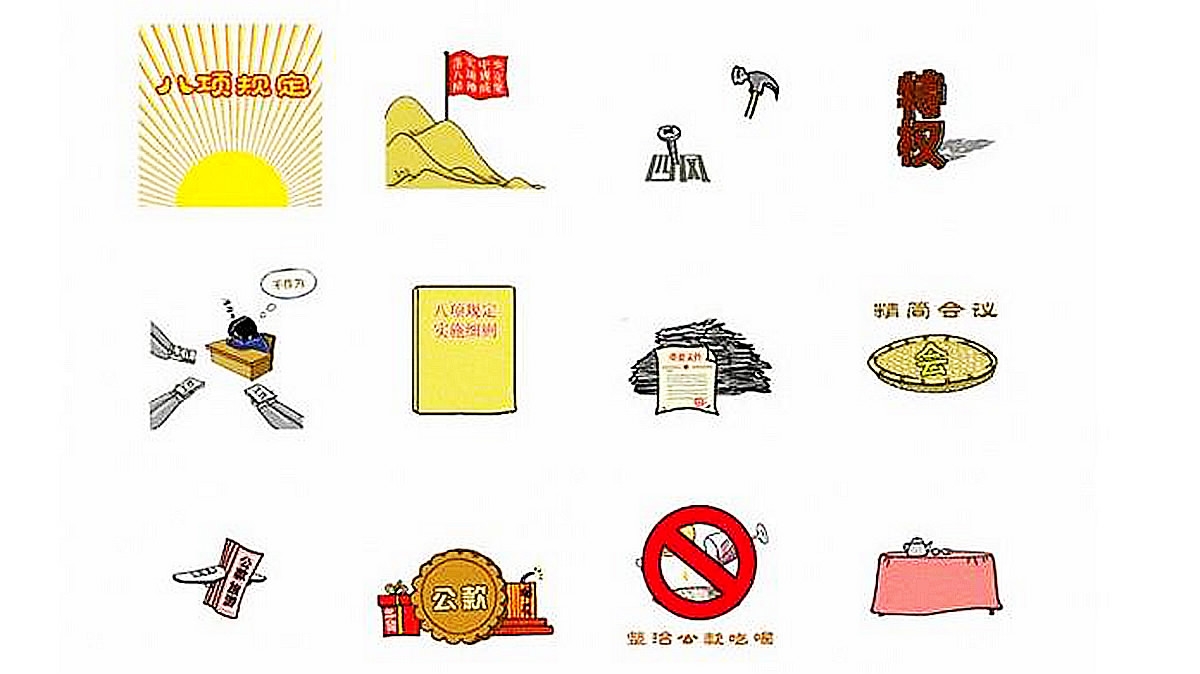
An animated sticker with a shining golden sun reads "eight-point regulation changes China." Other GIFs discourage playing golf, joining private clubs and holding banquets.
China's campaign against corruption has taken a fresh look on the fifth anniversary of the introduction of the "eight-point regulation" frugality code. The anti-graft stickers made their debut over the weekend on WeChat, the country's largest messaging app.
The series of stickers reflects the main principles of the code of conduct that was introduced in 2012 to weed out undesirable work styles that have long determined the behavior of government officials and members of the Communist Party of China (CPC).
The Communist Party of China (CPC) Central Commission for Discipline Inspection (CCDI) said on Sunday that the stickers were an instant hit.
WeChat has over 115 million daily active users, according to data from the platform's mother company Tencent Holdings Ltd.

Screenshot of the "eight-point regulations" sticker series on Wechat
Screenshot of the "eight-point regulations" sticker series on Wechat
The eight rules of conduct are:
- Officials must remain close contact with the public, cut extravagance and do away with welcome banners, red carpets and grand receptions.
- Strictly regulate and simplify meetings and events. Political Bureau (of the CPC Central Committee) members are not allowed to attend opening ceremonies, celebrations and seminars without approval.
- Cut bureaucracy and unnecessary government papers.
- Overseas trips are only permitted for foreign affairs.
- There should be fewer traffic controls when leaders travel by car to avoid unnecessary inconvenience to the public.
- Minimize news report about members and work of the Political Bureau. News report should consider the need, news value and social impact.
- Officials should not publish anything by themselves or issue any congratulatory letters in their own name without certain arrangement.
- Officials must practice diligence and thrift, and strictly follow regulations on accommodation and cars.
Social media presence
The CCDI said the anti-corruption campaign has changed the CPC and the country since it was launched five years ago.
The eight-point rule was proposed during a meeting of the Political Bureau of the CPC Central Committee, the country's top-ruling body, in December 4, 2012.
The stickers convey the message that the CPC is determined to discipline officials' behavior and to eradicate corruption, the CCDI said. This is the latest effort to promote such a determination, it added.

Xi Jinping talks with local villagers and cadres at Shibadong Village in Paibi Township of Huayuan County in the Tujia-Miao Autonomous Prefecture of Xiangxi, Hunan Province, November 3, 2013. /Xinhua Photo
Xi Jinping talks with local villagers and cadres at Shibadong Village in Paibi Township of Huayuan County in the Tujia-Miao Autonomous Prefecture of Xiangxi, Hunan Province, November 3, 2013. /Xinhua Photo
The behaviors of officials have been remarkably rectified under the eight-point regulation, it said, stressing that it will press ahead with the campaign until corruption is completely rooted out.
It said it plans to make more anti-graft stickers in the near future.
The stickers have created a buzz on social media, with thousands of comments and likes.
"More supervision is needed to discipline and check behavior of employees at state-owned enterprises (SOEs)," a user wrote on China's Twitter-like Weibo.
"Anti-corruption stickers cannot root out corrupt officials, more discipline and punishment needed," another user commented.
"I'm amazed (by the sticker), but I don't know under what circumstance I can use when chatting to friends," quipped a third Weibo user.
Law signature
Over the past five years, nearly 1.4 million Party members and officials were punished for taking bribes and abusing their positions.
During the 19th CPC National Congress, the CCDI announced plans to establish a new National Supervision Commission.

Zhao Leji (C), member of the Standing Committee of the Political Bureau of the CPC Central Committee and head of the CCDI, holds a meeting after the 19th CPC National Congress, October 30, 2017. /Xinhua Photo
Zhao Leji (C), member of the Standing Committee of the Political Bureau of the CPC Central Committee and head of the CCDI, holds a meeting after the 19th CPC National Congress, October 30, 2017. /Xinhua Photo
The National Supervision Commission will work alongside the CCDI, and will merge multiple additional anti-graft units. Unlike the CCDI, it will have jurisdiction over all government officials and employees at state-backed institutions.
A draft legislation will provide legitimate power for detention designed to replace the practice of "shuanggui", in which cadres suspected of graft and other disciplinary violations are routinely subjected to detention and interrogations by the CCDI "at a designated place and a designated time."
Details about the new system are expected to be announced next year.