
Politics
17:43, 30-Jan-2018
Catalonia leadership: What are the options as key vote nears?
 ["europe"]
Share







Copied

Catalan lawmakers are scheduled to elect the official candidate to be new president of the region on Tuesday. However, the chosen man, Carles Puigdemont, has sought exile in Belgium and faces arrest if he returns to Spain for his investiture.
The situation
Pro-independence parties won a majority of seats, though not votes, in the Catalan parliament in an election held in December. The poll was ordered by Spanish Prime Minister Mariano Rajoy after a failed attempt to declare secession by the administration led by Puigdemont in October 2017.
Puigdemont has been in exile since, fleeing to Belgium after being sacked by Spain’s central government. However, separatist parties have put him forward as the only candidate to take on the presidency after December’s elections.

Carles Puigdemont delivers a live speech from Belgium during an electoral rally on December 19, 2017. /VCG Photo
Carles Puigdemont delivers a live speech from Belgium during an electoral rally on December 19, 2017. /VCG Photo
Spain's Constitutional Court ruled on Saturday that the former leader could only attend a swearing-in session to again become regional president if he was physically present in the parliament and had a judge's permission to attend.
The options
1. Separatists abandon Puigdemont
The simplest solution, if not great for Puigdemont, would be for the pro-independence forces to choose another leader. The separatists have a small majority in parliament, and a drawn out battle over Puigdemont may not be in the best interests of their cause. “It is essential to have a government, if President Puigdemont has to be sacrificed, we will have to sacrifice him,” Joan Tardà, of Catalan Republican Left, told La Vanguardia. However, there is no clear alternative and any new candidate would have to be rushed through by Wednesday.
2. Constitutional Court investigates
Spain’s Constitutional Court is yet to make a decision on whether to consider the Spanish government’s challenge to Puigdemont’s legitimacy as a presidential candidate. Madrid claims he is a fugitive from justice and cannot take on the presidency, but his party says there is no legal basis for the claim. If the court decides to consider the challenge, Puigdemont’s candidacy will be suspended.
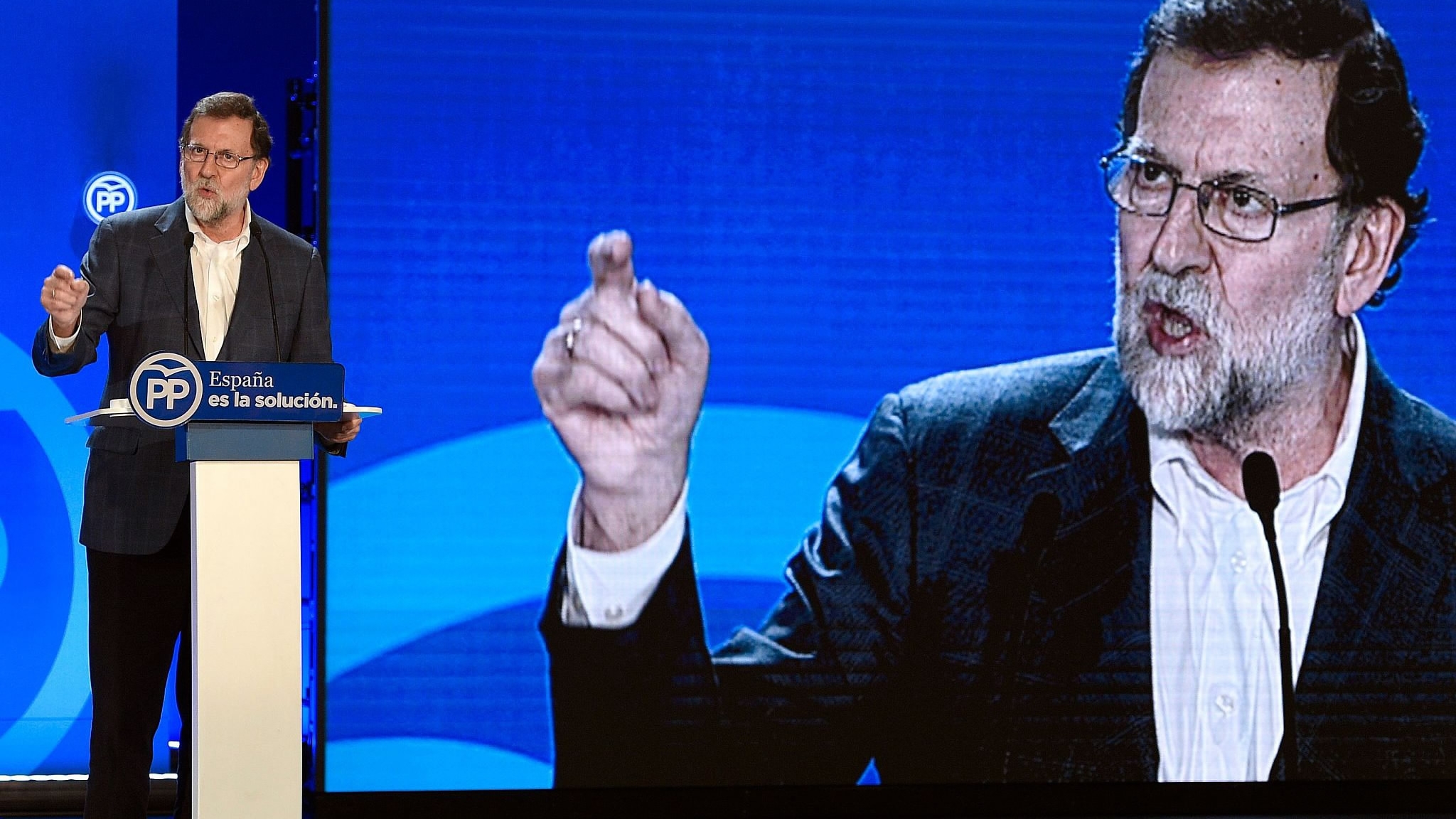
Spanish Prime Minister Mariano Rajoy speaks during a Catalan Popular party campaign meeting in Salou on December 17, 2017. /VCG Photo
Spanish Prime Minister Mariano Rajoy speaks during a Catalan Popular party campaign meeting in Salou on December 17, 2017. /VCG Photo
3. Puigdemont returns to Spain
The Constitutional Court insists Puigdemont can only be sworn in as president in person. But he is wanted on charges of rebellion, sedition and misuse of public funds in Spain and would likely be arrested if he were to return from Belgium. Border patrols have been stepped up. On Monday, Puigdemont asked the parliament to guarantee his right to attend Tuesday's session.
4. Constitutional Court ruling overturned
Puigdemont has appealed the Constitutional Court’s ruling that he must be physically present in the Catalan parliament to be sworn in as president. AFP reported that the court is scheduled to consider his arguments at 12:00 GMT on Tuesday.

A protester wears a Carles Puigdemont during a demonstration in Barcelona on January 28, 2018. /VCG Photo
A protester wears a Carles Puigdemont during a demonstration in Barcelona on January 28, 2018. /VCG Photo
5. Puigdemont tries to govern from Belgium
Supporters of Puigdemont argue that he can govern remotely in exile via video link, but Saturday’s Constitutional Court ruling appeared to rule out the option. That doesn’t mean Catalan lawmakers won’t elect Puigdemont, but such a move would deepen tensions. Madrid has suggested it would reinstate direct rule if Puigdemont tried to take office while in exile and in contravention of the court ruling. "A fugitive, a man who tried to unilaterally liquidate national sovereignty, can't be president of anything," Rajoy said on Monday.
6. Something else...
The situation in Catalonia is unprecedented, so there remains the possibility that an unlikely compromise or unexpected solution is found.
8814km