
19:31, 15-May-2019
China and the Arctic: China sticks to 'Polar Silk Road' despite US criticism
Updated
19:30, 18-May-2019
 []
[]
Share







Copied
03:14
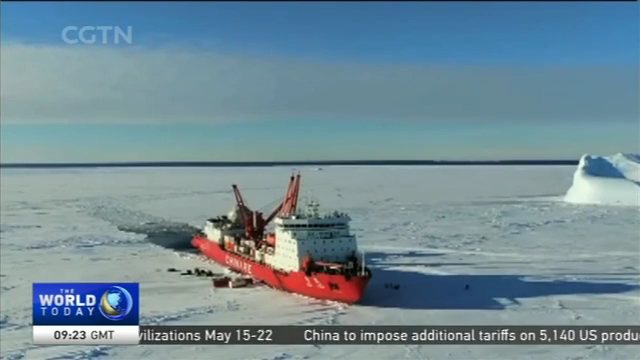
Chinese officials have reiterated the country's commitment to build a "Polar Silk Road" with Russia. This would be a network of maritime trade routes linking China and Europe through the Arctic. The remarks were made as China hosted an Arctic Forum in Shanghai this past weekend. And they follow comments made last week by US Secretary of State Mike Pompeo -- slamming China for what he called "aggressive behavior" in the Arctic. CGTN's Han Peng reports.
The Arctic is melting at an alarming rate. But amid concerns over the meltdown, global leaders also see opportunity in the form of new trade routes.
HAN PENG SHANGHAI "Some people say with the meltdown of the ice on both the North Pole and the South Pole, the animals are losing their homes, like the penguins and the bears. So it seems the thing we should do now is to stop the melting, instead of saying with more melting we can eventually have a route there to do trade."
B. SCOTT MINERD, MANAGING PARTNER GUGGENHEIM PARTNERS "This is a daunting problem, but we are not sure with the existing technologies it would be possible to stop."
China is among the many investors in the new shipping routes. Two years ago, Beijing and Moscow jointly announced plans for what they call a "Polar Silk Road". Sailing from China to Europe through the polar route could be 20 days faster than the traditional route through the Suez Canal. But the move is NOT welcomed by Washington.
MIKE POMPEO US SECRETARY OF STATE "Beijing claims to be a near-Arctic state. Yet the shortest distance between China and the Arctic is 900 miles. There are only Arctic states and non-Arctic states. No third categories exist and claiming otherwise entitles China to exactly nothing."
At an Arctic Council summit in Finland this month, Pompeo accused China and Russia of having military ambitions in the region, a charge Beijing denies. Some of the participants in the Shanghai Arctic Forum tried to explain why Washington might feel vulnerable.
B. SCOTT MINERD, MANAGING PARTNER GUGGENHEIM PARTNERS "We, the United States, only have one icebreaker. In Russia, they have eight of them."
HAN PENG SHANGHAI "China has two icebreakers, and it's also building a new one. But I think if the US has this anxiety of lagging behind, the answer should be building more icebreakers."
B. SCOTT MINERD, MANAGING PARTNER GUGGENHEIM PARTNERS "And I think that's the most appropriate response, because it's not just China who has interest in the Arctic. Japan has interest in the Arctic, Korea has interest in the Arctic and Russia has interest in the Arctic. So there are many players."
Besides shipping, Chinese scientists are concerned about global warming and see a role for China in environmental protection.
QU FENG, DIRECTOR ARCTIC RESEARCH CENTER, LIAOCHENG UNIVERSITY "The Arctic should not just be a geopolitical concept, but an environmental concept."
Some scientists believe the rising density of winter smog in Beijing in recent years is partly a result of the Arctic's record high temperatures, which weakened winds from the north that would otherwise disperse pollutants. That's just one smallest environmental consequence of the North Pole meltdown, and another argument for global collaboration by all countries. Han Peng, CGTN, Shanghai.