
15:38, 13-Apr-2019
China-Russia Cooperation: Two bridges will open, increase cross-border exchange of goods
Updated
15:30, 16-Apr-2019
 []
[]
Share







Copied
03:38
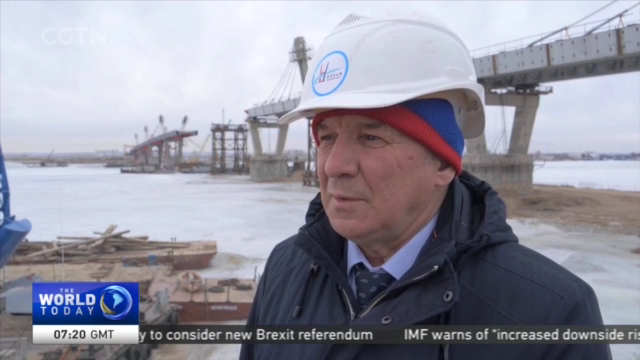
Although the border between China and Russia stretches for over 4,200 kilometers, cross-border transport connections are rather scarce. But, by the end of this year, two bridges will be opened and they will increase the amount of cross-border goods exchanged to millions of tons. CGTN's Aljosa Milenkovic was at the construction site of one of these two bridges and has this report.
Freezing cold still grips Russia's Amur region. It is one of the scarcely populated areas in Russia's far east, with only around 800,000 people living on the territory covering a space of over 360,000 square kilometers. The region's economy is struggling and people are leaving for other areas in Russia that offer a better life. Cross-border trade with China is seen as one of the ways out of this situation, yet lack of any reliable transport link has hampered any serious business.
ALJOSA MILENKOVIC BLAGOVESHCHENSK "I am in the Russian town of Blagoveshchensk. Across the frozen Heilongjiang river is the Chinese town of Heihe. For ages, those two cities have been so close, but at the same time, so far away, but now things are about to drastically change."
And here is the change. The bridge over the Heilongjiang River, just outside of Blagoveshchensk, which has entered its final stages of construction. The bridge is over one kilometer long with almost 20 kilometers of access roads. It costs over 330 million USD in total, with Russian part costing 250, and Chinese over 82 million.
Each country is building its own part of the bridge, and they will meet in the middle of the river, right at the border. Although the two sides of the bridge were scheduled to join in March, severe weather means the completion of the project will be postponed until May.
NIKOLAY ROGOV CHIEF CONSTRUCTION ENGINEER "Rivers like Amur sometimes cause some serious challenges. This year's specific challenge is the situation of very thick ice. That's why we'll have to wait for the icebreaker to pass here and only then can we continue with connecting both sides of the bridge, Chinese and Russian."
This bridge project was negotiated by the two countries for over two decades until finally, construction began at the end of 2016. The chief engineer of the Russian side says they will finish all their work by December 2019, and the bridge will be ready for use. Something that local and regional businesses in Blagoveshchensk are eagerly looking forward.
VALENTINA KALITA MAYOR OF BLAGOVESHCHENSK "They'll have more opportunities, and transporting capabilities will be more stable all year round. We are connected now, but that link depends upon the season of the year. We have times of the year when the Amur rises and transport between our two countries becomes difficult. The bridge will be open all year round without interruptions and our businessmen won't have to face troubles anymore."
At this moment, people and products are crossing the Heilongjiang River over the pontoon bridge during the winter, when the river is frozen. When the thaw comes, all traffic has to stop until the ice fully melts, so the ferries can start operating. But all of that is about to become a distant past, as the eagerly awaited bridge brings promises of not just better transportation, but of more jobs and a better life. Aljosa Milenkovic, CGTN, Blagoveshchensk.