
14:15, 03-Jul-2019
China Poverty Alleviation: Ancient embroidery technique helps create new job opportunities
Updated
16:56, 09-Jul-2019

Share






Copied
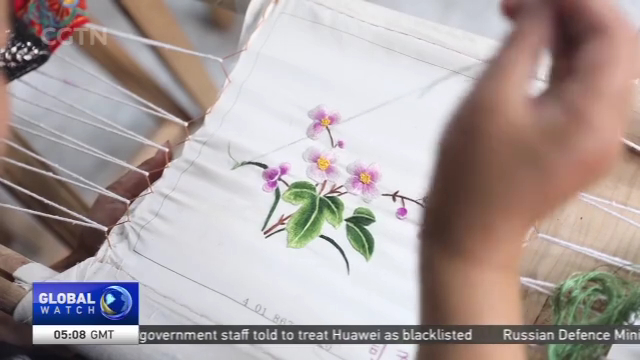
In Wuxi County of southwest China's Chongqing city, locals have revived an ancient embroidery skill to help alleviate poverty. The unique handicraft, named after the river that runs through the county, is known as Daning River Embroidery. CGTN's Meng Qingsheng has more.
At a handicraft exhibition in Chongqing, Daning River Embroidery wows visitors with its elaborate designs and subtle visual effects. The handicraft has thrived locally for thousands of years. Tang Lijuan used to work as a school teacher. In 2013, she quit the job and started her own business to pass the ancient craft down to the younger generation.
TANG LIJUAN BUSINESS OWNER "When I taught at the village primary school, there were many children, whose parents had left to earn money. Back then, I was keen on embroidering and decided to pass it down. But I couldn't do it alone. So, I wondered, if I paid the parents, they would be able to come back, take care of their children and help me with the embroidery as well."
The initiative is helping over 200 families in rural Wuxi County. More than 70 percent of them used to live below the poverty line -- with an annual per capita income of around 500 dollars.
Zhang Maoxiang is one of them. Her husband developed black lung disease 12 years ago and lost his job as a coal miner. Zhang says life was extremely difficult, especially raising her three children.
ZHANG MAOXIANG VILLAGER, WUXI COUNTY "The biggest difficulty was sending my children to school. Going to school needs money and my family could not afford it. I worked outside the village for some time, but it was hard to make money."
In September 2018, Tang Lijuan offered Zhang a training program on embroidery and then signed her up as a contract worker. Since then, Zhang has been receiving a regular monthly income of 1,700 yuan, about 250 dollars. Along with government subsidies, that's enough to lift the family out of poverty.
ZHANG MAOXIANG VILLAGER, WUXI COUNTY "The biggest change is that my children do not get embarrassed at school anymore. They used to eat only two meals a day, but now, with the money I earn, they can afford three meals. I hope I can stay on the program for a longer time. My children will be hopeful about life if I get a steady income."
MENG QINGSHENG WUXI COUNTY, CHONGQING "For much of its history, this mountainous area in southwest China, has remained isolated and underdeveloped. As part of nationwide efforts to reduce poverty, local departments have prioritized tourism and cultural industries to boost local income. And the embroidery project, best known for its flexibility, has proved to be among the most effective of these measures."
Official data shows, in Wuxi County, there are still more than four thousand families living in poverty, with an occurrence rate of slightly over three percent. Tang Lijuan has set up three embroidery workshops across the county. Under her watch, these people are turning the art of embroidery into sustainable products for modern taste.
TANG LIJUAN BUSINESS OWNER "I think it's necessary to retain the original flavor of Daning River Embroidery. But it's crucial to evolve with time by absorbing new elements and catering to customers' needs. Only this way, we can say that we've preserved the essence of this ancient handicraft."
The handicraft brought in a turnover of 8.3 million yuan in 2018, an increase of over 60 percent compared with the previous year. Tang says, as the business expands, more job opportunities will be created, and the ancient embroidery skill will continue to serve as a sustainable source of public good. Meng Qingsheng, CGTN, Chongqing.