
14:26, 24-Jul-2019
Fast Fashion: Can foreign brands still compete in China?
Updated
15:44, 24-Jul-2019

Share






Copied
Let's now take a look at China's fast fashion market. Fast fashion items are defined as those which have a quick turnaround time. In the past, foreign brands used to look at China as an enticing and profitable market. Is that still the case? Over time, some brands have exited the Chinese market. CGTN's Wei Lynn Tang takes a look at if foreign brands still have what it takes to compete in China. These foreign fast fashion brands have been in China for a decade or more. They have the lion share of China's foreign fast fashion market.
But they each garner just a tiny portion of the country's massive 2 trillion yuan retail apparel market. That's about 300 billion US dollars.
Some are still enjoying success, while others have pulled out of China - shutting down all of their physical AND online stores across the country. Forever 21 is the latest departure.
WEI LYNN TANG CHENGDU "Is it merely another 'one-off' case? Or does this signal a more apparent downward trend for the entire fast fashion industry in China?"
GUAN ZHENZHONG, PROFESSOR INSTITUTE OF INTERNET + INDUSTRY INNOVATION, SOUTHWEST JIAOTONG UNIVERSITY "There were two major turning points. In 2014, fast fashion brands were still on the rise. But it was also that year when China's mobile internet began its explosive growth. In 2017, China's economy slowed down and this affected its fast fashion industry. By then, China's technological advancements have spurred consumers to be more conscious of getting a better bang for their buck. And now, Chinese online retailers have a better understanding of Chinese consumer habits. If foreign brands don't grasp these trends, I foresee the pace of them closing down shop to accelerate."
More than 40 percent of China's population use mobile phones to buy and pay for things.
WEI LYNN TANG CHENGDU "Of course, with this increase in accessibility comes more options for consumers. And experts by and large believe, Chinese fast fashion brands can now compete on both - price points and quality."
GUAN ZHENZHONG, PROFESSOR INSTITUTE OF INTERNET + INDUSTRY INNOVATION, SOUTHWEST JIAOTONG UNIVERSITY "What millenials are after today is personality. They don't care if it's local or foreign, as long as they feel comfortable and the clothes offer good value for their money - especially in the face of increased choices."
"I used to shop a lot more in Zara and H&M. But after graduation, I began to pursue things of quality and realized these foreign fast fashion brands lack quality. Also, I have less time now to head out to malls. I now mostly buy from a few of my favourite local stores on Taobao, on my mobile."
"I will still buy these foreign fast fashion brands. I feel they have a strong sense of style and design. Once I like a brand, I will continuously buy its clothes. For domestic brands, I feel some still lack originality."
In its 2018 fiscal year, Uniqlo saw its Greater China revenue up an annual 27 percent. Inditex, the parent company of Zara, does not reveal its China numbers in its annual reports. Meanwhile, H&M's China operations used to grow at over 50 percent annually, in its early years after entering China in 2007. In 2018, net sales rose 13 percent year-on-year, but still better than its other markets.
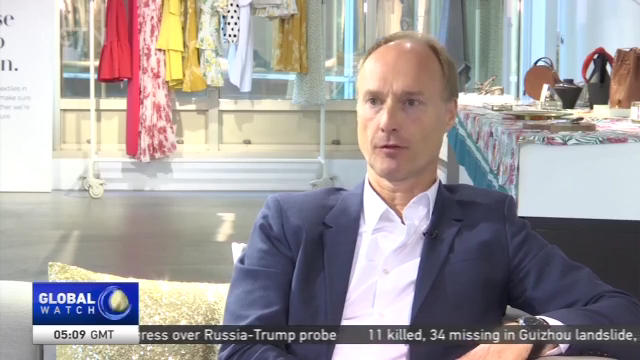
MAGNUS OLSSON, COUNTRY MANAGER H&M (GREATER CHINA) "In terms of numbers, there's a slowing down of the growth rate because the base of from where we increase is getting bigger, there's nothing strange in that. But I think that the market is giving us a lot of opportunities in the future as well. I think the market will be big and good enough for both Western and local brands. China is a very important market for us, we are committed here for the long-term."
It's easy to see why.The retail value of China's apparel sector rose 7.8 percent year-on-year in 2018 - its highest annual growth rate since 2014. Although, in 2019 and 2020, this growth rate is expected to slowdown, on the back of mounting economic uncertainty. China may increasingly be a hard market to crack, but for both local and foreign brands, they take comfort that the big market is at least still growing. WLT, CGTN, Chengdu.