
17:45, 24-Jun-2019
China-Japan Ties: Ancient temple in Japan witnesses centuries of exchanges
Updated
17:12, 09-Jul-2019

Share






Copied
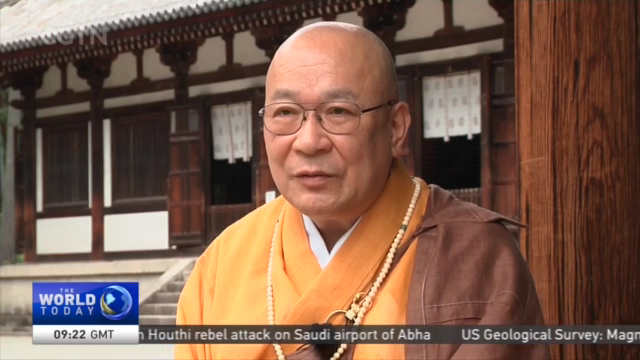
In the ancient Japanese city of Nara, the historic Toshodaji temple has long been a site of friendly exchanges between China and Japan. Links go back more than twelve-hundred years. CGTN's Zheng Yibing visited Nara, to find out more.
Toshodaiji, one of the most famous temples in Japan.
Its numerous Chinese features though, should come as no surprise. The complex was built by a Chinese monk named Jianzhen, or Ganjin in Japanese, back in the year 759.
ZHENG YIBING NARA, JAPAN "The ancient temple itself has witnessed the long and friendly ties between China and Japan. And there are many stories behind the structure."
Construction began during China's Tang Dynasty.
The monk, Jianzhen, was invited by the then-emperor of Japan to teach Chinese Buddhist precepts.
After five unsuccessful attempts to cross the stormy seas separating the two countries, one of which cost him his eyesight, Jianzhen finally reached Japanese shores, arriving in Nara in 754.
The monk's sacrifices are not lost on those who operate the temple today.
MYOGEN NISHIYAMA HEAD OF TOSHODAIJI TEMPLE "The structures built by the great monk Ganjin and his 24 Chinese apprentices 1,260 years ago have never suffered earthquakes nor fire and have been preserved to this day. The party of the great monk Ganjin left us with the advanced architectural legacy of China's Tang Dynasty."
But the monk brought with him more than just construction techniques.
MYOGEN NISHIYAMA HEAD OF TOSHODAIJI TEMPLE "There is a reason that Japanese people remember his name after 1,300 years. One is the medical supplies he brought to us. At the time, medical care was terrible in Japan. When you got sick, there were no means to cure it. But the great monk Ganjin brought the most advanced medical technology of Tang Dynasty. They did not only bring Buddhism into Japan, but they were also messengers of peace."
Jianzhen remained at the temple for four years until 763, when he passed away at the age of 76.
His tomb rests quietly there and continues to be worshipped by visitors, particularly by people from China and Japan.
VISITOR "I think through exchanges between people, through business, religion and more, Jianzhen is still remembered, and I believe good cross-border communication will benefit us all."
VISITOR "Just like what master Ganjin did in his efforts to come to Japan, we now must also try to understand each other more."
And what has resulted from Jianzhen signifies the long-lasting friendship between the two counties and what will continue for years to come. Zheng Yibing, CGTN, in Nara, Japan.