
22:59, 05-Jul-2019
Bat Friendly Tequila: Conservation effort ensures future of agave plant
Updated
16:52, 09-Jul-2019

Share






Copied
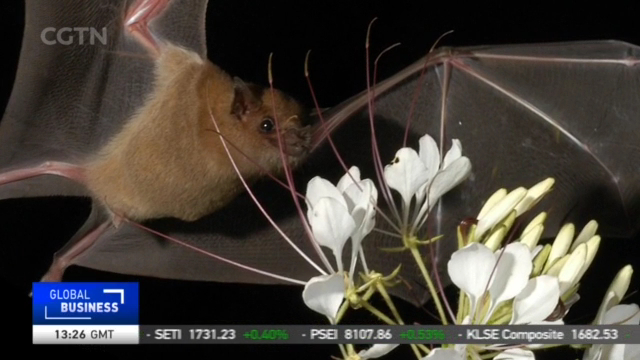
"Without bats, there will no Tequila." Local peasants say. Anyway, what's the connection between bats and Tequila production? Alasdair Baverstock has the report, and let's have a look.
The Blue Agave, the primary ingredient in Tequila. Every year, some sixty million of these plants are harvested to bottle Mexico's most famous spirit.
The plant flowers and reproduces once in its life-cycle, but the natural pollination process takes too long for commercial producers. So, to speed things up and maximize alcohol output, companies take a short cut.
And most Blue Agave farmed today is cultivated from clones.
CARLOS CAMARENA TEQUILA TANATIO "The plant can produce identical smaller plants through its roots, which are clones identical to the mother. These can be obtained in three years of planting, whereas to produce seeds, the plant needs a decade."
It boosts the industry's raw material, but for Carlos Camarena who runs one of Mexico oldest tequila distilleries, there's a serious long-term trade-off.
CARLOS CAMARENA TEQUILA TANATIO "After 150 years of not permitting the agaves to cross-pollinate and produce seeds, the plant has practically no genetic diversity. And that means that if a plague arrived that affected the crop, it would wipe the entire Blue Agave species off the map."
Yet there is a solution: Bats.
Specifically the "lesser long-nosed bat" - the Blue Agave primary pollinator, which until recently, was considered a threatened species due to commercial agave production.
RODRIGO MEDELLIN, BIOLOGIST MEXICO NATIONAL AUTONOMOUS UNIVERSITY "For twelve million years, bats and agaves have been linked. So now, they are stuck. Agaves depend on bats for pollination, and bats depend on agaves for food."
Better known as the Mexican Batman, Rodrigo Medellin is the founder of "Bat Friendly Tequila", an initiative to save the Blue Agave and the bats that depend on the plant by encouraging natural pollination.
RODRIGO MEDELLIN, BIOLOGIST MEXICO NATIONAL AUTONOMOUS UNIVERSITY "If you as a Tequila producer want to become Bat Friendly, all you need to do is allow five percent of your plants to flower. With that, we the University of Mexico will come to your piece of land, make sure that the bats are coming in to visit the plants, make sure that there is pollination, and finally that you as a producer use those seeds to replant the next generation. With that, you are in."
In three years, Carlos Camarena has produced more than 300,000 bottles of Bat Friendly Tequila, identified by special labels to appeal to environmentally-conscious consumers. He's also harvested over a million naturally produced seeds.
CARLOS CAMARENA TEQUILA TANATIO "Without bats, there is no Tequila. We are making sure the natural cycle is complete, and that Tequila has a guaranteed future, not for our own benefit, but for that of generations to come."
Now, the fight for Tequila future has become political, as the Bat Friendly producers work to convince their industry colleagues of Mother Nature vital role in Mexico signature spirit. Alasdair Baverstock, CGTN, Tequila, Mexico.