
13:08, 09-May-2019
US-Mexico Border: A look inside 'narco-tunnels' crossing the border
Updated
13:00, 12-May-2019
 []
[]
Share







Copied
04:00
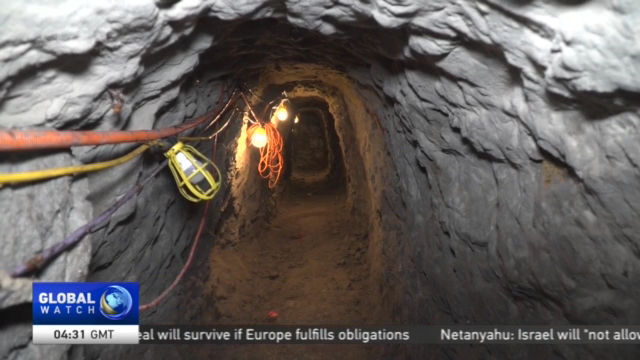
We continue with our series on the United States' southern border. President Trump says new walls will drastically reduce illegal drugs from entering the country. Some experts point out that most narcotics enter through official crossings. CGTN's Dan Williams has more from the Mexico-California border.
A team of workers busily continue the construction of a new reinforced border fence. The secondary fence between Tijuana, Mexico and the state of California will tower more than nine-meters high. The aim, to make it extremely difficult for traffickers to break through.
But if navigating the 'wall' becomes more challenging, the focus will then fall on other areas. One option would be to go around the fence this area, more than 22 meters from the sea, is without any border. But another option is to go under.
LANCE LENOIR DIRECTOR OF LOGISTICS, SAN DIEGO BORDER PATROL "In San Diego alone, we have discovered 70 cross border tunnels. 36 of those are of the sophisticated kind. We've seen them as long as 3,000 feet."
So-called 'narco-tunnels', operated by drug cartels, are known to have been in existence since the 1990s. U.S. Border Patrol agent Lance Lenoir is about to show us the Galvez tunnel, near the U.S.-Mexico border that was discovered in 2009 but it was never completed.
LANCE LENOIR DIRECTOR OF LOGISTICS, SAN DIEGO BORDER PATROL "This one here is 762 feet. It goes beyond that building over there."
Lance heads down first. And then it is my turn.
DAN WILLIAMS SAN YSIDRO, CALIFORNIA "So here it is then the Galvez tunnel. Let's see how we get on. What could go wrong?"
This access point was added years later.
DAN WILLIAMS SAN YSIDRO, CALIFORNIA "OK so we've reached the bottom of the tunnel now. You can see, it's covered in water. There's around a foot of water here - it goes to around four feet of water over there. That side is Mexico - that side has been blocked off, that way is the U.S."
When discovered, the tunnel had a rail system as well as electricity that was used for lighting and to power tools.
LANCE LENOIR DIRECTOR OF LOGISTICS, SAN DIEGO BORDER PATROL "This is probably one of the tallest tunnels I have ever been in. This is a typical. This is about six-feet high, give or take. Almost four feet wide. You don't normally see them that big."
"Mostly this is by hand. They still use pick axes, they still use shovels, they still use five-gallon buckets. It is still rudimentary in that regard. Nothing truly remarkable other than its audacity and its persistence."
The tunnel has been kept in place so that officers can test the effectiveness of new detection technology and for training new officers. Despite many successes over the years, Lance believes there are more tunnels nearby that have yet to be detected.
LANCE LENOIR DIRECTOR OF LOGISTICS, SAN DIEGO BORDER PATROL "As long as there is a will and a way to get something from Mexico into here in secret it is perfectly logical that there is already several in operation. As long as there is infrastructure on both sides in there, there is going to be a tunnel threat."
Although the Drug Enforcement Administration has reported that the vast majority of narcotics come through legal ports of entry, there is still an argument that a border wall will stop drugs from entering the U.S. This suggests that is unlikely to be the case. Dan Williams, CGTN, Tijuana, Mexico.