
17:20, 20-May-2019
Uber IPO: Rough ride for stock since going public
Updated
17:10, 23-May-2019
 []
[]
Share







Copied
03:07
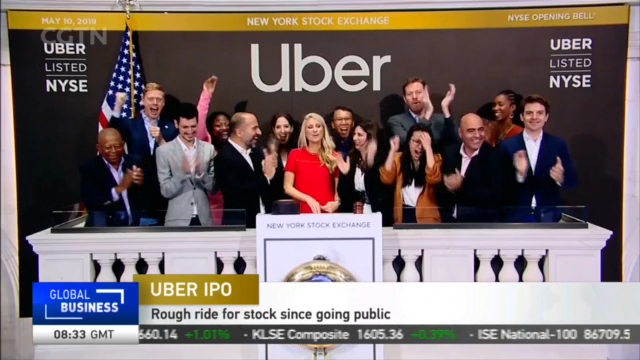
Looking at ride-hailing giant Uber. The company's stock didn't jump after Uber priced its IPO toward the low end of its stated range more than a week ago. Are investors holding back? CGTN's Giles Gibson reports from Washington.
It's been a week since smiling Uber executives rang the opening bell at the New York Stock Exchange.
But out on the trading floor, there were whispers about the company's finances and business model.
Some analysts say Uber's initial public offering was already set up for disappointment after being hyped-up.
ARUN SUNDARARAJAN PROFESSOR OF BUSINESS, NYU "The fact that Uber's IPO was not the success story that it should have been isn't really about the fundamentals of the company today. It's more about the fact that their valuation got too high too fast in the past and that severely constrained their ability to set a fair price for their IPO when they went public."
Uber's CEO Dara Khosrowshahi put the disappointing IPO down to the U.S.-China trade talks which hit an impasse the very same day Uber went public. But he insisted the company is measuring success in "five to ten years, not in one day".
But other Wall Street insiders, like Santosh Rao with Manhattan Venture Partners, do see weaknesses in Uber's fundamentals right now.
In 2018, the company's revenue was up by 43 percent from the year before - but that growth in revenue is slowing down.
SANTOSH RAO, HEAD OF RESEARCH MANHATTAN VENTURE PARTNERS "That's a huge problem for a company valued at $80 billion, which is what they wanted to do at the time. So when you're priced for perfection at that level you can't show revenues - ok, with profits, we can wait. We'll believe you, we'll give you the benefit of the doubt about profits. But, revenue? That's your thing, you've got to grow that."
This year, Uber has been paying out around $100 million per month in driver incentives.
GILES GIBSON WASHINGTON, D.C. "They're doing that to encourage drivers to stick with Uber, instead of switching to Lyft or another competitor. The more drivers there are, the less time you spend waiting for that little car to pop up on your screen."
But analysts say Uber can't keep pumping that amount of cash into driver incentives forever.
ARUN SUNDARARAJAN PROFESSOR OF BUSINESS, NYU "Ten years from now, if Uber is still spending the same amount of money on driver incentives, then they probably won't be in business. They have to build both passenger and driver loyalty, in ways other than paying them more to drive on our platform or charging below cost to use our platform."
Just before Uber's IPO debut, drivers around the world went on strike for better wages and working conditions.
Uber has already tested its vision of self-driving cars replacing those drivers, but like profitability, that could still be several years down the road. Giles Gibson, CGTN, Washington.