
19:44, 16-Mar-2019
Cloud Kitchens: Sharing economy coming to the boil in Seoul
Updated
19:40, 19-Mar-2019
 []
[]
Share







Copied
03:01
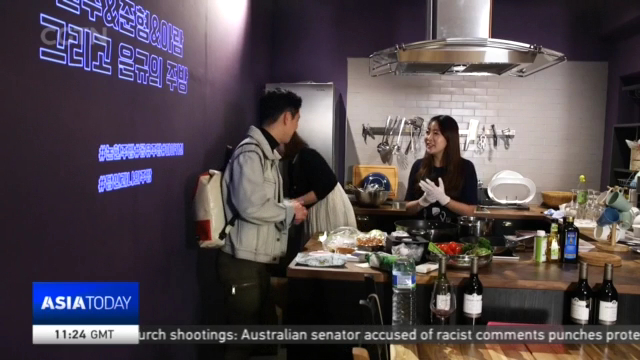
South Korea boasts one of the world's most advanced economies, but it's struggling to accept the more recent "sharing economy", which has seen growth in many countries. Big names like Airbnb and Uber have failed to take hold in South Korea due to red-tape, alleged protectionism and a risk adverse culture. However, CGTN's Jack Barton in Seoul says it might be slowly finding some traction, at least in the kitchen.
Friends gather for a dinner party in the South Korean capital Seoul. A dining event with a difference, not in a home or restaurant. This is just one of a growing number of kitchen and dining areas that can be rented for a few hours, the sharing economy at work once more. I've got an invite. The owner also drops by to check in on the second sharing kitchen he's opened.
CHOI SEUNG-KOOK OWNER MYKITCHEN "In Korea the young people still live with their parents so they don't have any privacy to have a small meal with their girlfriend or boyfriend or even with their friends, they have some problem with that."
No one here lives with their parents.
Jack Barton: "What makes this easier than doing it at home?"
LEE EUN-GYU REAL ESTATE AGENT "In the case of my house, the kitchen is too small to move when two people are standing, but the kitchen here is large and there is enough room for cooking so we can make a variety of food. Also, my table is small because my room is small, but the table here is big so six to ten people can sit."
YOON HYUN-JOO OFFICE WORKER "Normally, from the perspective of the people invited it is the host who should clean the house afterwards, but here it is better when we clean everything up together."
LIM JOON-HYUNG CAR REPAIR MANAGER "Our country is sensitive about the issue of noise between floors. If you invite many people to your house and make noise it can be become a nuisance for neighbors."
A sharing kitchen might seem a small thing, but not here.
JACK BARTON SEOUL "Companies like Uber and Airbnb have struggled due to tight regulation, but also a pervasive protectionist spirit when it comes to traditional industries like hotels, taxis and restaurants. Some legislators are now saying the current framework is half baked and at the national assembly it feels like something is cooking."
"There's a lot of interest in the national assembly. They think that the sharing industry that is ralated to sharing economy will be one of the more active industries in the future, capable of lot of growth."
Even shared kitchens still have their downsides, like dirty dishes. Jack Barton, CGTN, at a shared kitchen in Seoul.