
19:19, 03-May-2019
Reflecting on the Past: Donation gives glimpse into history of bilateral cultural ties
Updated
19:10, 06-May-2019
 []
[]
Share







Copied
02:41
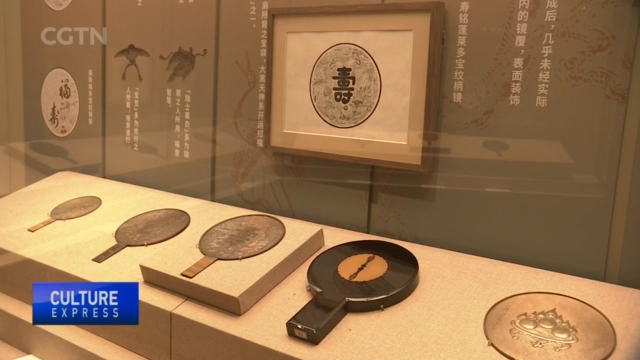
An exhibition featuring Japanese-style bronze mirrors is underway at Tsinghua University Art Museum in Beijing. The mirrors donated by an alumnus reflect a long history of cultural connections between China and Japan. Our reporter Ding Siyue has more.
74 exquisite Japanese-style bronze mirrors are on display, all donated to the museum by Tsinghua University alumnus Wang Ganghuai.
Generally speaking, Japanese mirrors are divided into three types: the Han-imitation style, the Tang-imitation style, and the purely Japanese style.
WANG GANGHUAI DONOR "The Japanese mirror is inherited from Chinese culture. In the 1960s, five Han Dynasty bronze mirrors were discovered from this archeological site in Japan. One of them has the exact same mold as what we have collected here today. It provides solid evidence of exchanges between China and Japan over 2,000 years ago."
After absorbing the Chinese culture of the Han and Tang dynasties, Japanese mirrors developed and took on their own appearance during the Edo period: changing the circular knob to a handle, marking the artisan's name, and enriching ornamentations.
WANG GANGHUAI DONOR "One of the most important themes in Japanese mirrors is the Chinese Penglai Fairyland, known as Hourai. This mirror is a classic of Hourai culture. It shows a huge turtle bearing Mount Hourai. The turtle is associated with longevity."
There's an interesting story behind the exchanges of mirrors between China and Japan.
The quality of China's bronze mirrors gradually declined after the Song Dynasty. That's when Japan replaced China as having the dominant mirror culture in the east.
During the Ming Dynasty, more exquisite Japanese mirrors were sold into China, and immediately became fashionable. But later the Japanese government imposed restrictions on maritime trade, causing a sharp decline in the exports. To meet the domestic demand, Chinese workshops began to imitate the Japanese-style mirrors.
DING SIYUE BEIJING "Although the Japanese mirror is only a small part of Japanese culture, it reflects many aspects of the society. By showcasing these mirrors, the exhibition aims to explore the cultural background behind them and further reveal the cultural ties between China and Japan throughout history. DSY, CGTN, BJ."