
10:47, 27-Jun-2018
Rediscovering Mexico: Looking into Mexico's oldest & most powerful political party
Updated
09:58, 30-Jun-2018
 []
[]
Share







Copied
04:50
On Sunday, Mexicans will choose their next president. The front-runner is a left-leaning populist and former Mexico City mayor, Andres Manuel Lopez Obrador. He's criticized the current ruling party, the Institutional Revolutionary Party or PRI. But like most Mexican politicians, Lopez Obrador once belonged to them too. CGTN's Franc Contreras has more on Mexico's most powerful and oldest political party.
To understand political power in Mexico, it's essential to know the history of the Institutional Revolutionary Party or PRI. The PRI was created by military elites clinging to power after winning the Mexican Revolution. Founded in 1929. General Plutarco Elias Calles who led Mexico's Revolution towards the end of the battle created the PRI's predecessor, the National Revolutionary Party or PRN. Historian Lorenzo Meyer says since the party's birth, it was designed to showcase the power Calles inherited.
LORENZO MEYER HISTORIAN "That's how the PRI was born in 1929, as a structure to help former president Calles, who was the strong man of the Revolution. The party was not born to compete for power. It already had power."
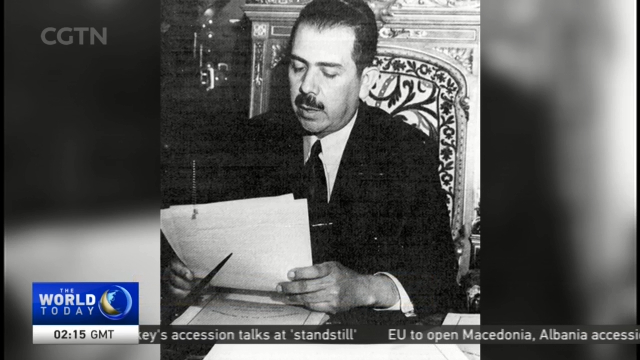
In 1934, Calles named his successor, another Revolutionary General Lazaro Cardenas. In 1938, Cardenas nationalized the oil sector, creating the state-owned oil monopoly, PEMEX. He said he did it for the benefit of the nation.
VOICE OF LAZARO CARDENAS FORMER MEXICAN PRESIDENT "This is a clear and evident case. It obligates the Government to apply the Law of Expropriation, not only to subject the oil companies to obedience, but also because they've broken labor contracts with their workers."
By 1946, the PRM changed its name for the last time to the Institutional Revolutionary Party, or PRI. A long period of economic growth, marked by authoritarian controls, characterized Mexico in the 1940s, 50s and 60s. The world's political climate changed in 1968, and like other major work cities, Mexico City's streets also filled with democracy protestors. The Mexican government ordered armed security forces to fire on hundreds of protesters in Mexico's Tlatelolco district.
GUSTAVO DIAZ ORDAZ FORMER MEXICAN PRESIDENT "I fully assume the personal, ethical, social, judicial, political and historical responsibility for the government's decisions in relation to the events of the past year."
The massacre did not prevent Mexico from hosting the 1968 Summer Olympics. This monument is a reminder for Mexicans that the bloody Revolution and its aftermath were largely responsible for creating a powerful state, which ruled with the one single political party.
FRANC CONTRERAS MEXICO CITY "This monument to the Mexican Revolution, and in fact the entire public space is in effect a symbol to the Institutional Revolutionary Party."
The 1985 Mexico City earthquake showed the PRI government's inability responding to the crisis. In the 1988 presidential election, a vote-counting computer system suddenly failed, Afterwards, another PRI president came to power. By the mid-1990s, a PRI government helped negotiate the creation of the North American Free Trade Agreement. But during that time, many still believed the PRI was a corrupt party.
In 2000, for the first time ever, the PRI loses the presidential election. President Ernesto Zedillo, also of the PRI, peacefully handed power to Vicente Fox of the National Action Party. The party lost two more presidential elections before returning to power in 2012. But a widespread perception of PRI corruption has the party's candidate in a distant third place current election, according to polls.
Left-leaning candidate Andres Manuel Lopez Obrador is favored to win the 2018 presidential election. Observers point out, he too started in the ranks of the Institutional Revolutionary Party. FC, CGTN, Mexico City.