
 []
[]
Share







Copied
U.S. Secretary of State Mike Pompeo will visit India from Tuesday to Thursday, becoming the first senior official in President Donald Trump's administration to make a trip to New Delhi after Narendra Modi's re-election as India's prime minister last month.
The visit comes days ahead of this year's G20 summit in Japan's Osaka, where Trump is expected to meet with Modi. In that sense, Pompeo's tour will kick off high-level exchanges between the United States and India in Modi's second term.
Besides Modi, the top U.S. diplomat will meet with the new External Affairs Minister S. Jaishankar, who previously served as India's ambassador in Beijing (2009-2013) and Washington (2014-2015).
How will U.S.-India ties unfold under Modi 2.0 and how will that impact India's relationship with China?
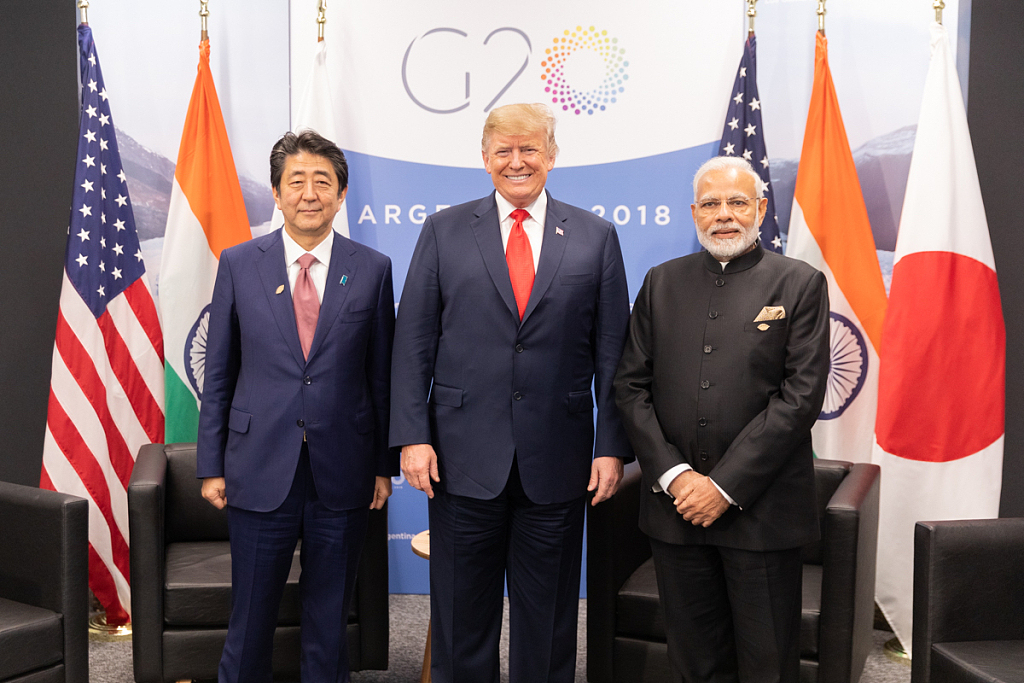
U.S. President Donald Trump (C), India's Prime Minister Narendra Modi (R) and Japanese Prime Minister Shinzo Abe participate in a trilateral meeting at the G20 summit in Buenos Aires, Argentina, November 30, 2018. /VCG Photo
Tensions amid deepening partnership
India, closer to the former Soviet Union for decades during the Cold War, has been deepening ties with the U.S. in recent years. On the one hand, the U.S. regards India as a potential partner to implement its "free and open Indo-Pacific" strategy. On the other hand, the Indian government led by Modi also sees the U.S. as playing a role in its Act East policy.
The U.S. State Department said last week that Pompeo will meet with Modi and Jaishankar to discuss their "ambitious agenda for the U.S.-India strategic partnership."
Last year, the two countries launched the 2+2 dialogue between their foreign and defense ministers, which is their highest-level institutionalized strategic dialogue.
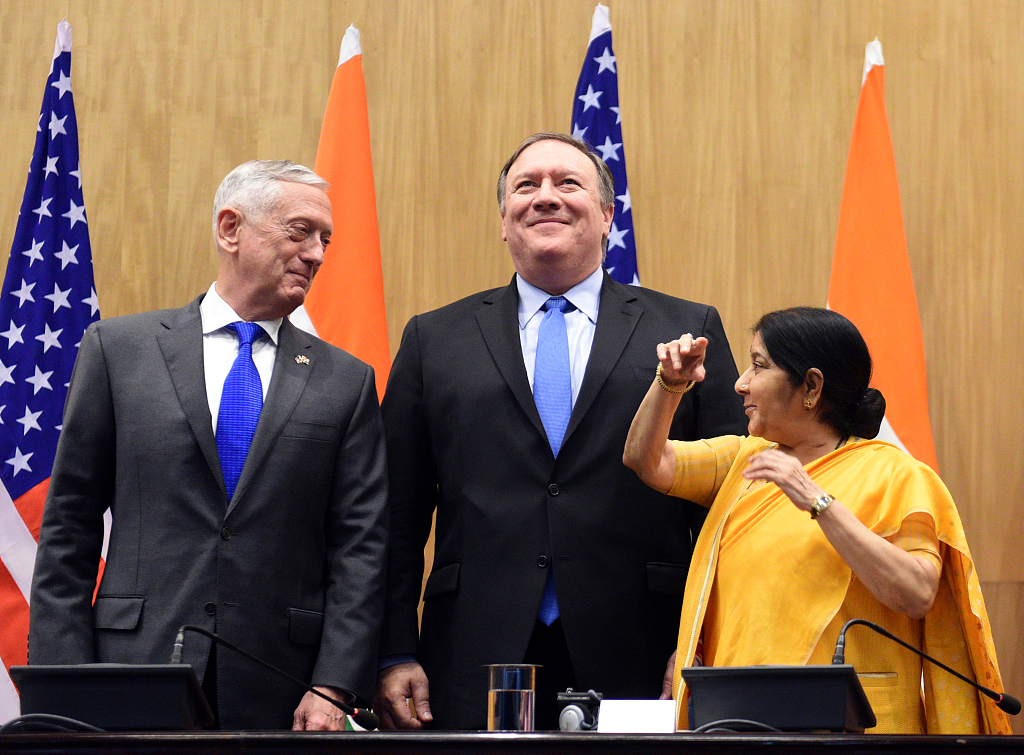
U.S. Secretary of State Mike Pompeo (C), then U.S. Secretary of Defense Jim Mattis (L) and then Indian External Affairs Minister Sushma Swaraj brief the press after their meeting in New Delhi, India, September 6, 2018. /VCG Photo
The U.S. is planning to include India on its International Traffic in Arms Regulations (ITAR) list to place the country at par with its NATO allies, enabling India to import advanced American military technologies. An article by political analyst Andrew Korybko recently published on the website of the Eurasia Future think tank described the plan as the "perfect carrot for Pompeo to dangle in front of Modi's mouth" during the visit.
While Washington steps up efforts to sell more military equipment to New Delhi, it is trying to dissuade India from going ahead with a deal to purchase Russian S-400 anti-missile systems.
The U.S. wants India to be its "security partner" and wants the South Asian country to get "closer to Washington" and away from Moscow, said Xu Qinduo, a senior fellow from China-based public policy think tank Pangoal Institution.
Meanwhile, economic issues are also expected to be high on the agenda in Pompeo's talks with Indian officials, following an escalation of trade tensions between the two sides.
Washington recently ended preferential benefits for Indian exports worth 6.35 billion U.S. dollars. In response, the Modi government imposed retaliatory tariffs on 28 American products.
"U.S.-India trade ties, at least between our capitals, are certainly worsening. We both have leaders who look at trade as a zero-sum game," said Richard Rossow, an expert on U.S.-India relations at the Washington-based Center for Strategic and International Studies (CSIS).
Moreover, there are reports that the U.S. may tighten work visas for Indian IT professionals in retaliation for India's insistence on local data storage by big foreign firms.
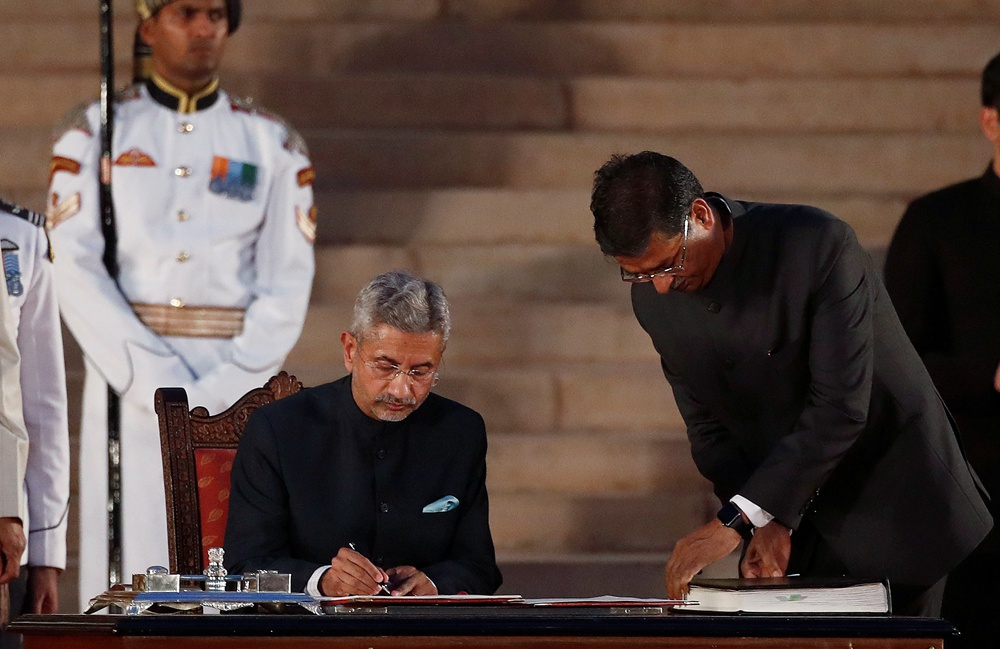
S. Jaishankar signs documents after taking his oath as a cabinet minister during a swearing-in ceremony at the presidential palace in New Delhi, India, May 30, 2019. /Reuters Photo
'India is not a tool against China'
Will the U.S. and India get closer at the cost of China-India relations, given the prolonged trade tensions between Beijing and Washington?
Modi's decision to give the portfolio of the external affairs minister to Jaishankar, who knows China and the U.S. well, shows that India values its relations with both countries.
Answering a question on India's position on the China-U.S. issue in January, Jaishankar, then Indian foreign secretary, indicated that his country would not take any sides but would be guided by its own national interests.
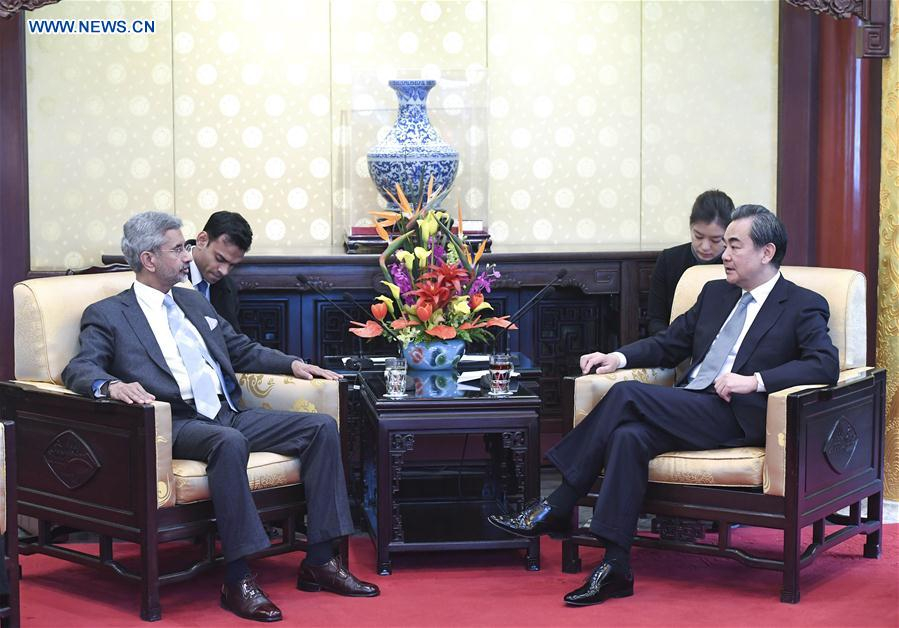
Chinese Foreign Minister Wang Yi (R) meets with then Indian Foreign Secretary S. Jaishankar in Beijing, February 22, 2017. /Xinhua Photo
The career diplomat, who was India's longest-serving ambassador to China before becoming the top envoy to the U.S., said in May that India would position itself by optimizing ties with all major players, which means "cultivating America, steadying Russia, managing China, enthusing Japan and attending to Europe," while increasing the country's footprint in its neighborhood.
After his appointment as external affairs minister, Jaishankar described his job as managing the risks and maximizing the opportunity in any clash.
"For a big country like India with a strong tradition of independence, we have always navigated the world with that sense of getting optimal outcome out of difficult landscapes," he noted.
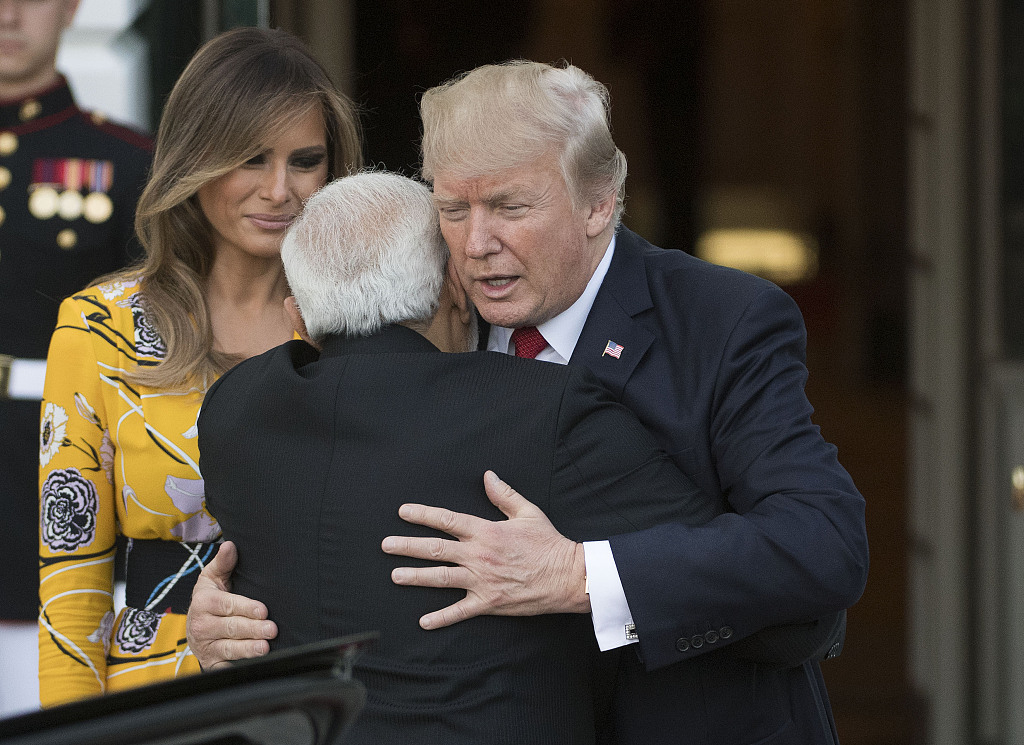
U.S. President Donald Trump (R) and Indian Prime Minister Narendra Modi hug outside the White House in Washington, U.S., June 26, 2017. /VCG Photo
Xu Qinduo from the Pangoal Institution also said India puts great emphasis on its independence and sovereignty and demands respect, adding that it does not want to be "treated as a tool" against other countries.
"Washington sees India mostly like a gambit or tool against the rise of China, against Russia, but India is more than that," Xu told CGTN in a recent interview.
"India is rising to become a global power, not only a regional power," he said.
Noting that China and India share lots of similarities as big developing countries, Xu said he is optimistic about the future of their ties. He believes India will prioritize its own interests when it develops relations with the U.S. and China.
"It (India) will take some of the offer from Washington and make good use of that," he said. "At the same time, they want to make good use of the Chinese offer."
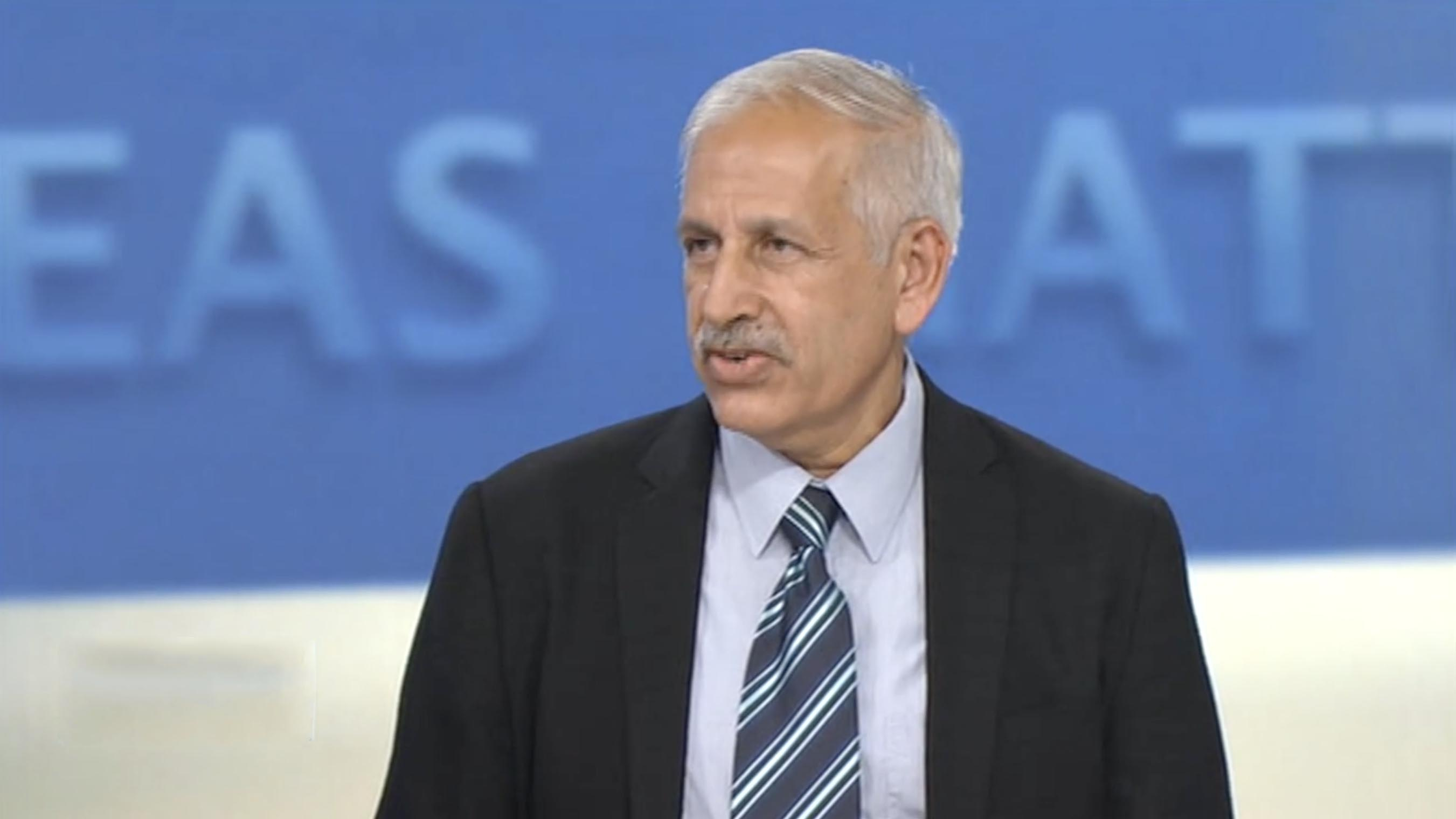
Atul Aneja, The Hindu's associate editor, underscored some differences between New Delhi and Washington regarding the so-called "Indo-Pacific" strategy.
Aneja said India is not interested in the "Pacific element" of the strategy. "India is more interested in the Indian Ocean element. If the cover for it is the Indo-Pacific, so be it," he told CGTN, adding that India will not join the U.S. in its operations in the South China Sea.
"So there are certain very clear-cut redlines within which we're confining our 'Indo-Pacific' strategy," he said.
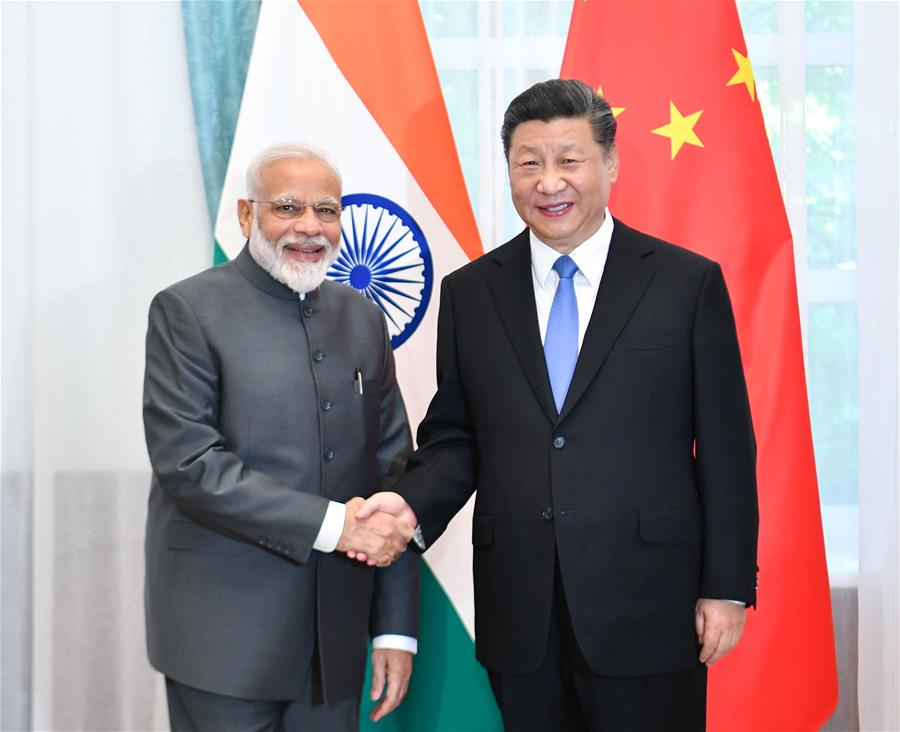
Chinese President Xi Jinping (R) meets with Indian Prime Minister Narendra Modi in Bishkek, Kyrgyzstan, June 13, 2019. /Xinhua Photo
In addition, there are multiple mechanisms through which China and India can manage their differences and enhance mutual trust. For example, both countries are members of the Shanghai Cooperation Organization (SCO) and BRICS, enabling their representatives at various levels to meet regularly.
Two weeks before Trump meets Modi at the G20 summit, Chinese President Xi Jinping already held talks with the re-elected Indian leader on the sidelines of the SCO summit in Bishkek, Kyrgyzstan. Xi will also take part in the Osaka gathering later this week.
(Cover: U.S. Secretary of State Mike Pompeo (L) and Indian Prime Minister Narendra Modi. /VCG Photo)