
 []
[]
Share







Copied
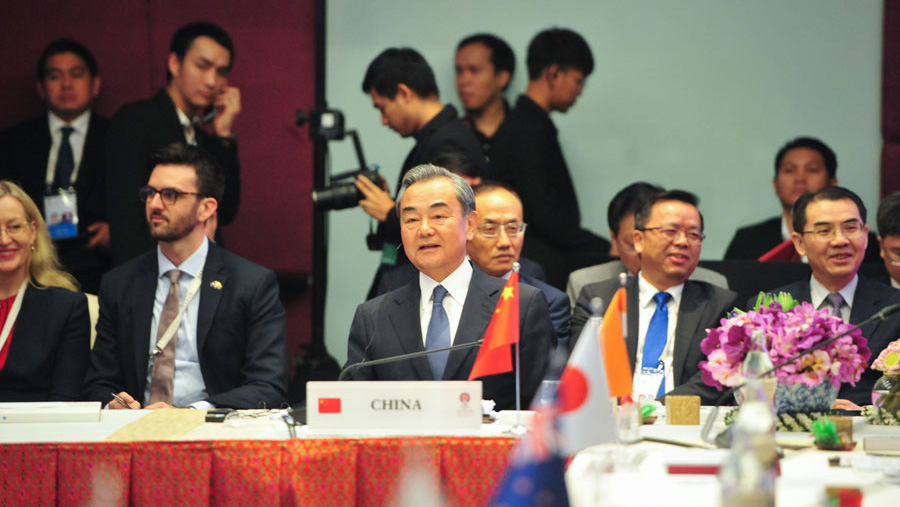
Unilateral sanctions, threats and pressures will only intensify the situation; dialogue and consultations are the only correct choices for resolving the problem, Chinese State Councilor and Foreign Minister Wang Yi on Friday made the remarks when attending the 9th foreign ministers' meeting of the East Asia Summit (EAS) in Bangkok.
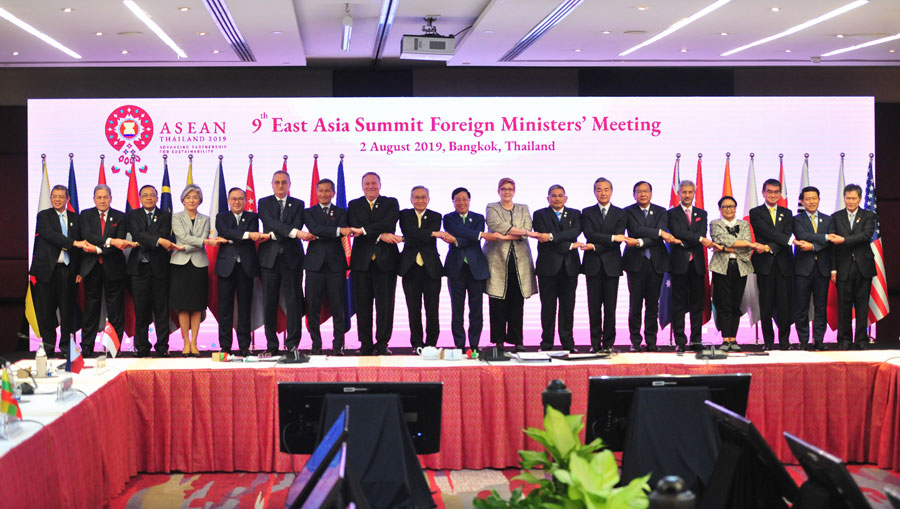
Foreign ministers of 10 countries of Association of Southeast Asian Nations (ASEAN) and key partners, such as China, Japan, Russia, South Korea and the U.S., expressed concern about recent developments on trade, particularly between the U.S. and China, and Japan and South Korea.
During the summit, Wang Yi urged East Asian countries to together uphold multilateralism and tackle challenges through open dialogue amid profound changes and increasing uncertainties in today's international landscape.
He stressed that countries, especially developing countries, in the East Asian region have the strong will in pursuit of peace and development. Regional countries should stay together to combat prevailing protectionism by adhering to the existing international system enshrined in the Charter of the United Nations, and strengthening multilateral trading system, he added.
"Unilateral sanctions and unilateral taxes violate WTO rules and are useless for solving trade issues," Wang said, stressing, "In face of rising global challenges, all countries are in a community with a shared future and no country can stay out of this."
According to him, cooperation and dialogue are the only ways to solve issues of major concerns in East Asia.
China slams claim of 'militarization' of South China Sea
Wang also said on the same day that it is the U.S. rather than China that is militarizing the South China Sea.
Hailing the fact that China and the Association of Southeast Asian Nations (ASEAN) have finished the first reading of a single draft negotiating text of the Code of Conduct (COC) in the South China Sea ahead of schedule, Wang said that China and ASEAN countries have in the past year followed the spirit of the Declaration on the Conduct of Parties in the South China Sea (DOC) and explored rule-based governance of the contentious waters.
"A certain non-regional country, however, have been sending massive strategic weaponry into this region, especially into the South China Sea, showing off military might and putting security threats and pressure on regional countries," he said, adding that such actions are against the common will of regional countries to pursue peace and cooperation.
China and other countries in the region have thus "undertaken steps to put in place defensive facilities," Wang explained, underscoring Beijing's rights of self-preservation and self-defense.
"Yet such legitimate acts have been labeled as 'acts of militarization'," he said.
"A country that is militarizing the entire world with hundreds of military bases outside its territory is not entitled to accuse China of militarizing the South China Sea. This label will never belong to China," he stressed.
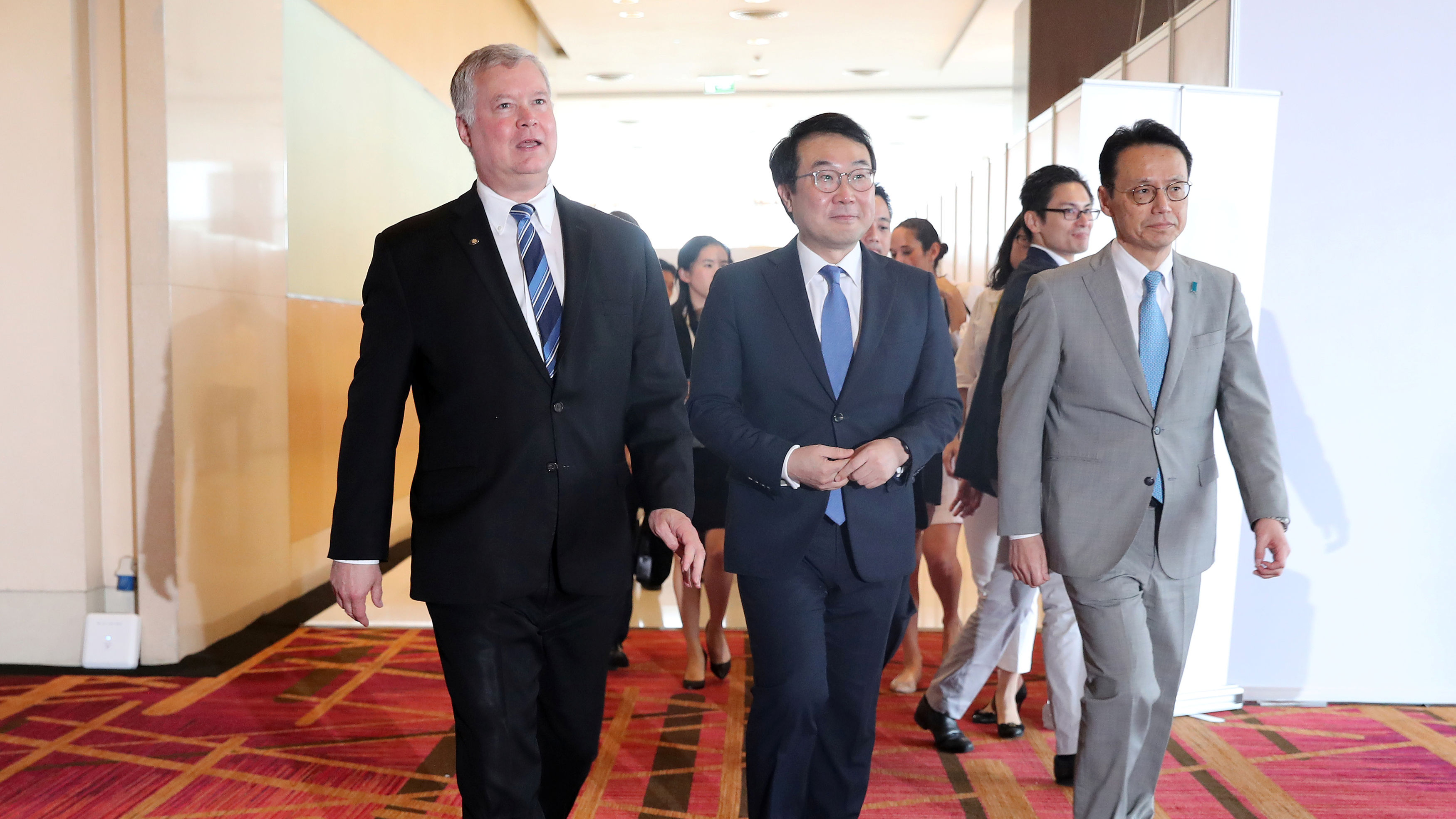
Respective special envoys for the Democratic People's Republic of Korea (DPRK), U.S. negotiator Stephen Biegun, South Korean negotiator Lee Do-hoon and Japan's negotiator Kenji Kanasugi, walk together at the media center during the ASEAN and East Asia summits in Bangkok, Thailand, August 2, 2019. /Reuters Photo
China to continue its 'constructive role' in denuclearization
During his speech, Wang also advocated for a phased and synchronized "dual-track" approach to resolving the Korean Peninsula issue, which pursues the peninsula's full denuclearization as well as the establishment of a peaceful mechanism.
He said the state visit by Chinese President Xi Jinping to the Democratic People's Republic of Korea (DPRK) and the successful meeting between leaders of the DPRK, the U.S. and the Republic of Korea (ROK) in Panmunjom showed all sides' willingness to seek consensus and resolve problem through dialogue.
China will continue to play a constructive role in working with all relevant parties to contribute to the denuclearization process and lasting peace and stability on the Korean Peninsula, he added.