- Home
- China
- World
- Europe
- Politics
- Business
- Opinions
- Tech & Sci
- Culture
- Sports
- Travel
- Nature
- Picture
- Video
- Live
- TV
- Specials


Share







Copied
A senior Palestinian official said Saturday that a special committee has been formed by President Mahmoud Abbas to follow up on the Palestinian measures in response to the Israeli threat to annex parts of the West Bank.
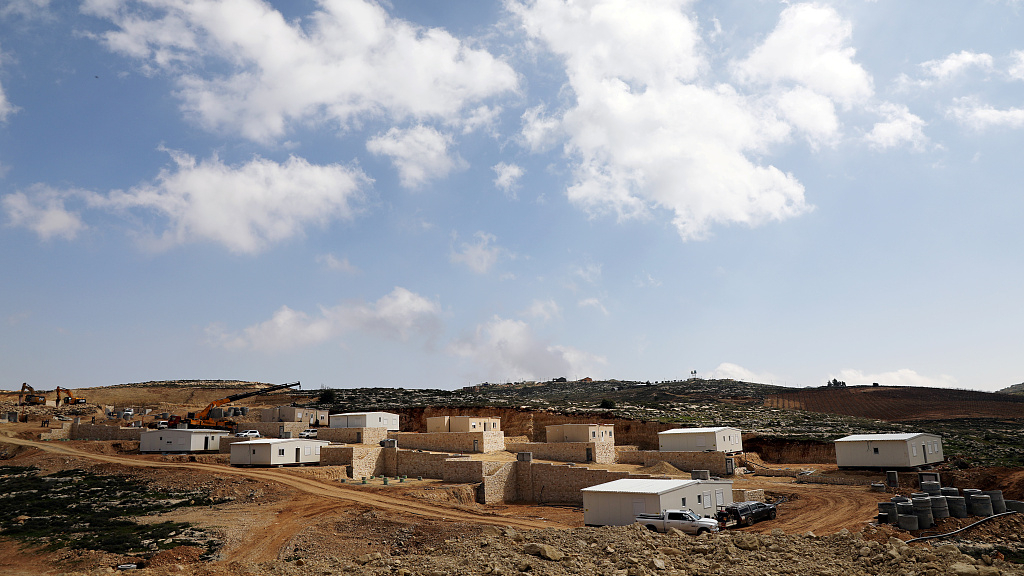
A general view of Amichai, a new settlement which will house some 300 Jewish settlers evicted in February 2017 from the illegal West Bank settlement of Amona, in the Israeli-occupied West Bank, February 22, 2018. /VCG
Azzam al-Ahmad, a member of Abbas's Fatah party Central Council and the Palestine Liberation Organization (PLO) Executive Committee, told the official Palestinian radio that the committee is scheduled to meet this week to determine its next steps and submit its recommendations to the PLO Executive Committee, which is considered the highest political level in Palestine.
"The next days might bring along an entirely new phase, that we must face with a united front in order to prevent the Israeli decision from taking place," al-Ahmad said.
He warned that the anticipated Israeli annexation decision would have grave political, economic and security repercussions.
The new Israeli government is expected to present its decision to the Israeli parliament on Wednesday, including the issue of annexing large areas of the West Bank and applying Israeli sovereignty on the settlements in the occupied territories.
Al-Ahmad mentioned that Abbas told the PLO's Executive Committee during its meeting on Thursday that all agreements with Israel and the U.S. will be annulled if Israel advances its plan of annexation.
He held the U.S. government responsible for the actions of the Israeli government because it "undermines international legitimacy and the chances to achieve peace."
Last month, Israeli Prime Minister Benjamin Netanyahu, leader of the right-wing Likud party, signed an agreement with Benny Gantz, the leader of Blue and White Party, to form a unity government.
Read more:
Netanyahu pledges to 'extend sovereignty' to West Bank settlements after vote
Netanyahu 'confident' U.S. will allow West Bank annexation soon
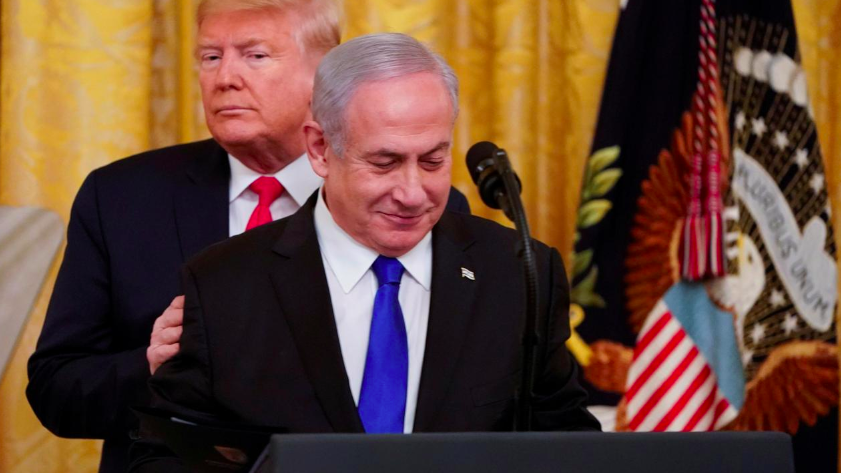
U.S. President Donald Trump (L) and Israeli Prime Minister Benjamin Netanyahu deliver joint remarks on a Middle East peace plan proposal in the East Room of the White House in Washington, U.S., January 28, 2020. /Reuters
They both agreed to impose Israeli sovereignty on the territories, which they called "part of the historic lands of Israel" as of July 1.
On Wednesday, U.S. Ambassador to Israel David Friedman said that U.S. President Donald Trump's administration supports Israel's application of sovereignty over the Jordan Valley and the settlements in the occupied West Bank and East Jerusalem.
Friedman said that the terms of Israel's sovereignty declaration will be recognized by the U.S., adding that mapping of West Bank areas designated for annexation will be accompanied by an Israeli freeze on construction in Area C, which is under Israeli control within the West Bank.
U.S. Secretary of State Mike Pompeo said that it was up to Israel whether to annex parts of the West Bank and said that Washington would offer its views privately to Israel's new government.
A special committee of the UN General Assembly has alerted about "the threat of annexation" of the Palestinian territory by Israel. "Annexation is a threat to the two-state solution," the committee said.
Earlier, on April 23, UN Special Coordinator Nickolay Mladenov warned the Security Council that "the dangerous prospect of annexation by Israel of parts of the occupied West Bank is a growing threat."
"If such a move were implemented, it would constitute a serious violation of international law, deal a devastating blow to the two-state solution, close the door to a renewal of negotiations, and threaten efforts to advance regional peace," he said, briefing the Council on the situation in the Middle East, including the Palestinian question.