- Home
- China
- World
- Europe
- Politics
- Business
- Opinions
- Tech & Sci
- Culture
- Sports
- Travel
- Nature
- Picture
- Video
- Live
- TV
- Specials


Share







Copied
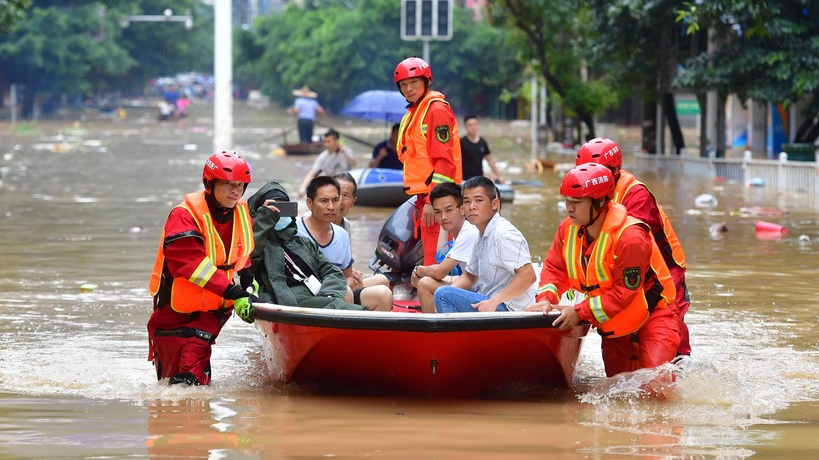
Rescuers transfer stranded people by boat in Rongshui, south China's Guangxi Zhuang Autonomous Region, July 11, 2020. /Xinhua
China's central government is set to give out an extra 5,000 yuan (725.5 U.S. dollars) in addition to the originally-planned 20,000 yuan (2,902.0 U.S. dollars) to households that have been heavily affected by recent floods, according to a decision announced at a meeting on Wednesday . This sets the emergency package at around 3,600 U.S. dollars.
In the meeting, chaired by Premier Li Keqiang, there were several proposals of detailed plans aimed at getting the devastated central and southern Chinese cities back to normal. The massive flooding - caused by month-long torrential rains - has stranded thousands along the Yangtze River, with experts calling it "the worst" disaster seen in decades.
Official data from the country's Ministry of Emergency Management (MEM) shows a total of 54.8 million people in 27 provincial-level regions have been affected.
Read more:
President Xi Jinping conducts inspection tour in flood-hit Anhui Province
Premier Li Keqiang pledges economic revival for flood-stricken Chongqing
According to the official release of the Wednesday meeting, a total of 100 billion yuan (14.51 billion U.S. dollars) - coming from both the central government and all local finance departments - will be put into disaster relief work.
Specifically, authorities have decided to grant a total of 16 billion yuan (2.32 billion U.S. dollars) to support the construction of high-standard farmlands in the next two years. Another 10 billion yuan (1.45 billion U.S. dollars) will be provided for the restoration of highways that were destroyed this time.
To vitalize local markets, officials have proposed plans to support the development of villages, while also calling for more opening-ups.